Jealousy Sells: Turning envy into sales

On this page
Envy sells because people measure what they own against what the people next door own, and the cleanest evidence comes from a lottery. A 2011 study in the American Economic Review looked at the Dutch Postcode Lottery and found that people who lived next door to winners, and hadn't played, spent significantly more on cars than other non-players did.
Key takeaways
- Next-door neighbors of Dutch Postcode Lottery winners had significantly higher car consumption than other non-participants (Kuhn, Kooreman, Soetevent and Kapteyn, American Economic Review, 2011).
- The winners' own extra spending was "largely confined to cars and other durables," the kind of purchase a neighbor can see from the driveway.
- In one roofing survey cited in the Kitchen Table Report, 66% of homeowners said they would gather three quotes. Comparing is the default.
- Treat envy as a signal of what a buyer wants. Using it as pressure is where reps get into trouble.
- SalesAsk has not measured envy in recorded appointments, so there is no close-rate number for it here.
If you run a home services sales team and want every appointment coached, not only the ones a manager can sit in on, book a SalesAsk demo.
Why does envy sell?
It sells because wanting is social. Your sedan was fine until the car next door changed. Nothing about the sedan got worse.
Home improvement works the same way, and it's even more visible. A new roof, new windows, a crew in the driveway for a week. The whole street watches the job happen.
What does envy tell you about a buyer?
It tells you what they value, in their own words. A homeowner who says "the Hendersons just did theirs" has handed you a reference point: what finished looks like to them, roughly what they think it costs, and how soon they want it.
So ask about it. What did they like about that job? What would they do differently? You'll learn more from those two answers than from ten minutes of features.
How do you use social proof without manipulating anyone?
- Show real jobs you did nearby, with the homeowner's permission.
- Let the buyer bring up the neighbor first. Then ask questions.
- Describe what the other job solved, in plain terms. Leave the neighbor's budget out of it.
- Offer a reference the buyer can call.
- Say so when the neighbor's choice is wrong for this house.
That last one matters most. I'd take a rep who talks a buyer out of the neighbor's premium package over one who sells it to a house that has no use for it.
Where is the line between social proof and pressure?
| Honest use | Over the line |
|---|---|
| "We finished a job two streets over last month. Want to see it?" | "Everyone on your street has already upgraded." |
| Asking what they liked about a neighbor's project | Hinting that their home looks dated next to it |
| A real reference who agreed to be contacted | A made-up neighbor or a made-up deadline |
| Telling them the cheaper option fits their house | Pushing the top package because the neighbor bought it |
The test I use is simple. Would you say it the same way if the neighbor were standing in the room?
How do you hear envy in your own appointments?
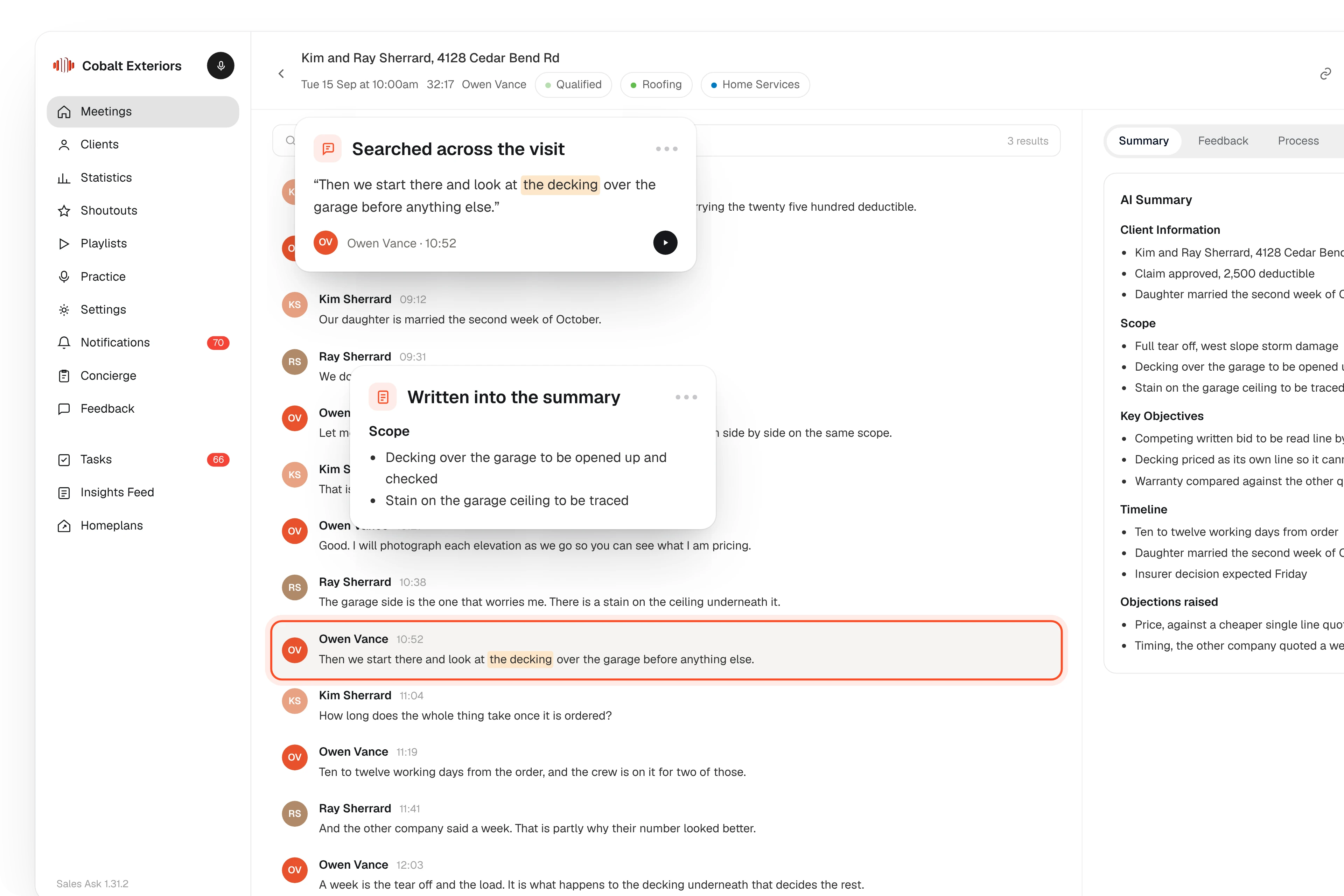
You record them, and SalesAsk is the tool we'd use for it. SalesAsk records, transcribes and analyzes in-person sales conversations, so a manager can search for the moment a buyer mentions a neighbor, a friend or a brother-in-law and hear what the rep did next.
It's an easy moment to skate past. The buyer says "my neighbor got a quote from you guys," the rep says "great" and goes back to the presentation. That was the opening. A rep can practice that exact moment in an AI roleplay before the next visit, get live coaching during it, and read written feedback on it afterward.
Where does this advice run out?
The lottery study is about cars in the Netherlands. It shows that neighbors' purchases move people, and it says nothing about roofs, close rates or what a rep should say.
We also haven't measured this in our own data. I can't tell you that appointments with a neighbor mention close more often, because nobody has counted. If you tag those appointments in your CRM for a quarter, you'll know more than we do.
Frequently asked questions
Is using envy in sales ethical?
It is when the proof is real and the product fits the buyer. It stops being ethical when a rep invents the comparison or leans on someone's insecurity.
What is the difference between envy and social proof?
Social proof is the evidence: other people chose this. Envy is one of the feelings that evidence can produce. A rep controls the first and should be careful with the second.
Does mentioning neighbors help close home improvement sales?
We don't have data on it. The research shows neighbors' purchases affect spending on cars; whether that carries over to your trade is something to test in your own appointments.
What should a rep say when a buyer brings up a neighbor's project?
Ask what they liked about it and what they'd change. Then show how your recommendation for this house is the same or different, and why.
Sources
Moe Abbas
CEO and founder of SalesAsk. Spent 20+ years in the trades before building software.
More posts byWritten by the SalesAsk team
SalesAsk records and coaches in-home sales conversations for home service, home improvement and home builder teams.
More posts