Roofing Sales Training: The Complete Guide to Closing More Jobs
On this page
Roofing sales training should drill one process: inspect and photograph, ask the same discovery questions, show good, better and best, and raise financing before the total. In SalesAsk's Kitchen Table Report, the gap between top and bottom reps runs 25 to 35 points of close rate. A gap that size is the reason to train one process and then check that it happened.
Key takeaways
- The gap between top and bottom reps runs 25 to 35 points of close rate in the Kitchen Table Report.
- The median roofing and exteriors appointment runs 49.5 minutes, across 15,401 appointments at 68 companies.
- Appointments where financing was mentioned closed at 49%, against 38% where it was not.
- 66% of homeowners say they would gather three roof quotes, and 1% would accept a single one.
- A sale made at the homeowner's door or kitchen table can be canceled until midnight of the third business day under the FTC's Cooling-Off Rule, so the paperwork is part of the training.
Nobody needs a new personality to close that gap. They need to run the same appointment every time, and someone needs to check whether they did. If you'd rather see coaching on real roofing appointments, book a SalesAsk demo.
What is the roofing sales process, step by step?
The roofing sales process has five stages: first contact, inspection, discovery, options, and financing with the ask. They happen in that order on every job.
- The first contact. A door knock after a storm or an inbound lead. The goal is the inspection, not the sale.
- The inspection. Photos of everything, narrated. The homeowner should see the granule loss and the lifted flashing on your phone before they hear a number.
- Discovery at the table. The seven questions below. This is where a roof gets lost ten minutes before the price comes out.
- Options. Good, better, best, presented from the top down.
- Financing and the ask. The monthly number goes on the same page as the total, and the rep asks which option, not whether.
Storm work adds a sixth stage, the insurance conversation, which gets its own section below.
What is the best roofing sales training?
The best roofing sales training is coaching on your own reps' real appointments, because it is the only format that checks whether the process happened. A course or a manual teaches the process. Neither can tell you whether Tuesday's rep asked the budget question.
| Format | What it gives you | Where it runs out |
|---|---|---|
| Classroom course or sales academy | A shared process and vocabulary in a few days | Nobody checks what happens on the roof the following week |
| Written manual or script | A reference a new hire can study | Reading a script is not the same as saying it under pressure |
| Ride-alongs | A manager's judgment on a real appointment | A couple of appointments a month, with the boss in the truck |
| AI roleplay | Repetition on one objection before the visit | A simulated homeowner is not a real one |
| Coaching on recorded appointments | Feedback on every appointment, against your own steps | It shows what was said, not what the homeowner decided later |
Our pick is the last row with roleplay feeding it, which is how SalesAsk works: practice before the appointment, live coaching during it if the rep wants it, and scored feedback afterward. Keep the course and the manual. They're how a team learns the process in the first place.
How long should a roofing sales appointment take?
About 50 minutes, which is shorter than kitchens and longer than plumbing. In the Kitchen Table Report's sample of 80,887 in-person appointments, roofing and exteriors ran a median of 49.5 minutes across 68 companies and 15,401 appointments. One in five ran past 90 minutes.
| Roofing benchmark | Number | Source |
|---|---|---|
| Median roofing and exteriors appointment | 49.5 minutes | SalesAsk Kitchen Table Report 2026 |
| Roofing appointments running 90 minutes or more | 21.1% | SalesAsk Kitchen Table Report 2026 |
| Homeowners who say they'll gather three roof quotes | 66% | Roofing Contractor 2026 Homeowner Roofing Survey, sponsored by Owens Corning |
| Homeowners who'd accept a single quote | 1% | Same survey |
| Homeowners who say proven experience and certifications decide it | 46% | Same survey |
| Homeowners who say the sales rep decides it | 17% | Same survey |
Read the last two rows together. Homeowners say the company's track record matters more than the rep. The rep is the one who has to show that track record at the table, with photos, certifications and the warranty paperwork, and plenty of reps leave it in the truck.
Length on its own isn't a skill signal. A 30-minute close can be a clean appointment and a two-hour one can be a rep who never asked for the order.
What discovery questions should roofing reps ask?
Roofing reps should ask these seven questions before any price, in roughly this order. Have them write the answers down and read them back.
- "What made you reach out now?" The trigger: a storm, a stain on the ceiling, a neighbor's new roof, a home sale coming up.
- "Have you had any leaks or damage inside?" Pain, and where to look.
- "What worries you most about this project?" The objection, ten minutes early, while it's still easy to answer.
- "What were you expecting to put into it?" Budget, asked without the word budget.
- "When would you want it done?" Then: "What happens if it waits until spring?"
- "Who else are you talking to?" If they say two other roofers, ask when, and what they're hoping to see that they haven't yet.
- "Is anyone else part of this decision?" If the spouse isn't home, rebook. Running the full presentation for one spouse means you'll be running it again.
Question four is the one reps skip. They feel rude asking about money and then they're surprised when the number lands badly.
How should roofers present good, better, best?
Start at the top. Recap what you found on the roof first ("granule loss on the south face, two lifted flashings, soft decking by the vent") so the options answer a problem the homeowner has already seen.
Then present best, better, good, and stop talking after each one. Don't apologize for the top option. The middle one is easier to say yes to when it sits next to something bigger.
Price the options in monthly terms as well as totals. The rep who says "a lot of people finance this, here's what each option looks like per month" before the homeowner asks gets a different conversation. In the Kitchen Table Report, appointments where financing was mentioned closed at 49% against 38% where it wasn't. That's across all trades and it's a correlation, but it's the biggest single difference we've measured at the table.
What is the best roofing sales strategy?
Decide what you'll be compared on, because you will be compared. With 66% of homeowners collecting three quotes, the strategy is to be the roofer who made the comparison easy. Five habits do that.
- Show photos before the price. On the homeowner's own phone if you can text them over during the inspection.
- Raise financing before the total. After the total it sounds like a rescue.
- Name the comparison for them. "When the other quotes come in, check the underlayment, the ventilation and who honors the warranty."
- Leave with a written number and a time. "I'll text the proposal tonight" is weaker than handing it over and booking a 15-minute follow-up for Thursday.
- Rebook one-legged appointments. It feels like losing a day. It's cheaper than losing the roof.
How do you sell roofs door to door?
You sell the inspection at the door and the roof at the kitchen table. The knock has one job, which is a look at the roof with photos. Say who you are, say why you're on the street, offer the inspection, and book the sit-down for a time when everyone who decides is home. Everything after the inspection is the same five stages.
The part door-to-door teams skip in training is the paperwork. Under the FTC's Cooling-Off Rule, a buyer can cancel a sale made at their home until midnight of the third business day. The seller has to tell them so and hand over two copies of a cancellation form with the dated contract. Train reps to explain that at signing as a normal step. Hearing it from the rep is better than finding it in the fine print.
Watch out: cities and towns set their own rules on door-to-door solicitation, including permits and hours. Check the rules for every market you knock in before the crew goes out.
How do you handle the most common roofing objections?
"We need to think about it." Ask what specifically. Price, timing, or trust in the company? Then answer that one thing. A rep who accepts "think about it" without a follow-up question has agreed to lose.
"We're getting other bids." Agree, then teach them how to compare: same shingle line, same underlayment, same warranty terms, licensed and insured. You're positioning yourself as the one who explained it.
"Your price is too high." Ask what they expected. Then show what changes between your option and a cheaper one. If the difference is real, say it. If the cheaper option is fine for their house, say that too. Homeowners can tell.
"I need to talk to my husband." This one should have been caught by question seven. If it wasn't, offer to come back when both are home, or call him now for five minutes.
"Can you knock something off?" Show what would have to come out of the scope to get there, and let them choose.
How should reps handle insurance claims?
Explain the claim process in plain words and promise only what you control. Storm jobs are a different sale. The homeowner isn't deciding whether to buy a roof, they're deciding whether to trust you with a process they don't understand: the adjuster visit, the scope, the deductible, the supplement.
Never suggest waiving or covering a deductible. In Texas, for example, the Department of Insurance says plainly that "it's illegal for contractors to waive your deductible or help you avoid paying it," and that the insurer can ask the homeowner for proof it was paid. Rules differ by state, so put your own state's rule in the training manual in writing.
What goes in a roofing sales training manual?
A roofing sales training manual needs nine things, and it should be short enough that a new hire reads it in one sitting.
| Section | What it holds |
|---|---|
| The process | The five stages on one page, plus the insurance stage for storm work |
| Inspection checklist | The photos to take on every roof, in order |
| Discovery questions | The seven questions, with room to write the answers |
| Options sheet | Good, better and best, each with a total and a monthly number |
| Financing wording | The sentence your reps use to raise it before the total |
| Objections | The five above, with your company's answer to each |
| Insurance explainer | The claim process in plain words, and what a rep must never promise |
| Paperwork | The contract, the cancellation notice, and how to explain it |
| Scorecard | The steps a manager or the software checks on every appointment |
The scorecard is the page that makes the rest matter. A manual without one is a document. With one, every appointment gets checked against it.
How do I track sales metrics for a roofing company?
Track four numbers per rep every month: inspection to appointment, close rate, average contract value, and steps completed per appointment.
| Metric | What it tells you |
|---|---|
| Inspection to appointment | Whether the first contact and inspection are earning a sit-down |
| Appointment to signed contract | Close rate, the number everyone watches |
| Average contract value | Whether reps are presenting options or just the cheapest roof |
| Steps completed per appointment | Whether the process above is happening |
The last one is the leading indicator and the hardest to get. Without recorded appointments, you're relying on the rep to tell you whether they asked the budget question. With them, it's a percentage on a dashboard.
How do you coach roofing reps without more ride-alongs?
Record the appointments and coach from the recordings. A manager who rides along twice a month sees two appointments. A rep runs dozens. The ride-along also changes the appointment, because nobody sells the same way with the boss in the truck.
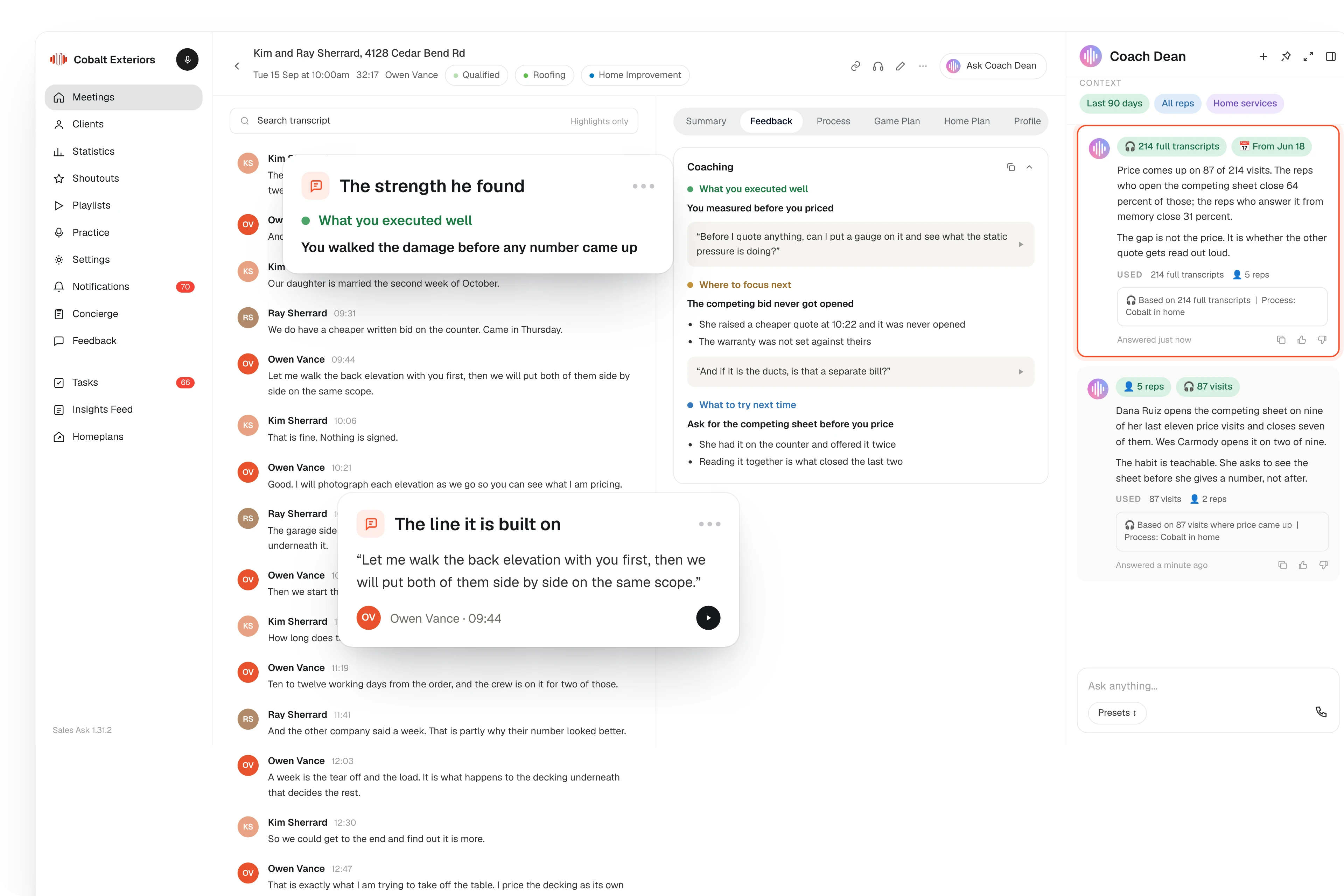
At 5 Star Disaster Services, a restoration company in Walla Walla, Washington, the sales manager couldn't listen to every inspection either. "What SalesAsk has done is pull out the steps that should have happened, highlight areas we can improve, and give us real-time feedback we can actually act on," said Anthony Cannone, Sales Manager. At Connell Roofing, Vincent Brown, a sales rep, put it from the other side: "It's like having my sales manager on every call."
One limit: recordings show what was said, not what the homeowner did at 9 pm with three proposals on the counter. Follow-up still matters, and the After the Table chapter of the report covers what's known about it.
Frequently asked questions
How long does it take to train a new roofing sales rep?
It depends on whether they've sold in the home before. What shortens it is volume of feedback: a new rep coached on every appointment gets more corrections in a month than one who sees a manager twice.
What's the best roofing sales process?
The one your best rep already runs, written down and checked on every appointment. The five stages above are a starting point. Your own recordings will tell you where your team deviates.
Should roofing reps close on the first visit?
Ask for the decision on the first visit, every time. Whether it's realistic depends on the job. Insurance work often can't sign until the adjuster has been out. Retail replacements often can.
How much do roofing sales reps make?
It varies too much by market and commission plan to quote one number. Roofing reps are commonly paid on commission, so close rate and average contract value drive pay more than anything in a job posting.
Does SalesAsk coach roofing reps during the appointment?
Yes, as an option. SalesAsk covers AI roleplay before the appointment, live coaching during it, and scored feedback from Coach Dean after it, all against your own roofing process.
Sources
Dara Shabnam
Leads growth at SalesAsk and writes about in-home sales training and recording consent.
More posts byWritten by the SalesAsk team
SalesAsk records and coaches in-home sales conversations for home service, home improvement and home builder teams.
More posts