Phoenix Doesn’t Give You a Second Chance to Make a First Sale
There’s something about Phoenix that makes sales harder than it looks from the outside.
You’d think a city that’s been growing by 100,000 people a year would be easy pickings for home services contractors. More homes, more jobs, more revenue. And it is — until you realize that every other contractor in the Valley of the Sun is thinking the same thing.
The Phoenix metro is 4.5 million people spread across a patchwork of cities — Scottsdale, Mesa, Chandler, Gilbert, Tempe, Glendale, Peoria, Buckeye — each with its own buyer profile, price tolerance, and competitive density. National franchises flood in every spring. Referral networks are tight. And the homeowner sitting across from your rep has probably already talked to three other companies before you knocked on the door.
In that environment, “good enough” selling doesn’t close jobs. It loses them.
The Phoenix Sales Problem Is a Seasonality Problem
Most home services markets have seasons. Phoenix has extremes.
When summer arrives — and by May, it arrives fast — HVAC demand spikes so hard that some companies literally can’t answer every call. Your reps are running back-to-back estimates, sweating through the close, and fighting to hold price when the homeowner knows you need the job as much as they need the fix.
Then there’s monsoon season, July through September. Dust storms, haboobs, flash flooding, wind damage. Roofing calls spike. Painting jobs multiply. Screen enclosures get destroyed. It’s a window — sometimes literally three or four weeks long — where roofing and exterior contractors have to hit targets that will carry them through a quieter fall.
And then there’s the snowbird cycle. Half the Valley empties in summer and refills in October. That means a surge of older, out-of-state homeowners arriving to find six months of deferred maintenance. If your reps don’t know how to have a conversation with a 70-year-old Midwesterner who thinks Phoenix contractors are expensive and pushy, you’re going to watch those jobs walk to whoever does.
The problem isn’t finding opportunities. It’s your team’s ability to convert the opportunities you do have, in a compressed window, when stakes are high.
What’s Actually Breaking Down in Phoenix Sales Conversations
Ask any Phoenix home services owner what kills deals, and you’ll hear the same answers:
Price objections. Competitors promising the same thing for less. Reps who get flustered when a homeowner says “we’re still getting bids.” Technicians who are great at diagnosis but can’t connect the technical finding to the homeowner’s motivation.
The deeper issue is rarely the market. It’s the conversation.
A rep who hesitates when the homeowner says “that sounds expensive” is leaving money on the table. A technician who quotes a $12,000 AC system replacement without first asking the right questions about the home’s age, the family’s comfort needs, and what the current unit is costing them in energy bills — that tech is working harder than he needs to, and closing less than he should.
AI sales coaching for HVAC contractors shows exactly where these breakdowns happen. Not in general theory, but in the actual recording of what your rep said — word by word — and where the conversation started losing momentum.
AI Coaching in a High-Volume, High-Pressure Market
Phoenix home services companies don’t have time to sit every rep down for a two-hour coaching session every week. During peak season, the field manager is running jobs. The office manager is handling scheduling chaos. Nobody has bandwidth for traditional training.
That’s what makes SalesAsk’s AI sales coaching platform valuable in a market like Phoenix — it doesn’t require a dedicated coaching slot. It listens to every call your reps run, surfaces the patterns, and tells you exactly what to fix.
Not “your team needs better objection handling.” But: Your new tech, Marco, hesitates for 4-5 seconds every time a homeowner mentions a competitor. Here are the three calls where that hesitation cost you the close.
That specificity is what makes the feedback land. Reps don’t argue with a recording. They hear themselves, recognize the pattern, and they change.
During Phoenix’s summer peak, when a company might be running 40+ jobs a day, that automated analysis becomes the only viable coaching mechanism. You’re not choosing between coaching and production. You’re doing both.
The Close That’s Unique to Phoenix
There’s a Phoenix buyer dynamic that shows up in the data constantly: the multi-bid stall.
“We’re still getting other quotes” is the most common objection in this market. The competition is dense, homeowners know it, and they use it as leverage. Reps who don’t have a confident, non-pushy response to this lose the job — even when they had the best price and the best offer on the table.
The pattern AI coaching tends to uncover is that reps expect to lose this objection before they even hear it. They’ve been conditioned by repeated losses to become passive at this stage of the conversation. So they backpedal, offer a discount, or say “that’s totally fine” and then never follow up effectively.
The fix isn’t a script. It’s giving reps enough exposure to successful versions of this conversation that they develop an instinct for it. Hearing ten examples of what it sounds like when a rep confidently bridges from “we’re still getting bids” to “let me make sure you have everything you need to make the best decision” — and seeing that confidence close deals — rewires the pattern faster than any training module.
New Reps in the Valley: The Onboarding Gap
Phoenix’s rapid growth means contractors are constantly hiring. New construction in Buckeye, Queen Creek, and the East Valley suburbs is generating demand for trades that can’t be met with existing crews. Companies that were 12-person operations two years ago are trying to run 30 reps today.
The onboarding problem is predictable: you’re hiring reps who’ve never sold a $15,000 roofing job or an $18,000 solar-plus-battery package. You’re putting them in front of homeowners in Scottsdale who have done their research, know competitors’ pricing, and can smell uncertainty from across a kitchen table.
Cache’s story is instructive. A growing HVAC company using SalesAsk found that new hires reached production-level performance faster when AI coaching analyzed their early calls and gave managers specific feedback to deliver — rather than managers having to guess what wasn’t clicking. The babysitting loop broke. New reps learned faster. Revenue followed.
That model translates directly to Phoenix’s growth environment. You can hire aggressively and still maintain quality, if you have a system that catches gaps early.
The Solar Conversation Is Different
Phoenix has some of the highest solar adoption rates in the country. Which means many homeowners have already had four or five solar conversations and know more about panel efficiency ratings than some of the reps pitching them.
That’s a harder room to walk into than most. Reps who lean on enthusiasm and broad claims lose credibility fast with experienced buyers. The sales conversations that win in Phoenix solar — and in the broader premium home services categories — are the ones where the rep spends more time asking and less time talking.
AI coaching doesn’t just flag when reps are talking too much. It shows the specific moments where reps interrupted a homeowner who was about to reveal a genuine buying motivation. Those moments are recoverable with practice. But only if someone surfaces them.
Building a Sales Team That Can Handle the Arizona Market
The contractors winning in Phoenix right now aren’t necessarily better at marketing. They’re not always bigger or cheaper. What they tend to have is a tighter feedback loop between what happens in the field and what gets trained in the office.
The data tells a story. The reps who consistently close in competitive markets have a shorter lag between a bad conversation and the correction of the behavior that caused it. They don’t wait for a quarterly review or an annual training day. They see the feedback, adjust, and go back out.
What Phoenix Contractors Should Be Tracking
If you’re managing a home services sales team in the Phoenix metro, the metrics that matter aren’t just close rates and average ticket. They’re:
- First-visit close rate by rep — Phoenix buyers rarely reschedule. If your rep leaves without a decision, the job goes to a competitor.
- Objection frequency by neighborhood — East Valley, North Scottsdale, and West Phoenix buyers behave differently. Your coaching should reflect that.
- Seasonal performance dips — Most teams drop in late October when demand cools. The reps who maintain performance year-round have a fundamentally different skill set.
- New-hire ramp time — How many jobs does a new rep lose before they find their footing? Shrinking that number is worth more than any marketing spend.
These numbers exist in your call data. The question is whether you’re surfacing them.
Arizona Is a Market That Rewards Execution
The opportunity in Phoenix is real. The growth is real. The demand — especially in HVAC, roofing, solar, and remodeling — isn’t slowing down.
But the contractors who capture disproportionate market share will be the ones who train better, coach more consistently, and build sales teams that don’t peak in summer and collapse in November.
That’s a systems problem. And it has a solution.
Related Topics: Phoenix home services sales training, Arizona contractor sales coaching, HVAC sales coaching Arizona, AI sales training for contractors, home services close rate improvement, Phoenix HVAC training, sales coaching software for field teams, Arizona home improvement sales
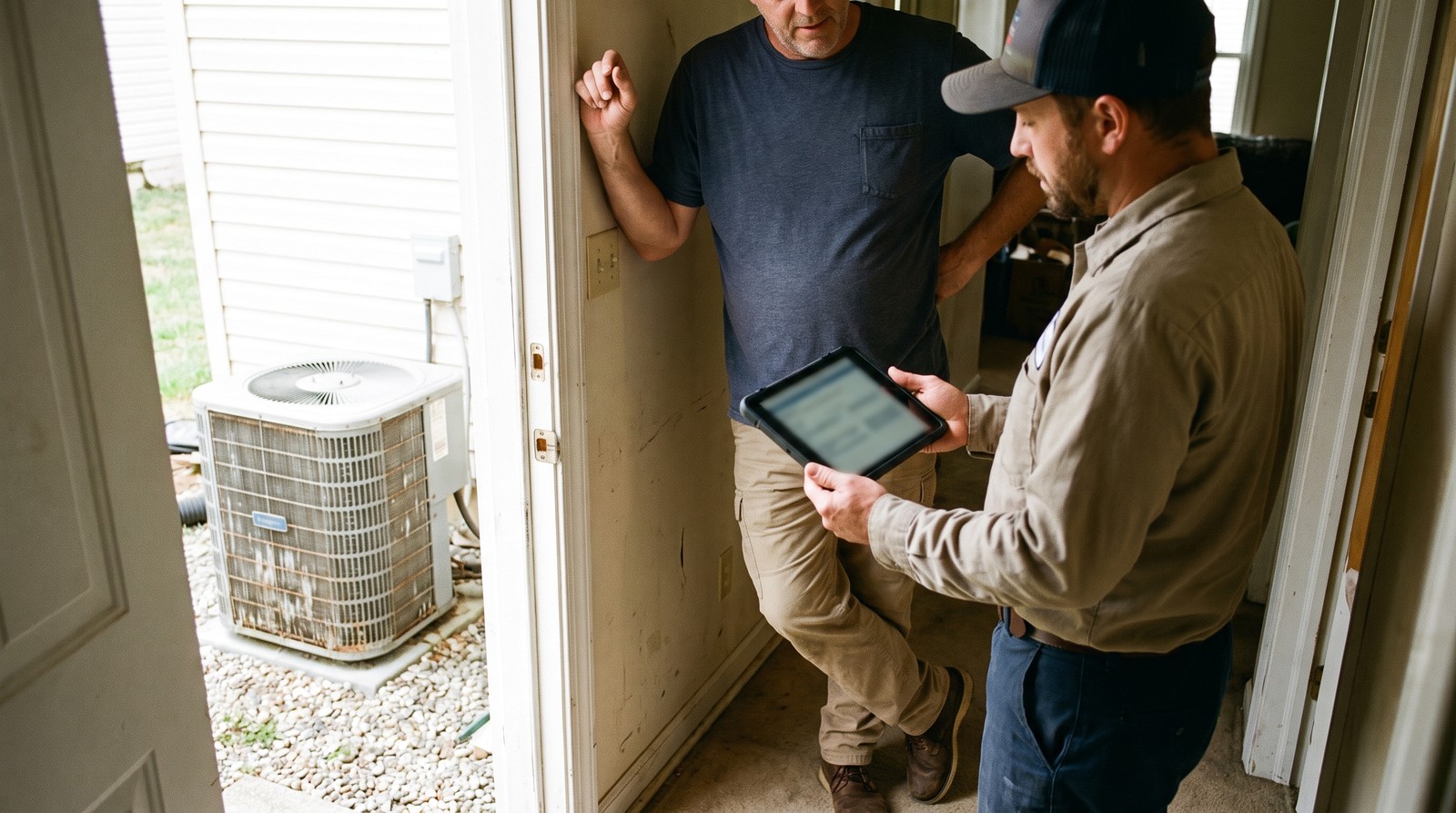
Image Suggestions: 1. Hero: Phoenix skyline at dusk with contractor van in foreground — representing scale of the market 2. Section image (HVAC): Technician reviewing tablet with homeowner in Phoenix suburban home — shows the coaching-in-context angle 3. Section image (coaching): Split screen of AI dashboard showing call analytics alongside a field rep — the feedback loop visualization

Related articles

Start closing more deals, without hiring more reps
See exactly what’s holding your team back and fix it fast.
.avif)