AI Sales Roleplay Training: Practice Without the Pressure
The first time I heard “let’s roleplay this” in a sales meeting, my internal monologue was screaming. Not because I didn’t want to get better. Because roleplaying with your manager watching feels performative. You’re not practicing. You’re performing.
Real learning happens when nobody’s grading you. When you can fail, restart, try again, and figure it out without the boss scribbling notes on a clipboard.
That’s the promise of AI sales roleplay training. And after watching teams use it for the past year, I’m convinced it’s not just a nice-to-have. It’s the difference between reps who freeze on real calls and reps who close confidently.
Why Traditional Sales Roleplay Doesn’t Work
Here’s the uncomfortable truth: most sales managers hate running roleplays almost as much as reps hate participating.
The manager knows it’s awkward. The rep knows it’s fake. Everyone knows the script is contrived. So you go through the motions, the manager says “good job,” and nobody gets better.
The problems stack up fast:
It’s embarrassing. Nobody wants to stumble through a pitch while their peers watch. So reps play it safe. They don’t try new techniques. They don’t risk looking stupid. They stick to what’s comfortable and learn nothing.
It’s infrequent. Even the best managers only roleplay once a week, maybe. New reps need repetition — dozens of pitches before muscle memory kicks in. Weekly roleplays don’t cut it.
The feedback is generic. “Be more confident.” “Ask better questions.” “Listen more.” Cool. How? What specifically should I change? Traditional roleplays rarely give actionable next steps.
There’s no safe space to fail. You get one shot in front of the team. If you blow it, you’re the cautionary tale. So reps hold back, play defense, and never push their limits.
I’ve seen teams abandon roleplays entirely because participation was so low. The manager scheduled them, nobody showed up, and eventually they just stopped trying.
What AI Roleplay Training Actually Does
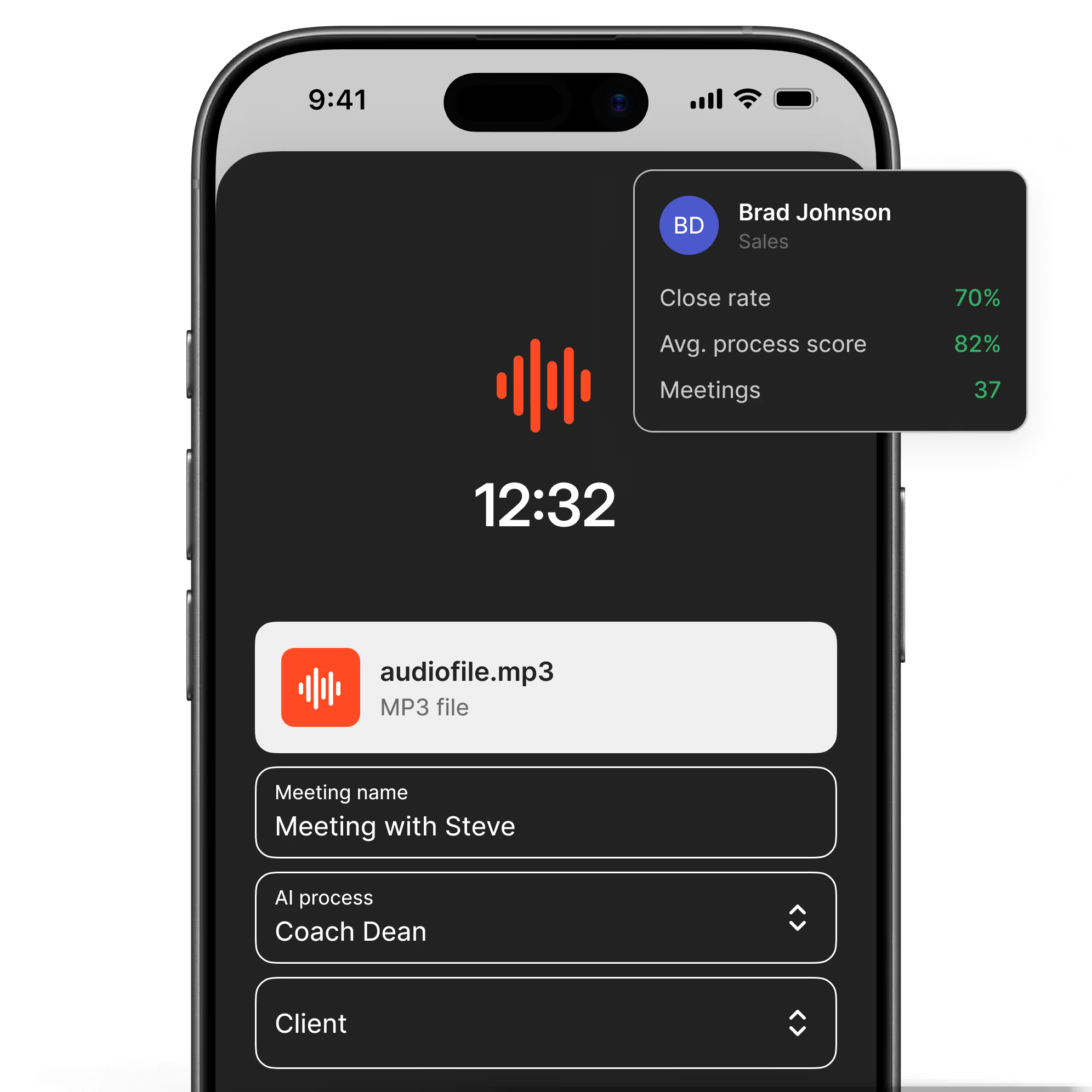
AI roleplay flips the script. Instead of practicing in front of humans who judge you, you practice with an AI that reacts like a real buyer but doesn’t care if you fail.
Here’s what a session looks like:
You start a call. The AI answers as a homeowner, business owner, or prospect (depending on your industry). You deliver your pitch. The AI responds with objections, questions, and buying signals based on how you’re performing.
If you fumble the objection, it pushes back. If you nail the value prop, it asks about pricing. If you try to close too early, it shuts you down. Just like a real buyer.
After the call, you get instant feedback: - Which objections you handled well - Where you lost momentum - Specific phrases that worked (or didn’t) - Suggestions for next time
Then you try again. Same scenario or a variation. You iterate until it clicks.
The Difference: Volume + Repetition
The real power isn’t the AI. It’s the volume.
With traditional roleplays, a new rep might practice a pitch 5-10 times before their first real call. With AI roleplay, they can practice 50 times. 100 times. As many times as it takes.
That’s when learning compounds. The first 10 reps sound robotic. The next 10, they start improvising. By 30-40 reps, they’re responding naturally to objections they’ve heard before. By 50+, they sound confident.
Confidence comes from repetition. AI roleplay gives you unlimited reps without the social friction.
Who Benefits Most from AI Roleplay Training
Not every team needs AI roleplay. If your sales process is purely relationship-driven — no pitch, no objection handling, just rapport-building — this probably isn’t your bottleneck.
But if you’re in any of these situations, AI roleplay training is a game-changer:
1. Onboarding New Reps
New hires are terrified of looking dumb in front of experienced reps. AI roleplay lets them practice privately until they’re ready for the real stage.
Instead of throwing them on calls after a week of training and hoping they don’t crater, give them 2 weeks of AI roleplay first. By the time they hit the field, they’ve already handled “we’re getting 3 bids” 40 times.
2. Ramping Seasonal Teams
HVAC companies, landscapers, roofing contractors — anyone who hires seasonal reps — can’t afford a 3-month ramp. You need people selling in week 2.
AI roleplay compresses ramp time. Instead of shadowing for weeks and learning slowly, new reps practice intensively for 5-7 days, then hit the field with muscle memory already built.
3. Teams That Struggle with Objection Handling
“We need to think about it.” “Can you send a quote?” “We’re talking to other companies.” “Your price is too high.”
If your reps freeze when they hear these, it’s not because they don’t know the answer. It’s because they haven’t practiced enough to respond instinctively.
AI roleplay drills objection handling until responses become automatic. You don’t think about what to say. You’ve said it 50 times already. It just flows.
4. Remote or Distributed Teams
If your reps are spread across multiple markets, traditional in-person roleplays are logistically impossible. AI roleplay works anywhere, anytime, on any device.
Your rep in Phoenix can practice at 6 AM. Your rep in Boston can practice at 9 PM. No coordination needed.
5. Managers Who Don’t Have Time for Weekly Roleplays
Let’s be honest — most sales managers are underwater. They’re juggling pipeline reviews, ride-alongs, admin work, and firefighting. Weekly roleplays are the first thing to slip.
AI roleplay takes that burden off the manager. Reps self-train. Managers review performance summaries instead of running sessions themselves.
How to Implement AI Roleplay Training (Without It Feeling Like Homework)
The biggest mistake teams make: treating AI roleplay like mandatory compliance training. “Everyone must complete 10 sessions this week.” That’s how you kill adoption.
Here’s what works:
Make it voluntary at first
Launch it to your top 3 reps first. Let them try it, see results, and evangelize it to the team. When other reps hear “I closed 2 more deals this week because I practiced handling price objections on the AI,” they’ll want in.
Tie it to real performance gaps
Don’t say “everyone should practice everything.” Say “if you’re struggling with objection X, here’s a roleplay scenario that drills it.”
Use it as a tool to fix specific weaknesses, not a blanket requirement.
Gamify it (lightly)
Leaderboards, badges, streaks — all the engagement tactics that work in apps — work here too. But don’t make it competitive. Make it personal. “You’ve completed 25 roleplays this month. Want to hit 30?”
Give managers visibility, not control
Managers should see summary stats (who’s practicing, how often, where they’re improving), but they shouldn’t micromanage. The point is to create a safe space for reps to fail privately. If every session is scrutinized, you’re back to performance anxiety.
What Good AI Roleplay Looks Like (vs. Bad)
Not all AI roleplay platforms are created equal. Some are glorified chatbots that spit out canned responses. Others actually understand sales dynamics.
Here’s what separates good from mediocre:
Good AI Roleplay:
- Responds dynamically based on what you say (not scripted paths)
- Surfaces objections at realistic moments (not all at once)
- Adjusts difficulty based on performance (gets harder as you improve)
- Gives specific, actionable feedback (not vague platitudes)
- Tracks improvement over time (shows you’re actually getting better)
Bad AI Roleplay:
- Feels like talking to a script
- Repeats the same objections in the same order every time
- Gives generic feedback (“be more confident”)
- No progression or skill tracking
- Designed for compliance, not learning
If the AI feels robotic after 3 sessions, it’s not doing its job.
Real Results from Teams Using AI Roleplay
I don’t love anecdotes, but here’s what we’ve seen with teams using AI roleplay training over the last 6-12 months:
New rep ramp time: Cut from 8 weeks to 4-5 weeks (they hit quota faster)
Objection handling: Conversion rates improve 15-25% when reps practice the same objection 20+ times
Manager time saved: Managers spend 3-5 hours less per week on training, redirecting that time to pipeline coaching
Rep confidence: Self-reported confidence scores go up 40-50% after 20+ roleplay sessions
The ROI isn’t just faster ramp or higher close rates. It’s the compounding effect of reps who actually enjoy practicing because it’s not awkward anymore.
The Limitations (Let’s Be Honest)
AI roleplay training solves a lot, but it’s not magic. Here’s what it doesn’t do:
It doesn’t replace ride-alongs. You still need managers observing real calls to catch issues AI can’t detect (rapport, body language, reading the room).
It doesn’t teach product knowledge. If a rep doesn’t understand your pricing or features, AI roleplay won’t fix that. That’s a training gap, not a practice gap.
It’s not a performance management tool. AI roleplay is for learning, not evaluation. If you turn it into a quota (“everyone must do 10 sessions or you’re written up”), adoption dies.
It requires buy-in. If reps see it as busywork, they’ll half-ass it. You need champions who see the value and spread it internally.
Bottom Line: Practice Like Your Close Rate Depends On It
The best reps aren’t naturally gifted. They’re the ones who practiced more than everyone else.
AI roleplay training removes the friction from practice. No scheduling. No embarrassment. No waiting for the manager to have time. Just you, the AI, and as many reps as you need to get better.
If your team struggles with objection handling, slow ramp times, or inconsistent pitches, AI roleplay isn’t a luxury. It’s the fastest way to fix it.
Try it. See if your reps actually use it. If they do, you’ll see results within weeks.
If they don’t, you’ve got a different problem — and AI won’t fix it.
Related Topics: AI sales roleplay, sales roleplay training, AI roleplay practice, sales coaching software, virtual sales training, objection handling practice, AI sales coach
Meta Title: AI Sales Roleplay Training: Practice Without the Pressure | SalesAsk
Meta Description: AI roleplay training lets sales reps practice pitches and objection handling without embarrassment. Learn how AI sales roleplay improves close rates, ramp time, and confidence.
Similar Blogs


Sell More with
AI & Coach your
sales team.
Get Results in 21 Days. See it in action now!

Join 15,000+ reps


The #1 Ai Sales Growth System for Home Builders, Home service and Home remodeling companies.
Mon-Fri 9-6pm