
How AI Sales Coaching Works for In-Person Sales
Most sales coaching happens after the deal is lost. Your rep sits in a conference room two days later, rewatching what went wrong while the prospect is already signing with someone else. That's not coaching—that's an autopsy.
AI sales coaching for in-person sales changes the entire timeline. Instead of post-game analysis, reps get real-time guidance during the actual appointment. While they're standing in someone's kitchen explaining pricing or walking a homeowner through financing options, they're getting immediate feedback on what's working and what's not.
This isn't theoretical. Home service companies using AI coaching are seeing 20-30% increases in close rates specifically because the coaching happens during the sale, not after it's already dead.
The Old Model: Ride-Alongs Don't Scale
Traditional field sales coaching meant physical ride-alongs. A sales manager sits in the truck, shadows the appointment, takes notes, debriefs afterward. It works—for the one rep you can ride with that day.
The math breaks fast:
- You have 12 field reps
- You can ride with 1-2 per week
- That's 6-8 weeks to see everyone once
- By the time you get to rep #12, rep #1 has already developed new bad habits
And ride-alongs introduce their own problems. Reps perform differently when the boss is watching. Customers pick up on the dynamic. The manager's presence changes the entire interaction, so you're not even observing normal behavior.
AI sales coaching for in-person sales solves the scalability problem without the observer effect. Every rep gets coached on every call. No scheduling. No travel time. No awkward three-person kitchen conversations.
How AI Coaching Actually Works During Field Appointments
The technology isn't magic—it's structured listening at scale. Here's the actual process:
1. Audio Capture (Transparent to the Customer)
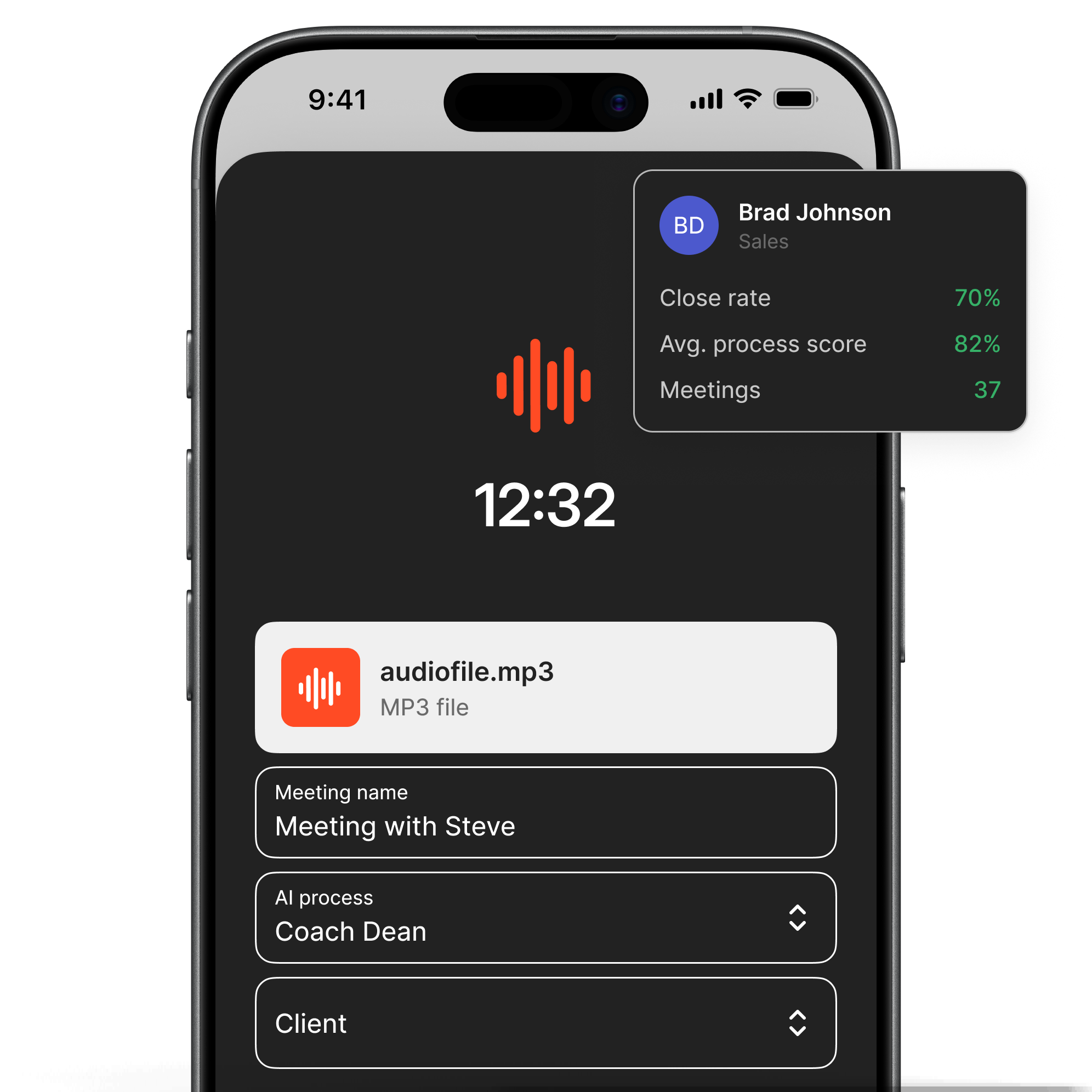
The sales rep's phone or tablet records the conversation. Most systems use a simple mobile app that runs in the background during appointments. The customer doesn't need to download anything or sign into anything. Many reps just tell customers upfront: "I record calls for training purposes"—same disclosure call centers have used for decades.
Some companies worry about recording consent laws. In practice, one-party consent states (38 states) make this straightforward. In two-party consent states (12 states), reps disclose at the start of the appointment. After thousands of appointments, customer pushback is rare. People are used to being recorded—their bank does it, their cable company does it, their insurance company does it.
2. Real-Time Transcription and Analysis
As the conversation happens, the audio streams to the AI system, which transcribes it in near-real-time (2-5 second delay). The transcription engine is trained on home services vocabulary—product names, industry terms, financing options, objection patterns.
Simultaneously, the AI analyzes conversational dynamics:
- Talk ratios: Is the rep dominating the conversation or letting the customer speak?
- Qualification questions: Did they ask about budget, timeline, decision-makers?
- Objection handling: When the customer said "I need to think about it," how did the rep respond?
- Closing attempts: Did they ask for the sale? How many times?
This isn't sentiment analysis or vibe checking. It's pattern recognition based on thousands of successful and unsuccessful appointments. The AI knows what good looks like because it's seen 50,000 appointments from top performers.
3. Instant Feedback Delivery
Here's where it gets useful: the AI sends real-time coaching prompts to the rep's phone during the appointment.
Customer says: "This seems expensive compared to what I saw online."
AI detects: Price objection + comparison shopping + implicit budget concern
Rep's phone buzzes with a prompt: "Address value gap—ask what they're comparing to, then pivot to warranty/quality differences."
The rep glances at their phone (same way they'd check a text), sees the prompt, and adjusts their approach mid-conversation. The customer doesn't see a robot coaching the rep—they see a professional checking their notes.
Some systems use earbuds for audio-only prompts. Others use smartwatches for discrete vibration alerts with short text. The delivery method matters less than the timing—reps get guidance while they can still use it, not two days later in a review meeting.
What AI Coaching Sees That Managers Miss
Even the best sales managers can't track everything happening in an appointment. They're focused on the big picture—did the rep build rapport, did they present options, did they ask for the sale. Micro-level conversational patterns slip through.
AI coaching catches the details:
Interruption Patterns
When a rep interrupts customers 8 times in 15 minutes, it signals they're presenting rather than listening. Managers might notice this in one appointment, but they won't track the pattern across 50 appointments to realize it's a chronic issue. AI flags this after 3 appointments and prompts the rep to let customers finish their thoughts.
Missed Discovery Opportunities
Customer mentions: "We're also thinking about replacing the windows next year."
Average rep response: Continues talking about the current project.
AI-coached rep response: "Tell me more about that—if we could bundle both projects, would that affect your timeline?"
That one redirect can double deal size. Managers might catch this if they're riding along and paying close attention. AI catches it every single time because it's listening for buying signals that indicate expansion opportunities.
Weak Trial Closes
Top performers test for readiness throughout the appointment: "If we could get this installed by next Friday, does that work for your schedule?" or "Between the premium and standard package, which one feels like a better fit?"
Weak reps skip trial closes and jump straight to asking for a decision at the end—when the customer hasn't been prepped for it. AI tracks trial close frequency and prompts reps who aren't doing it: "Try a timeline trial close now."
Proposal Presentation Speed
When reps present pricing options, the speed at which they talk correlates strongly with whether customers feel pressured. AI measures words per minute during the pricing section and alerts reps in real-time: "Slow down—you're at 180 WPM, target is 140 WPM for pricing."
This is coaching granularity that's impossible for humans to track manually at scale.
Field Sales Use Cases: Where This Works Best
Not every in-person sales interaction needs AI coaching. High-volume, high-stakes, consultative sales benefit most:
Home Remodeling and Construction
Kitchen remodels, bathroom renovations, additions—these are $25K-$150K purchases with long sales cycles and complex decision-making. Reps often meet with couples who have different priorities. One spouse cares about budget, the other cares about design. AI coaching helps reps navigate the dynamic by flagging which stakeholder is engaged and which is skeptical.
Example prompt: "The husband hasn't asked a question in 8 minutes—re-engage him by asking about his priorities."
HVAC and Home Services
Replacement sales (new furnace, AC unit, water heater) happen under time pressure. The customer's unit just failed, they're uncomfortable, they want a solution fast. This urgency creates buying motivation but also decision paralysis—customers worry they're being rushed into a bad deal.
AI coaching helps reps balance speed and thoroughness. If the rep is moving too fast through options, AI prompts them to slow down and explain financing. If the customer is stalling on decision-making, AI suggests urgency-building questions: "What happens if we don't get this installed before the next heatwave?"
Roofing and Exterior Services
Storm damage claims, insurance adjustments, financing coordination—roofing sales involve layers of complexity beyond the roof itself. Reps who can't explain the insurance process lose deals to competitors who make it simple.
AI coaching tracks whether reps are addressing insurance concerns proactively. If a customer mentions storm damage but the rep doesn't bring up insurance within 5 minutes, AI prompts: "Ask about their insurance coverage—this is likely a claim opportunity."
Solar and Energy Efficiency
These are long-term ROI sales requiring financial literacy and trust-building. Customers are skeptical of payback calculations and worried about installation quality. Reps need to present numbers clearly without overselling.
AI coaching monitors for credibility-building language: Did the rep cite third-party sources? Did they address common objections preemptively? Did they explain financing terms without jargon?
The "Virtual Ride-Along" Experience
The term "virtual ride-along" isn't marketing speak—it describes what the AI is actually doing. A traditional ride-along gives a manager visibility into an appointment they can't physically attend. Virtual ride-alongs give managers visibility into every appointment without leaving the office.
Post-appointment, managers see:
- Full transcripts of customer conversations
- Talk ratio breakdowns
- Key moments flagged (objections, closing attempts, pricing discussions)
- Performance scores based on coaching metrics
This replaces the note-taking and memory-reliant process of manual ride-alongs. Instead of a manager saying "I think you interrupted the customer a few times," they show the rep the transcript with timestamps: "Here at 14:22, the customer was starting to explain their budget concerns, and you cut them off to talk about financing."
That specificity makes coaching conversations faster and more productive. No arguing about what happened. No defensive reactions. Just objective data and targeted improvement.
Training the AI on Your Sales Process
Out-of-the-box AI coaching gives generic sales advice: ask open-ended questions, listen more than you talk, handle objections confidently. That's useful but not differentiated. Real value comes from training the AI on your specific sales methodology.
Most AI sales coaching platforms let you customize:
Company-Specific Scripts
If your company uses a particular closing script or financing explanation, the AI can recognize when reps are following it correctly vs. deviating. When a rep skips a step in your qualification process, AI flags it in real-time.
Product Configuration Rules
Complex products have configuration dependencies. If a customer wants Feature A, they also need Feature B. AI can prompt reps when they're building a quote that won't work: "This package requires the upgraded warranty—confirm with the customer."
Objection Response Libraries
Your top performers have proven responses to common objections. Instead of leaving newer reps to figure it out themselves, AI suggests the high-performing script when that objection appears: "Try this response: 'I understand the price feels high compared to what you saw online. Let me show you exactly what's included in our installation that most online quotes don't cover...'"
This turns institutional knowledge into real-time coaching.
What AI Coaching Doesn't Replace
AI sales coaching for in-person sales is a tool, not a replacement for human judgment. It handles volume and consistency. It doesn't handle nuance and relationship-building.
AI can't read body language. If a customer's arms are crossed and they're leaning away from the table, that's a buying signal that audio-only AI misses. Human managers still need to teach reps how to read physical cues.
AI can't assess rapport quality. Two reps might both ask the same qualifying questions, but one builds trust through conversational tone and the other feels interrogative. AI can measure question quantity but not rapport quality.
AI can't coach complex negotiation. When a deal involves multiple stakeholders, custom pricing, or non-standard terms, human coaching is essential. AI can flag that a negotiation is happening, but it can't guide the strategy.
The most effective implementations combine AI coaching for tactical execution with human coaching for strategic thinking and relationship skills.
Implementation: What It Actually Takes
Rolling out AI sales coaching isn't plug-and-play, but it's not a 6-month IT project either. Realistic timeline: 2-4 weeks.
Week 1: System Setup and Rep Onboarding
- Sales ops configures the platform (connects CRM, sets coaching parameters)
- Reps download the mobile app and complete training (usually 30-minute video + practice call)
- IT reviews recording consent requirements by state
Week 2: Pilot with Top Performers
Start with your best reps. They're less likely to resist the technology and more likely to give useful feedback on what's helpful vs. noisy. Run 20-30 appointments through the system and review the coaching prompts with the reps afterward.
Key question: Are the prompts timely and relevant, or are they distracting and generic?
Adjust sensitivity settings based on feedback. Some reps want coaching on every call. Others only want it flagged when they're significantly off-track.
Week 3-4: Broader Rollout
Expand to the full sales team. Hold a kickoff meeting to address concerns (usually privacy-related or "is this tracking me?" fears). Emphasize that AI coaching is a development tool, not a surveillance system. Managers should review AI insights to coach more effectively, not to punish reps for mistakes.
Successful implementations focus on improvement, not compliance.
ROI: Where the Value Shows Up
AI sales coaching for in-person sales pays for itself quickly because the improvements compound. Small gains in close rate, average ticket, or sales cycle length multiply across every appointment.
Close rate improvement: 3-5 percentage points in the first 90 days is common. A team closing 30% moves to 33-35%. If you're running 200 appointments per month at $10K average ticket, that's $600K-$1M in additional annual revenue.
Ramp time reduction: New reps reach quota 30-40% faster with AI coaching. Instead of 6 months to full productivity, they get there in 4 months. That's two extra months of quota attainment per rep per year.
Manager leverage: Sales managers can effectively coach 2-3x more reps when AI handles the appointment-level feedback. A manager who could previously coach 5 reps effectively can now handle 12-15.
Voluntary turnover reduction: Reps stay longer when they feel supported and see their performance improving. Better coaching reduces frustration and increases confidence.
The Next Evolution: Predictive Coaching
Current AI sales coaching is reactive—it listens to what's happening and suggests responses. The next generation will be predictive—it will anticipate what's about to happen and prep reps before appointments.
Imagine an AI system that analyzes a customer's online behavior before the rep even arrives at the appointment:
- Visited pricing page 4 times → likely price-sensitive, prep financing options
- Spent 10 minutes on warranty page → concerned about long-term reliability, emphasize quality
- Compared to competitor websites → price-shopping, expect objections
The rep walks into the appointment already knowing the customer's likely concerns and objections. Coaching happens before the conversation even starts.
Some companies are already piloting this. It's not widespread yet, but the infrastructure is in place.
Related Topics: virtual sales coaching for field reps, AI sales training for in-person appointments, real-time sales guidance for home services, conversational AI for outside sales, AI-powered ride-alongs for field sales teams, in-home sales coaching technology, remote sales coaching for field teams
Similar Blogs



Sell More with
AI & Coach your
sales team.
Get Results in 21 Days. See it in action now!

Join 11,000+ reps


The #1 Ai Sales Growth System for Home Builders, Home service and Home remodeling companies.
Mon-Fri 9-6pm