
Home Services Sales Training: AI vs Traditional Methods
I’ve sat through a lot of sales training. The kind where you fly your team to a hotel conference room, hire a consultant who’s never sold HVAC in their life, and spend two days doing role-plays while everyone checks their phone under the table.
Three weeks later, nothing changes. Your reps go back to the same habits. The consultant cashes the check. And you’re out $10K wondering why close rates didn’t move.
Traditional sales training isn’t bad because the instructors are incompetent. It’s bad because it’s built for a world where salespeople spend months perfecting a pitch before they ever talk to a customer. Home services doesn’t work that way. Your reps are in the field every day, and they need coaching that keeps up.
AI sales training doesn’t replace good fundamentals. But it solves the problems that classroom training can’t.
Why traditional training fails contractors
The model is broken for home services. Here’s how it usually goes:
You send your reps to a two-day workshop. They learn frameworks like “SPIN selling” or “challenger sales.” They practice objection handling with other reps who aren’t actual homeowners. Everyone nods, takes notes, maybe gets excited.
Then they go back to work. First call of the week, they forget half of it. Second call, they revert to old habits because the homeowner says something they didn’t practice for. Third call, they’re back to winging it.
The problem isn’t that the training is wrong. The problem is that it’s one-and-done. You can’t teach someone to close deals in a classroom and expect it to stick when they’re standing in a hot attic explaining why a new AC costs $8,000.
Traditional training assumes sales is a static skill you learn once. It’s not. It’s a dynamic skill that gets better with real feedback on real calls.
What AI training does differently
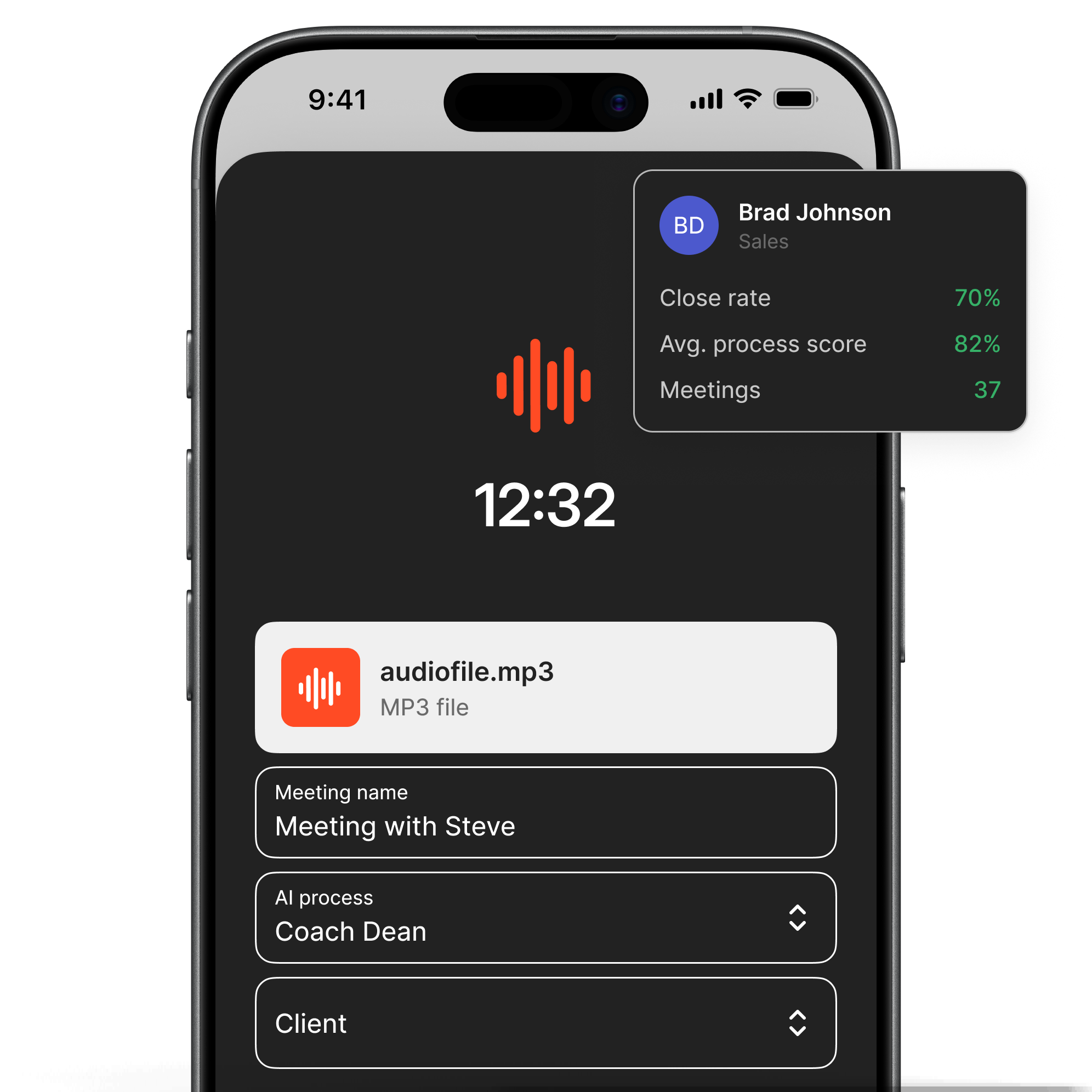
AI doesn’t teach your reps in a conference room. It coaches them during actual sales conversations.
Here’s the difference:
Traditional training: Your rep forgets to mention financing during a call. Two weeks later, during a review session, you listen to the recording and say “you should’ve brought up financing.” They nod. They forget again next week.
AI training: Your rep forgets to mention financing. The AI catches it in real-time and prompts them: “Ask about payment options.” They ask. The homeowner says yes. They close the deal. Next time, they remember because it worked.
One approach teaches theory. The other builds habits through live reinforcement.
The five problems AI solves that classrooms can’t
1. Real-time feedback during calls
You can’t have a sales manager sit in every call. But AI can. It listens, catches mistakes, and gives reps nudges while they’re still in the conversation.
Example: your tech quotes a roof replacement but doesn’t ask for the sale. The AI prompts: “Ask for the close.” The rep asks. The homeowner signs. That’s training that sticks because it’s tied to a result.
Traditional training would review that call a week later. By then, the deal is lost and the lesson is theoretical.
2. Personalized coaching for every rep
Classroom training treats everyone the same. Rep A needs help with objection handling. Rep B forgets to ask qualifying questions. Rep C talks too much and doesn’t listen.
In a group session, you pick one topic and hope it applies to everyone. AI coaches each rep based on their specific mistakes.
Rep A gets real-time objection scripts when a homeowner pushes back. Rep B gets prompts to ask about budget and timeline. Rep C gets nudges to pause and let the homeowner talk.
It’s individualized without requiring a dedicated coach for every rep.
3. Continuous improvement, not one-and-done events
Traditional training is episodic. You do it once a quarter, maybe twice a year. Between sessions, reps are on their own.
AI trains your reps on every single call. After a hundred calls, your rep has practiced more in a month than they would in a year of quarterly workshops.
Volume matters. The more reps you get, the faster habits form. AI gives you volume that classroom training physically can’t match.
4. No guesswork on what to fix
Most sales training is based on intuition. A manager listens to a call and says “that didn’t sound good.” But what specifically didn’t sound good? Was it the opening? The value prop? The close?
AI scores every part of the conversation. It tells you exactly where deals are lost. Then it coaches reps on those specific moments.
You’re not guessing. You’re fixing the actual bottlenecks.
5. Scalable without hiring more managers
If you have 10 reps, you need a sales manager. If you have 50 reps, you need five managers. If you have 100 reps… you see the problem.
AI scales infinitely. One platform can coach 10 reps or 1,000 reps. The cost doesn’t explode the way headcount does.
For contractors growing fast, that matters. You can double your sales team without doubling your coaching overhead.
When traditional training still matters
AI isn’t a replacement for everything. There are things it can’t teach.
Product knowledge. Your reps need to understand what they’re selling. AI can remind them to mention features, but it can’t teach them how a heat pump works or why one roofing material is better than another. That’s still classroom or hands-on training.
Company culture and values. How your reps represent your brand, how they treat homeowners, what your service standards are — that’s human training. AI can enforce scripts, but it can’t instill values.
New rep onboarding. If someone has never sold before, they need fundamentals. How to structure a conversation, how to read body language, how to ask open-ended questions. You can’t throw them into the field with just AI.
The best approach isn’t AI vs traditional training. It’s traditional training for foundation, AI for everything after that.
Teach your reps the basics in a classroom. Then let AI refine them in the field.
What to look for in AI sales training
Not all AI tools are built the same. Some are glorified call recorders. Others actually coach in real-time. Here’s what separates the good from the useless:
It needs to work during calls, not after
Post-call analysis is better than nothing. But it’s not coaching. Coaching happens in the moment, when your rep can still save the deal.
Look for platforms that listen live and give feedback while the conversation is happening.
It needs to understand your trade
AI trained on generic sales data won’t help a plumber sell water heaters. You need a platform built specifically for home services that knows the difference between service calls, maintenance agreements, and project sales.
It needs to integrate with your existing tools
If your reps have to use a separate app, log into a different dashboard, or manually upload calls, they won’t use it. The best AI training integrates with the tools you already use — your CRM, your dispatch software, your phone system.
It needs to show ROI
Sales training is worthless if it doesn’t increase close rates. Period. Any AI platform should track before-and-after performance and show you exactly which reps improved and by how much.
If it can’t do that, it’s not training. It’s just analytics.
How contractors are using AI training today
Here’s what it looks like in practice:
HVAC contractor in Phoenix: Uses AI to coach techs on maintenance agreement sales. Before AI, conversion rate was 12%. After three months, it’s 28%. The AI prompts reps to explain the value of seasonal tune-ups instead of just offering a discount.
Roofing company in Dallas: Uses AI to catch reps who quote too low. The AI analyzes the conversation, detects when a homeowner is ready to pay more, and nudges the rep to upsell premium materials. Average ticket increased by $1,200 per job.
Plumbing company in Atlanta: Uses AI to train new reps faster. Instead of spending six months shadowing senior techs, new hires get real-time coaching on their first calls. Time to first close dropped from 90 days to 30 days.
These aren’t edge cases. This is what happens when you move from periodic training events to continuous, live coaching.
Making the switch from traditional to AI training
If you’re used to quarterly sales workshops, switching to AI feels weird at first. Here’s how to do it without losing your team:
Start with your best reps. Don’t roll out AI to everyone at once. Pick your top performers, let them test it, and use their feedback to refine the rollout. When other reps see that your closers are using it, they’ll want in.
Keep some traditional training. You don’t have to choose one or the other. Use workshops for onboarding and product updates. Use AI for daily coaching and skill reinforcement.
Track the numbers. Before you switch, measure your baseline close rates, average ticket, and time to first close. After three months of AI coaching, measure again. If the numbers don’t improve, something’s wrong.
Give it time. AI training works, but it’s not magic. Reps need a few weeks to get comfortable with live prompts. Managers need time to learn how to review AI-generated insights. Don’t judge it based on the first week.
The real question
The question isn’t whether AI training is better than traditional training. It’s whether you want your reps to get better once a quarter or every single day.
Classroom training has its place. But if you’re serious about improving close rates, cutting ramp time, and scaling without hiring more managers, you need something that works in real-time.
AI sales training isn’t the future. It’s what contractors are using right now to beat competitors who are still stuck in conference rooms doing role-plays.
[IMAGE: Side-by-side comparison - classroom training session vs rep using real-time AI coaching on a tablet in the field]
[IMAGE: Graph showing close rate improvements: quarterly workshops (flat line) vs continuous AI coaching (upward trend)]
Related Topics: AI sales training home services, contractor sales coaching software, real-time sales coaching tools, traditional vs AI training methods, HVAC sales training programs, field sales coaching technology, home improvement sales training


Sell More with
AI & Coach your
sales team.
Get Results in 21 Days. See it in action now!

Join 15,000+ reps


The #1 Ai Sales Growth System for Home Builders, Home service and Home remodeling companies.
Mon-Fri 9-6pm