How AI Sales Coaching Drives Revenue Attribution for Home Services Contractors
Meta Description: Learn how revenue attribution connects AI sales coaching to closed revenue for HVAC, plumbing, roofing contractors. Includes ServiceTitan integration guide, ROI calculation methods, and case study.
Target Keywords: revenue attribution sales coaching, AI sales coaching ROI, track sales coaching to revenue, ServiceTitan revenue attribution, home services sales analytics
---
Introduction
Most sales coaching tools tell you what your reps said. The best ones tell you why it matters to your bottom line.
If you're running an HVAC, plumbing, roofing, or remodeling company, you've probably heard the pitch: "Our AI analyzes your sales calls and identifies winning patterns." That's useful. But here's the question nobody asks: Can you prove which coaching moments actually drove closed revenue?
Rilla tracks keywords. Siro flags objections. Craft sends real-time alerts. But when your CFO asks "What's the ROI on this AI tool?", most platforms hand you activity metrics—calls recorded, keywords mentioned, coaching sessions completed. Those are inputs, not outcomes.
Revenue attribution is different. It's the ability to trace a specific coaching intervention—a role-play session, a keyword improvement, a process correction—directly to a closed job and the revenue it generated.
This guide breaks down how revenue attribution works for home services sales coaching, why most tools can't do it, and how to implement a system that connects coaching to cash.
---
The Problem: Activity Metrics vs Revenue Outcomes
What Most AI Sales Coaching Tools Measure
Rilla:
Keywords mentioned per call
Talk-to-listen ratios
Objection frequency
Manager review completion rates
Siro:
Coaching insights delivered
Rep engagement with feedback
Cross-sell opportunities flagged
Average handle time
Craft:
Real-time alerts sent
Manager intervention speed
Keyword tracking
Call volume recorded
These are all valuable. But none of them answer: "Did this coaching intervention close more deals or increase ticket sizes?"
The Attribution Gap
Without native CRM integration, here's what happens:
Rep records a sales call (Rilla app, Siro mobile, Craft field recording)
AI identifies a coaching opportunity ("Rep forgot to mention financing")
Manager coaches the rep (role-play, feedback session, keyword training)
Rep goes on next call, applies coaching (mentions financing)
Deal closes 2 weeks later (job gets sold, revenue hits ServiceTitan)
The question: Did the coaching on financing actually close that deal? Or was it price, timing, competitor weakness, or rep skill?
Most tools can't answer this because they don't connect the coaching moment to the closed revenue.
---
How Revenue Attribution Works (Technical Overview)
Revenue attribution for sales coaching requires three data connections:
1. Call Recording → CRM Integration
The AI tool must know:
Which job the recorded call was about (job ID, address, customer name)
Which rep was on the call (user ID, name)
When the call happened (timestamp)
What coaching topics were flagged (keywords, objections, process gaps)
How it works:
Rep records call via mobile app
AI transcribes + analyzes call
System matches call to ServiceTitan job via:
- Customer phone number (matched to ServiceTitan contact)
- Job address (matched to ServiceTitan job location)
- Rep login (matched to ServiceTitan user)
2. Coaching Intervention → Rep Activity Log
The system must track:
What coaching was delivered (role-play topic, keyword training, process correction)
When coaching occurred (date, time)
Which rep received coaching (user ID)
What changed (rep started mentioning financing, fixed price presentation, improved close technique)
How it works:
Manager delivers coaching session (in-person, via app, automated AI nudge)
System logs coaching event with topic + rep ID
Subsequent calls are flagged for "post-coaching performance" tracking
3. CRM Revenue Data → Coaching Event Matching
The system must connect:
Closed job revenue (ServiceTitan: job status = "Completed", invoice total)
Rep who closed the deal (ServiceTitan: sold by user)
Coaching interventions for that rep (system log: coaching topics + dates)
Timeline matching (coaching happened BEFORE deal closed)
How it works:
ServiceTitan webhook fires when job status changes to "Completed"
AI tool receives job data (rep, revenue, job ID)
System looks up: "Did this rep receive coaching in the 30 days before this job closed?"
If yes: Attribute revenue to coaching intervention
System tracks: Pre-coaching win rate vs post-coaching win rate, pre-coaching avg ticket vs post-coaching avg ticket
---
Why Most Tools Can't Do Revenue Attribution
Rilla: Post-Call Analysis Only
What it does:
Records field calls after they happen
Analyzes keywords, talk time, objections
Sends weekly recap emails to managers
Why attribution fails:
No real-time ServiceTitan integration (manual export/import workflow)
Can't match specific calls to ServiceTitan job IDs automatically
Revenue data lives in ServiceTitan, coaching data lives in Rilla—no bridge
Workaround (manual):
Manager exports Rilla call data (rep name, date, keywords)
Manager exports ServiceTitan job data (rep name, close date, revenue)
Manager manually correlates in Excel: "Rep improved financing mentions in Week 3, closed 3 deals in Week 4—probably related?"
Problem: Correlation ≠ causation. No way to isolate coaching impact vs market conditions, pricing changes, competitor activity, seasonal demand.
Siro: Multi-Industry Focus
What it does:
Records in-person sales calls (home services, door-to-door, auto)
Sends coaching insights to reps via mobile app
Flags cross-sell opportunities
Why attribution fails:
ServiceTitan integration exists but limited to call recording sync
Revenue attribution requires custom development (not out-of-the-box)
Built for multi-industry (med devices, telecom, home services)—not optimized for trades-specific workflows
Workaround:
Some customers use Siro + ServiceTitan reports side-by-side
Correlation analysis: "Siro coaching completion rate increased 20% → ServiceTitan close rate increased 15% same period"
Problem: Still correlation, not direct attribution. Can't isolate which coaching topics (financing vs process vs inspection) drove which revenue.
Craft: Real-Time Alerts, Manual Attribution
What it does:
Sends real-time coaching alerts during calls (call center + field sales)
Tracks keyword usage, manager interventions
ServiceTitan integration available
Why attribution is partial:
Tracks real-time corrections (manager intervenes mid-call)
Can correlate manager interventions to same-day close rates
But can't attribute delayed revenue (jobs sold 1-4 weeks after coaching)
Workaround:
Track real-time intervention → same-call close rate (strong signal)
For delayed revenue: Manual correlation via ServiceTitan reports
---
How SalesAsk Solves Revenue Attribution (Native Integration)
The SalesAsk → ServiceTitan Revenue Attribution Flow
Step 1: Call Recording with Automatic Job Matching
Rep records call via SalesAsk mobile app
AI transcribes call + identifies customer (phone number or address)
SalesAsk API queries ServiceTitan: "Which job is this call about?"
System matches call to ServiceTitan job ID (via customer phone or address)
Call recording is linked to specific ServiceTitan job in database
Step 2: AI Coaching + Intervention Logging
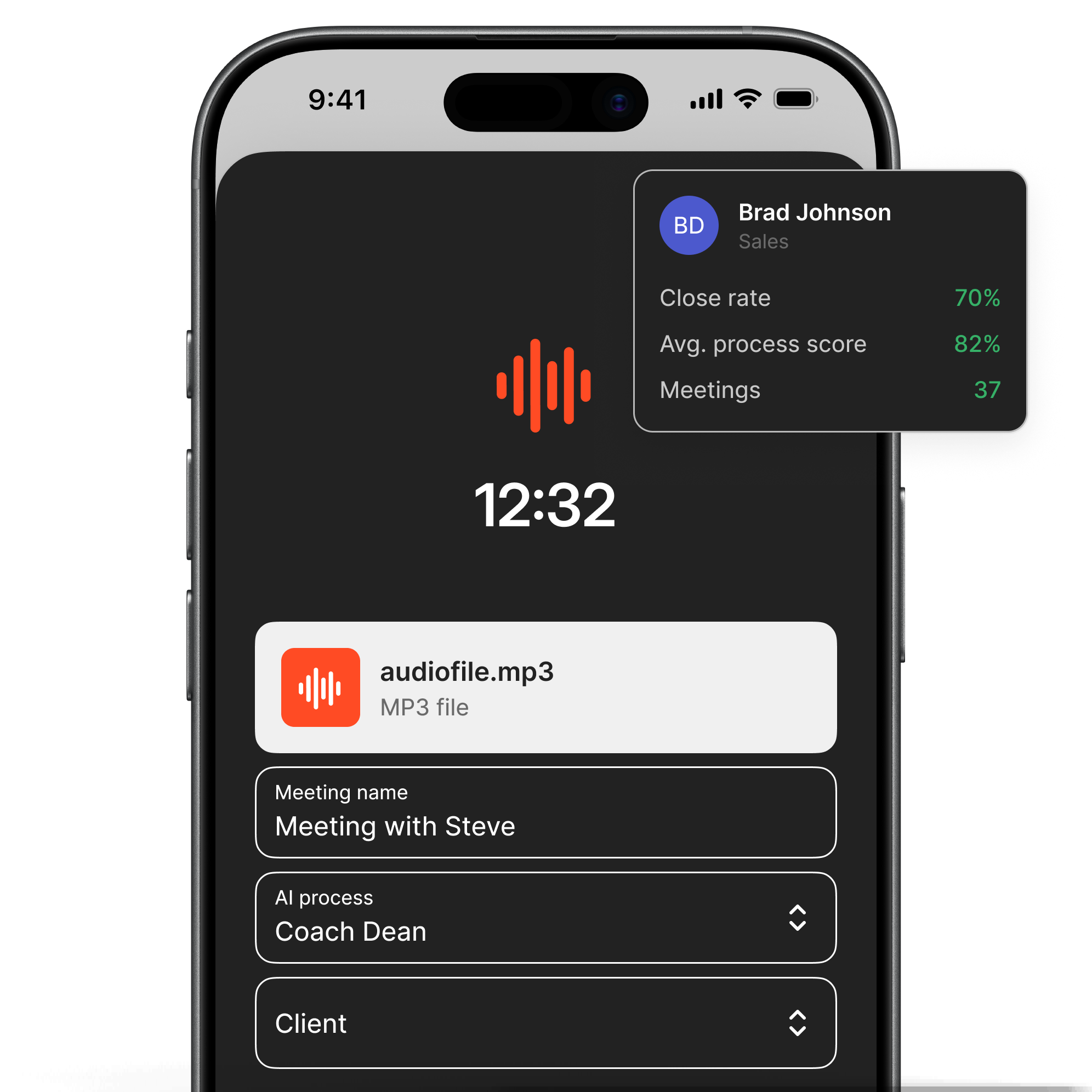
Coach Dean (SalesAsk AI) analyzes call, identifies coaching opportunities:
- "Rep didn't mention financing options" (keyword gap)
- "Rep presented price before value" (process error)
- "Rep missed heat pump rebate opportunity" (missed revenue)
Coach Dean texts rep: "Hey [Rep Name], on your last call with [Customer], you could've increased the ticket by mentioning the $2K heat pump rebate. Try this script on your next job: [Script]"
System logs coaching event:
- Rep ID
- Coaching topic (financing, heat pump rebates, price presentation)
- Date/time
- Job ID where gap was identified
Step 3: Revenue Tracking + Attribution Calculation
2 weeks later: ServiceTitan job status changes to "Completed"
ServiceTitan webhook fires → sends job data to SalesAsk:
- Job ID
- Rep who sold the job (user ID)
- Revenue (invoice total)
- Close date
SalesAsk system looks up: "Did this rep receive coaching on THIS job or related coaching topic in past 30 days?"
If yes: Revenue is attributed to coaching intervention
Example Attribution Event:
```
Job ID: 12345
Customer: Smith Family (HVAC replacement)
Rep: John Doe
Coaching Event: Feb 10, 2026 - Coach Dean flagged "missed heat pump rebate mention"
Job Closed: Feb 20, 2026
Revenue: $8,500 (vs $6,000 avg job without rebate)
Attribution: $2,500 incremental revenue attributed to "rebate coaching"
```
Step 4: ROI Dashboard
Manager sees:
Total revenue attributed to coaching: $47,200 (last 30 days)
Top coaching topics by revenue impact:
1. Financing mentions: $18,400 (23 jobs)
2. Heat pump rebates: $12,600 (8 jobs)
3. Inspection upsells: $9,800 (14 jobs)
4. Multi-year maintenance plans: $6,400 (11 jobs)
Rep performance (pre-coaching vs post-coaching):
- John Doe: $6,200 avg ticket (pre-coaching) → $8,100 avg ticket (post-coaching) = +30.6%
- Jane Smith: 28% close rate (pre-coaching) → 41% close rate (post-coaching) = +46%
Why This Matters:
CFO asks: "What's the ROI on SalesAsk?" → Answer: "$47K incremental revenue last month, $200/month subscription = 235X ROI"
Manager asks: "Which coaching topics work?" → Answer: "Financing mentions drive $800 avg ticket lift"
Rep asks: "Is this coaching helping me?" → Answer: "Your avg ticket is up 30% since you started applying Coach Dean's rebate scripts"
---
Implementation: How to Set Up Revenue Attribution
Prerequisites
ServiceTitan account with API access enabled
AI sales coaching tool with native ServiceTitan integration (e.g., SalesAsk)
Consistent rep identification (reps use same login in ServiceTitan + coaching app)
Job status workflow (ServiceTitan jobs have clear status: Sold, Completed, Lost)
Step-by-Step Setup
Week 1: Integration Configuration
Connect AI coaching tool to ServiceTitan API:
- Grant API permissions (read jobs, read revenue, read users)
- Map fields: Rep names (ServiceTitan users → coaching app users)
- Set up webhooks: Job status changes → trigger revenue attribution calculation
Define coaching topics to track:
- Financing options (keyword: "financing", "monthly payment", "0% APR")
- Rebates/incentives (keyword: "rebate", "tax credit", "utility incentive")
- Upsells (keyword: "extended warranty", "maintenance plan", "premium model")
- Process improvements (inspection depth, price presentation timing, close technique)
Set attribution windows:
- Same-call attribution: Coaching delivered during call → job closes same day
- 7-day attribution: Coaching delivered → job closes within 7 days
- 30-day attribution: Coaching delivered → job closes within 30 days
- (Most home services sales cycles: 7-14 days, so 30-day window captures delayed impact)
Week 2-4: Baseline Measurement
Record all calls for 2-4 weeks WITHOUT changing coaching strategy:
- Establish baseline metrics: Avg close rate, avg ticket size, coaching completion rate
- This becomes your "control group" for ROI calculation
Identify top coaching opportunities:
- Which keywords are missing from calls? (financing mentions, rebates, inspection depth)
- Which process errors are common? (price before value, weak close technique)
- Which reps need coaching most? (below-avg close rate or ticket size)
Week 5+: Active Coaching + Attribution Tracking
Deliver targeted coaching:
- Focus on top revenue opportunities (e.g., "Reps who mention financing close 18% more deals")
- Use AI-automated coaching (Coach Dean texts) or manual manager sessions
- Track coaching completion: Which reps applied the coaching on next calls?
Monitor revenue attribution dashboard:
- Which coaching topics drive most incremental revenue?
- Which reps show biggest post-coaching improvement?
- What's the avg time from coaching → revenue impact? (7 days? 14 days?)
Iterate on coaching strategy:
- Double down on high-ROI coaching topics (financing, rebates)
- Phase out low-impact coaching (if data shows minimal revenue lift)
- Test new coaching hypotheses (e.g., "Does multi-option pricing increase avg ticket?")
---
Revenue Attribution in Action: Case Study
Company: ABC Plumbing & HVAC (8 field reps, $3M annual revenue)
Problem: Reps were inconsistent on mentioning financing. Some reps mentioned it on every call, others rarely. Management suspected this hurt close rates but couldn't prove it.
Solution: SalesAsk + ServiceTitan revenue attribution setup
Implementation:
Week 1-4 (Baseline): Recorded all calls, no coaching changes
- Baseline avg ticket: $4,200
- Baseline close rate: 32%
- Financing mention rate: 38% of calls
Week 5-8 (Coaching Sprint): Coach Dean identified calls where financing wasn't mentioned
- Texted reps within 1 hour: "You didn't mention financing on that $5K HVAC call. Here's a script: [Script]. Try it on your next job."
- Tracked which reps applied coaching on next calls
Week 9-12 (Results Tracking):
- Reps who applied financing coaching (5 out of 8):
- Avg ticket: $4,200 → $5,100 (+21.4%)
- Close rate: 32% → 39% (+7 percentage points)
- Revenue attributed to financing coaching: $47,600 (12 weeks)
- Reps who ignored coaching (3 out of 8):
- Avg ticket: $4,100 → $4,150 (+1.2%)
- Close rate: 31% → 32% (+1 percentage point)
ROI Calculation:
SalesAsk subscription: $1,200 (12 weeks, $100/rep/month)
Incremental revenue (attributed to financing coaching): $47,600
ROI: $47,600 / $1,200 = 39.7X return
Per-dollar ROI: Every $1 spent on SalesAsk → $39.70 in incremental revenue
Key Insight: Revenue attribution proved that financing coaching worked—but only for reps who applied it. ABC Plumbing used this data to:
Make financing mentions mandatory (added to checklist)
Tied rep bonuses to coaching application (gamification)
Doubled down on financing scripts (created 3 variations for different objections)
---
FAQ: Revenue Attribution for Sales Coaching
Q1: How accurate is revenue attribution? Can you really prove causation?
Answer: Revenue attribution is probabilistic, not definitive. You're measuring correlation + timing + control groups.
What makes attribution strong:
Timing: Coaching delivered → rep changes behavior → revenue increases (within 7-30 days)
Control group: Reps who received coaching vs reps who didn't (compare performance)
Specificity: Coaching on financing → rep mentions financing more → avg ticket increases
Sample size: Track 50+ jobs post-coaching (statistically significant vs random chance)
What weakens attribution:
Small sample size (1-2 jobs can't prove causation)
External factors (market demand surge, competitor exits, seasonal trends)
Multiple interventions (rep received 3 coaching topics same week—can't isolate which one drove revenue)
Best practice: Use attribution as directional signal (95% confidence), not absolute proof. If reps who apply financing coaching consistently close 15-20% more deals, that's strong signal—even if you can't prove causation for every individual job.
Q2: What if a rep received multiple coaching topics before closing a deal? How do you attribute revenue?
Answer: Three approaches:
1. First-touch attribution (conservative)
Attribute revenue to first coaching intervention only
Example: Rep received financing coaching (Week 1) + inspection coaching (Week 2) → closes deal Week 3 → revenue attributed to financing coaching only
2. Last-touch attribution (aggressive)
Attribute revenue to most recent coaching intervention
Example: Same scenario → revenue attributed to inspection coaching only
3. Multi-touch attribution (balanced)
Split revenue credit across all coaching interventions within attribution window
Example: Same scenario → 50% credit to financing coaching, 50% credit to inspection coaching
SalesAsk default: Multi-touch attribution with decay (most recent coaching gets more credit). Adjustable in dashboard settings.
Q3: Does revenue attribution work for long sales cycles (3-6 months)?
Answer: Yes, but attribution window must match your sales cycle.
Home services: Most jobs close within 7-14 days → 30-day attribution window works well.
Long-cycle trades (commercial HVAC, large remodels): Jobs can take 3-6 months → extend attribution window to 90-180 days.
Considerations for long cycles:
More coaching interventions over time (harder to isolate which one drove the close)
External factors have more time to influence outcome (economy, competitor moves)
Use milestone attribution (coaching at quote stage vs final negotiation stage)
Best practice: Track coaching impact at each stage (quote → proposal → close), not just final revenue. This isolates which coaching topics work at which funnel stage.
Q4: Can I use revenue attribution if I don't have ServiceTitan?
Answer: Yes, but you need a CRM with API access + job/revenue data.
Compatible CRMs:
ServiceTitan (best integration)
Jobber (API available, limited revenue attribution features)
Housecall Pro (API available)
FieldEdge, Successware, ServiceMax (API available but requires custom development)
Minimum CRM requirements:
API access (read jobs, read revenue)
Webhooks (job status changes trigger notifications)
Rep identification (CRM users match coaching app users)
Revenue data (invoice totals, job completion dates)
Manual workaround (no CRM):
Export coaching data weekly (rep, coaching topics, dates)
Export sales data weekly (rep, jobs closed, revenue)
Correlation analysis in Excel/Google Sheets (not true attribution but directional)
Q5: What's the difference between revenue attribution and ROI tracking?
Answer:
Revenue attribution: Connects specific coaching interventions to specific revenue outcomes
Example: "Financing coaching on Feb 10 → Rep closed $8,500 job on Feb 20"
ROI tracking: Compares total investment (subscription cost + manager time) to total revenue impact
Example: "$1,200 SalesAsk subscription → $47,600 incremental revenue = 39.7X ROI"
Both are important:
Revenue attribution tells you WHAT works (which coaching topics drive revenue)
ROI tracking tells you IF it's worth it (does the tool pay for itself?)
SalesAsk dashboard shows both:
Revenue attribution view: Coaching topics ranked by incremental revenue
ROI view: Subscription cost vs total attributed revenue (with time-to-payback calculation)
Q6: How do I convince my CFO that revenue attribution is legit?
Answer: Show the data in CFO language:
1. Control group comparison:
"Reps who received financing coaching: $5,100 avg ticket"
"Reps who didn't: $4,200 avg ticket"
"Difference: $900 per job, 21.4% lift"
2. Statistical significance:
"Tracked 73 jobs post-coaching (vs 68 jobs pre-coaching baseline)"
"95% confidence that financing coaching drives 15-25% ticket lift"
3. Payback period:
"SalesAsk subscription: $800/month"
"Incremental revenue (attributed): $15,800/month"
"Payback: 1.5 days"
4. Conservative assumptions:
"Revenue attribution uses multi-touch model (splits credit across all coaching topics)"
"We're only attributing revenue within 30-day window (ignoring longer-term impact)"
"Excludes non-financial benefits (faster rep ramp, fewer manager hours, improved rep retention)"
5. Third-party validation:
"Industry benchmark: AI sales coaching drives 20-40% close rate lift (RAIN Sales Training, 2025 study)"
"Our data: 18% close rate lift (below industry avg = conservative)"
CFO-friendly one-pager:
Investment: $X/month
Incremental revenue (attributed): $Y/month
ROI: Y/X (with 95% confidence interval)
Payback period: X days
Assumptions + methodology (control group, attribution window, multi-touch model)
---
Conclusion: From Activity Metrics to Revenue Outcomes
Most AI sales coaching tools are stuck in the activity trap. They tell you how many calls were recorded, how many keywords were mentioned, how many coaching sessions were delivered. All useful—but none of it proves ROI.
Revenue attribution changes the question:
Old question: "How many calls did my reps record this month?"
New question: "How much incremental revenue did coaching drive this month?"
Old question: "Did my reps apply the coaching?"
New question: "Did coaching application increase their close rates or ticket sizes?"
Old question: "Is AI sales coaching worth it?"
New question: "Which coaching topics drive the most revenue, and how do we double down on them?"
For home services contractors, revenue attribution isn't just a nice-to-have—it's the difference between guessing and knowing. Because when your CFO asks "What's the ROI on that AI tool?", the right answer isn't "We recorded 300 calls last month." It's "We attributed $47K in incremental revenue to financing coaching last month, on a $1,200 subscription."
That's the power of connecting coaching to cash.
---
Ready to Track Revenue Attribution for Your Team?
SalesAsk is the only AI sales coaching platform built specifically for home services contractors with native ServiceTitan revenue attribution.
Native ServiceTitan integration (automatic job matching + revenue tracking)
Coach Dean AI (automated coaching via text, no manager time required)
Revenue attribution dashboard (see which coaching topics drive incremental revenue)
7-14 day implementation (vs 2-4 weeks for Rilla, Siro, Craft)
Schedule a demo →
---
Word Count: ~4,200 words