Garage Door Sales Training: Close More Installs With AI Coaching
A garage door replacement is one of the most common home improvement projects in North America. It’s also one of the most under-coached sales categories in the trades.
Most garage door companies treat their sales process like a commodity transaction: customer calls, rep shows up, presents options, quotes a price, leaves. If the customer buys, great. If they don’t, the rep moves on to the next lead. There’s rarely a structured sales process, rarely a real discovery conversation, and almost never any coaching after the appointment.
That’s a lot of revenue left in driveways.
Why Garage Door Sales Is Harder Than It Looks
On the surface, garage door sales seems simple. The customer knows they need a new door. You show up, measure, show samples, give a price. Straightforward.
Except it’s not. The average garage door replacement ticket — with opener, installation, and any needed hardware — runs $1,200 to $3,500 or more for high-end doors. At that price point, customers don’t just automatically say yes. They compare. They delay. They call their spouse. They get three more quotes.
And the rep who handled that appointment usually has no idea what they did wrong, or whether they did anything wrong at all.
The gap in garage door sales training isn’t product knowledge. Most reps know the difference between steel and composite, between belt drive and chain drive. The gap is in the sales conversation — how reps handle hesitation, how they position value over price, and whether they’re actually asking for the business at the end of the appointment.
What Happens Without Real Coaching
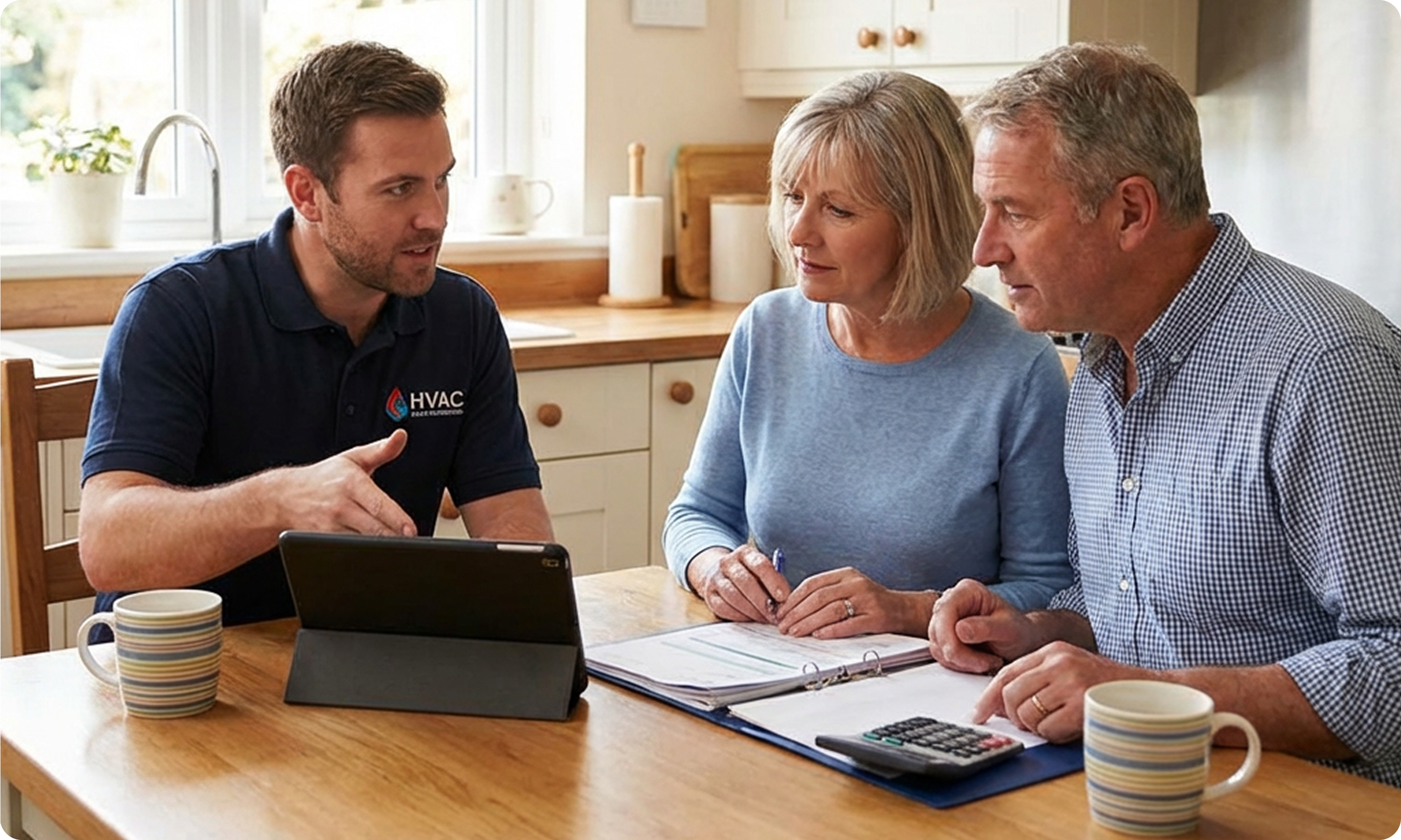
[IMAGE: Garage door sales rep presenting door samples to homeowners in driveway]
The typical coaching cycle in a garage door company looks like this: the owner or sales manager rides along once every few weeks, watches the rep do an estimate, offers some feedback in the truck afterward, and calls it training. If the rep’s numbers are okay, they’re basically left alone.
The problem with this model isn’t that ride-alongs are bad — they’re actually very effective when done consistently. The problem is that they can’t scale. A manager can’t sit in on every estimate. So most of what happens in the field stays invisible.
When a rep loses a sale, the standard post-mortem is: “What did the customer say?” Not “What did you say, and when did you say it?” That distinction matters. Because customers rarely tell you the real reason they didn’t buy. Reps have to be trained to uncover hesitation before it becomes a lost sale, not after.
AI sales coaching for garage door companies closes this gap. Every appointment gets analyzed. Managers see exactly how much time was spent on discovery vs. presenting. They see whether the rep addressed the biggest objections — “we’re getting other quotes,” “we need to think about it,” “can you do better on price” — and how effectively.
This isn’t surveillance. It’s feedback at a scale that was never possible before.
The Discovery Problem
In garage door sales, the customer usually starts the conversation by telling the rep what they want: “We need a new door, probably something similar to what we have.”
Most reps take that at face value and go straight to product presentation. This is a mistake.
What the customer said is a starting point, not a buying decision. Behind “something similar to what we have” might be:
- An HOA with color restrictions they forgot to mention
- A spouse who’s been wanting to upgrade to a carriage-style door for years
- A concern about insulation because the garage is attached and the house is cold
- Kids who keep denting the door and they’d really prefer something more durable
- A plan to sell the house in two years and they want curb appeal
Top-performing garage door reps dig into all of this before showing a single sample. The discovery conversation changes everything: the product they recommend, the price point they anchor to, the emotional hook in the pitch.
SalesAsk’s AI coaching platform tracks exactly how long reps spend in discovery mode versus presentation mode. The data across home services companies is consistent: reps who spend more time asking questions in the first five minutes close at significantly higher rates.
Handling the “We’re Getting Other Quotes” Moment
This is the moment that separates average garage door reps from great ones.
When a customer says “we’re getting other quotes,” a weak rep says “okay, just let me know” and walks out. A trained rep treats it as the beginning of a conversation, not the end.
The right response isn’t to panic, discount, or pressure. It’s to understand what’s driving the comparison. Is it price? Doubt about quality? They don’t feel like they have enough information to make a decision? Each answer points to a different response — and a different way to keep the conversation going.
Most reps have never been trained on this moment in any systematic way. They’ve heard a manager say “try to overcome it” without being told how. AI coaching changes this by showing managers exactly how their reps responded to objections in real appointments — and giving them the data to run targeted training sessions on the moments that matter most.
Scaling a Garage Door Sales Team
For companies with multiple reps across different markets, inconsistency is the core training problem. One rep closes at 55%. Another closes at 30%. The owner assumes it’s just a personality difference and lives with it.
But when you can analyze every appointment, the gap is almost always behavioral, not inherent. The high-performer does a longer discovery. Handles the quote differently. Follows up within 24 hours. The lower performer skips steps under pressure or time constraints.
That’s trainable. With consistent coaching.
For franchise or multi-location garage door companies, this matters especially — you need every rep performing to the same standard regardless of which market they’re in. That’s exactly the challenge that SalesAsk helped Kitchen Tune-Up solve across their national franchise network.
The ROI of Better Garage Door Sales Training
Let’s put some numbers on this.
If your company runs 150 estimates per month at an average ticket of $1,800, and your close rate is 35%, you’re closing 52-53 jobs per month. Raise that close rate to 45% — which is achievable with structured AI coaching — and you’re closing 67-68 jobs. That’s 15 more jobs per month, or roughly $27,000 in additional revenue, from the exact same lead volume.
[IMAGE: ROI comparison chart showing close rate improvement impact on garage door company revenue]
The math changes fast. And unlike paid lead generation or expanded service territory, improving close rate costs nothing extra per lead. You’re just getting more out of what you’re already spending on marketing and operations.
Where to Start
If you’ve never formally tracked your estimate close rate by rep, start there. You might be surprised at the spread. If you’re losing 60-70% of your estimates and don’t know exactly why, that’s the problem to solve.
AI-powered sales coaching gives you the visibility to answer that question with actual data from actual appointments — not guesses or self-reported feedback from reps.
Explore how SalesAsk works for home services companies or book a demo to see the platform in action.
[IMAGE: Split-screen showing before/after coaching metrics for a garage door sales rep]
Related Topics: garage door sales training, home services sales coaching, AI sales coaching for contractors, estimate close rate improvement, in-home sales training, sales coaching software for trades, garage door installer sales process
Similar Blogs

Sell More with
AI & Coach your
sales team.
Get Results in 21 Days. See it in action now!

Join 15K+ reps


The #1 Ai Sales Growth System for Home Builders, Home service, Dental/DSO and Home remodeling companies.
Mon-Fri 9-6pm
Join 15K+ reps