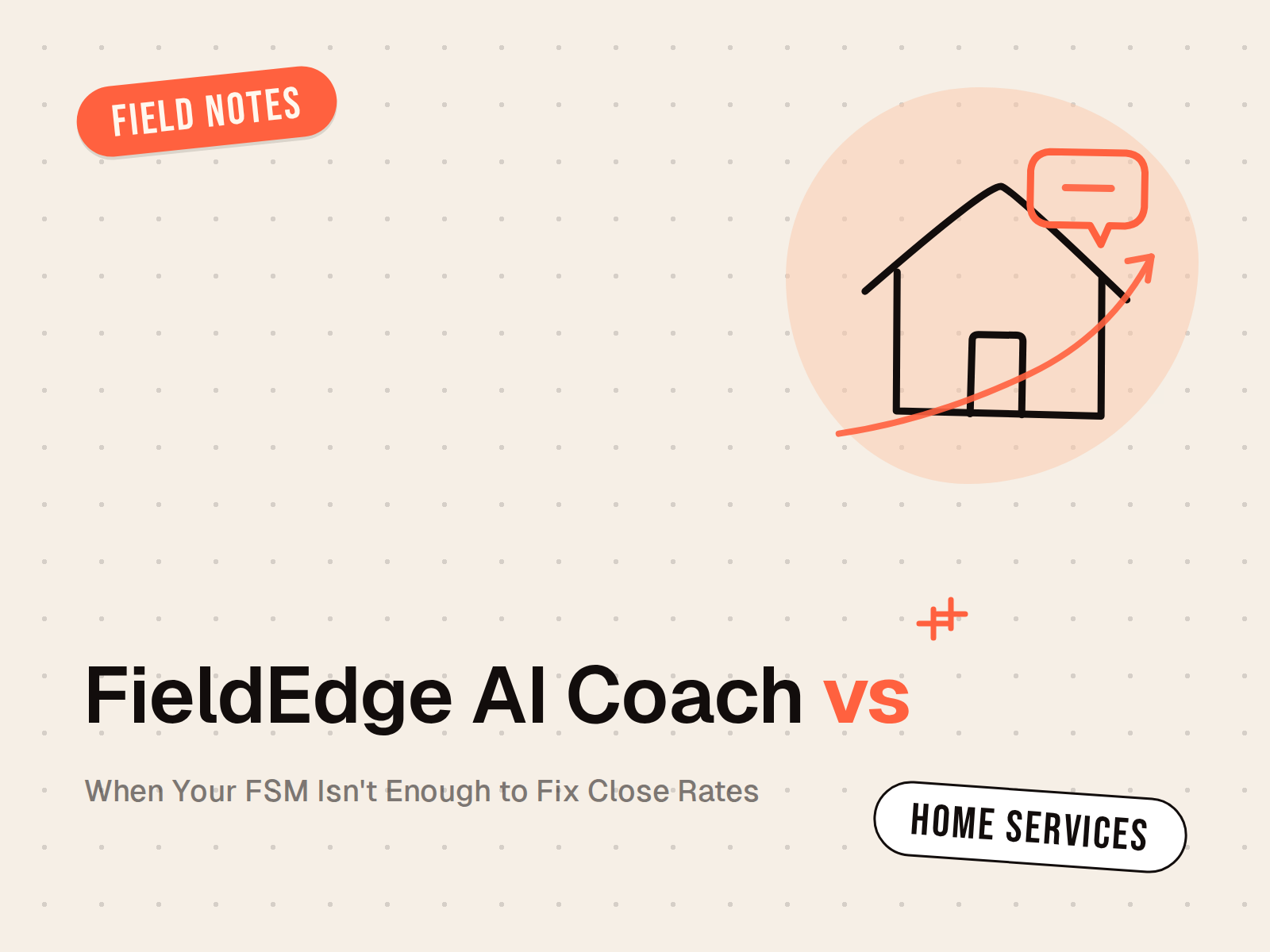
If your business runs on FieldEdge, you already know it handles the operational side well. Scheduling, dispatch, invoicing, QuickBooks sync — it's a solid platform for keeping a home services business organized. And FieldEdge has been adding AI features, including something they call AI Coach, which sounds like it might bridge the gap between running jobs and actually closing them at higher rates.
It doesn't. Not fully, anyway.
That distinction matters more than it sounds. Let me explain what FieldEdge AI Coach actually does, where it stops, and when companies on FieldEdge need a dedicated sales coaching layer like SalesAsk.
What FieldEdge AI Coach Actually Does
FieldEdge's AI Coach is a narrowly focused feature, not a broad sales coaching platform. It's designed to solve a specific problem: identifying when a repair job should become a replacement conversation, and helping technicians build ROI-based proposals for that moment.
Here's what that looks like in practice. A technician diagnoses a failing 11-year-old condenser. FieldEdge's AI Coach analyzes the equipment data — age, repair history, model — and generates a proposal comparing repair cost against a 10-year ownership analysis for replacement. It gives the tech numbers to show the homeowner: "Repair costs X now, but replacement at Y costs you Z less over a decade, especially with current rebates."
That's genuinely useful for one specific scenario. System replacement conversations are high-stakes and easy to fumble without data backing you up.
But that's also where FieldEdge AI Coach ends.
It doesn't listen to calls. It doesn't watch in-home presentations. It doesn't analyze whether your CSR mentioned financing on the booking call, or whether your technician acknowledged the homeowner's objection about timing. It doesn't tell you why the tech closed 28% of system replacements when your best rep closes 54%. The proposal generation is good — the coaching is absent.
FieldEdge's own documentation acknowledges this plainly: the platform lacks built-in AI functionality for direct sales coaching. For call assistance and customer communication, FieldEdge directs users toward third-party integrations like GoodCall (an AI phone assistant) and Birdeye (a marketing platform). These are add-ons solving adjacent problems, not a coaching system.
What "AI Coach" Means in a Sales Context
There's a terminology problem in home services software right now. A lot of platforms are slapping "AI coach" on features that are really just AI analytics or AI proposal tools. The distinction matters when you're trying to fix close rates.
Genuine AI sales coaching involves analyzing the conversation — what was said, when, how — and providing feedback that changes how reps perform next time. That feedback loop needs to be fast (ideally same-day), specific (not "needs improvement" but "you didn't offer financing after they mentioned the $800 repair cost"), and consistent (every call, not just the ones managers happen to review).
FieldEdge AI Coach generates smart proposals. That's proposal intelligence. It's not the same thing as coaching a technician through objection handling, follow-up calls, or how to frame a system replacement conversation with a homeowner who's already said "we'll just get the repair for now."
Confusing the two leads to a predictable outcome: operations improve, but close rates don't move.
SalesAsk for FieldEdge Users
SalesAsk was built for this exact gap. It's a conversation intelligence and coaching platform built specifically for high-ticket in-home sales — HVAC systems, plumbing replacements, roofing projects, electrical panel upgrades. The kinds of sales where a human is sitting across from a homeowner and the outcome depends on how that conversation goes.
SalesAsk's AI agent, Coach Dean, analyzes calls and field presentations, scores them against your sales process, and sends the technician or CSR specific written feedback within minutes of the appointment ending. Not a scorecard. Actual coaching: "You mentioned financing but didn't explain the monthly payment. On three recent calls where you explained the $97/month payment, you closed all three. Try it on the next call."
That's the difference. SalesAsk is coaching what happened in the room, using your own call data, to change what happens in the next room.
For FieldEdge customers specifically, here's how the stack works:
FieldEdge handles:
- Job scheduling and dispatch
- Work orders and invoicing
- Customer records and history
- QuickBooks integration
- System replacement proposals (AI Coach)
SalesAsk handles:
- CSR call coaching (did the booking call set up the appointment correctly?)
- In-home presentation coaching (how did the tech frame the conversation?)
- Follow-up coaching (what's being said on unsold estimates?)
- Revenue attribution (which coaching moments led to which closed jobs?)
- Pattern analysis (what do your top closers do differently?)
The Integration Reality
FieldEdge doesn't integrate natively with SalesAsk, and that's worth being honest about. SalesAsk's deepest native integrations are with ServiceTitan and Jobber. For FieldEdge users, SalesAsk works independently — it captures conversations through its mobile app or call recording, coaches reps based on those conversations, and gives managers visibility into what's happening across all their calls.
You won't get the direct revenue attribution that ServiceTitan users get (where SalesAsk can see exactly which coached job closed and for how much). But you'll still get the core coaching feedback loop, the CSR analysis, and the pattern recognition across your best and worst performing reps. For most FieldEdge companies, that's the bottleneck — not a lack of data integration but a lack of consistent coaching feedback.
If you're growing toward ServiceTitan, it's also worth knowing that SalesAsk's full revenue attribution capability becomes available when you make that transition. Companies we've seen move from FieldEdge to ServiceTitan and add SalesAsk at that stage tend to see the biggest lift because they've already built a coaching culture by then.
Who Should Stick with FieldEdge AI Coach Alone
If your team's close rate on system replacements is already strong — say, above 50% for qualified replacement conversations — and the main gap is that technicians aren't generating proposals systematically, FieldEdge AI Coach addresses that problem directly. It's good at automating the proposal creation step for techs who know how to close but haven't been disciplined about showing homeowners the 10-year math.
If you're also running GoodCall for after-hours intake and Birdeye for review management, you've built a reasonable AI-augmented stack around FieldEdge without adding another platform. That's a valid approach for businesses where the sales process itself is working.
Who Needs SalesAsk in Addition to FieldEdge
Close rate variability is the tell. If your best technician closes system replacements at 60% and your worst closes them at 20%, you have a coaching problem, not a proposal problem. FieldEdge AI Coach generates the same proposal for both techs. SalesAsk tells you why one is closing and one isn't.
The other signal is your CSR conversion rate. A lot of HVAC businesses focus on field performance while ignoring that the booking call is where many jobs are lost before a tech ever goes out. SalesAsk coaches CSRs as part of its core functionality. FieldEdge doesn't have any equivalent — your CSR calls are outside its visibility entirely.
Finally, if you're tracking close rates manually or not at all, SalesAsk changes what you can see. When Coach Dean reviews every call and gives you a weekly breakdown of where your team's leaving revenue on the table, you stop guessing and start coaching toward specific behaviors.
The Honest Comparison
| Feature | FieldEdge AI Coach | SalesAsk |
|---|---|---|
| System replacement proposals | ✅ Automated, ROI-based | ❌ Not applicable |
| FSM scheduling + dispatch | ✅ Core platform | ❌ Not applicable |
| CSR call coaching | ❌ No call analysis | ✅ Full CSR coaching |
| In-home presentation coaching | ❌ No conversation analysis | ✅ Coach Dean analyzes every call |
| Post-call feedback to reps | ❌ Not available | ✅ Within minutes |
| Revenue attribution | ❌ Not available | ✅ ServiceTitan native; independent tracking for others |
| Close rate variability analysis | ❌ Not available | ✅ What top performers do differently |
| Follow-up coaching | ❌ Not available | ✅ Unsold estimate follow-ups |
| QuickBooks integration | ✅ Core feature | ❌ Not applicable |
These aren't competing products in any meaningful sense. They solve different problems. FieldEdge is your operational foundation. If close rates are the constraint on your revenue, SalesAsk is the coaching layer FieldEdge doesn't provide.
The Question That Actually Matters
FieldEdge customers usually end up evaluating SalesAsk because they've run the numbers and can't figure out why their close rate isn't improving. They've hired experienced technicians. They've been doing FieldEdge AI Coach proposals. They've had managers do ride-alongs. Nothing is moving the needle consistently.
We cover AI coaching across a home services network separately.
The answer is almost always that coaching is happening too infrequently, too subjectively, and too late. A manager doing a ride-along once a month and a tech getting the same proposal template as everyone else doesn't create the feedback loop that changes behavior.
For a straight comparison, see how Rilla and Siro differ on coverage.
SalesAsk creates that feedback loop, for every tech, on every call. If that's what's missing from your current stack, it's worth talking through how it would work with FieldEdge as your FSM.
See how home services companies are measuring coaching ROI →
Related articles

Ready to convert
every conversation?
See exactly what’s holding your team back and fix it fast.
.avif)