How to Tell Homeowners You're Recording the Sales Call
Dara Shabnam
Head of Growth, SalesAsk
August 29, 2026
9 min read

On this page
Four seconds. I timed it on a ride-along in Mesa last spring, because the rep, a comfort advisor named Danny with a 52 percent close rate, had told me in the truck that mentioning the recording was the part of the appointment he used to dread most. He set his phone face-up on the kitchen table, said one sentence, the homeowner said "sure," and we were talking about a dead compressor. Four seconds. The thing his whole team had spent a month arguing about at morning meetings was over before the coffee was poured.
I work at SalesAsk, so I've heard the objection in every accent the trades have to offer: homeowners will hate it. They'll clam up. They'll think we're building a case against them. It comes up in nearly every rollout conversation we have, and here's what's strange: it almost never comes from homeowners. It comes from reps and owners predicting how homeowners will feel. The homeowners themselves, when the moment actually arrives, mostly shrug. This post is about that moment: when to bring the recording up, the exact words that work at the kitchen table, and what to do on the rare occasion someone says no.
If you run a home services sales team and want every appointment coached, not only the ones a manager can sit in on, book a SalesAsk demo.
Why are reps so afraid to mention the recording?
Because they imagine disclosure as a confession, when the homeowner experiences it as a formality: the fear is the rep's projection, not the customer's reaction.
Think about the last stranger who stood on your own doorstep. You probably watched him walk up on a doorbell camera. Your utility company records its calls "for quality and training." Your teenager livestreams dinner. Homeowners live inside more recording than any sales rep does, and they know it. A phone on the table capturing an hour-long conversation about ductwork is not, to them, an exotic intrusion. It's Tuesday.
What actually spooks homeowners is furtiveness. A rep who mumbles, who angles the phone away, who visibly hopes the subject won't come up, that rep reads as someone hiding something, and now the recording really is a rapport problem, one the rep manufactured. I've listened to hundreds of these openings, and the pattern is consistent: the discomfort transfers. A rep who treats disclosure as a non-event gets a non-event back. A rep who treats it as an apology invites the homeowner to wonder what's being apologized for.
Siro's own writing on recording concedes the point that customer pushback is "far less than teams typically expect", and then moves on without telling anyone what to actually say. That gap is the whole game. Nobody fails at this because they misunderstand the concept. They fail because at 7 p.m. on a Thursday, standing in a stranger's kitchen, they don't have a sentence ready.
What should you actually say at the kitchen table?
One plain sentence, delivered early, that names the recording and attaches it to a benefit the homeowner keeps.
Not a speech. Not a waiver form. One sentence with three parts: what you're doing, why it helps them, and a small check for consent. Here are three that I've heard work in the field, one per trade:
For a comfort advisor: "By the way, I record my appointments on my phone so I'm not scribbling notes while you're talking, it also means the quote you get tonight covers what we actually discussed, not what I remembered on the drive home. That okay with you?"
For a roofer on a storm claim: "I'm going to record while we walk the property, it catches every bit of damage in your own words and mine, which matters when the adjuster starts asking questions later. Sound good?"
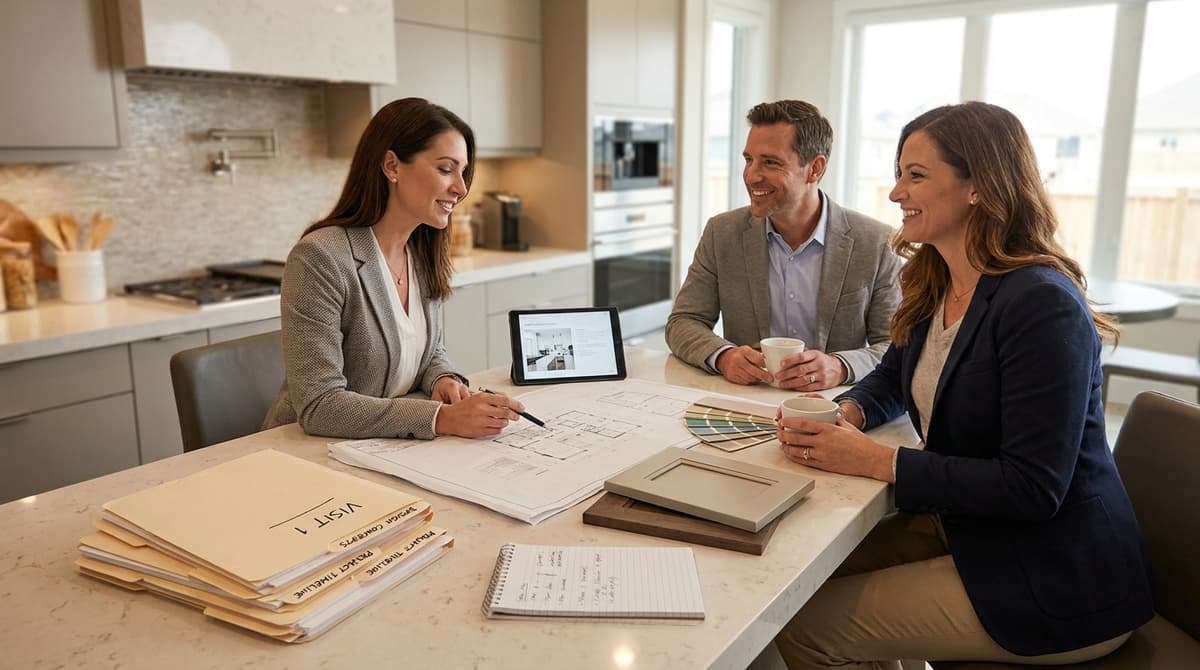
For a kitchen and bath designer: "I record my consultations so the person building your renderings hears you describe what you want in your own voice, instead of my translation of it. All right with you?"
Notice what none of these say: "for training purposes." That phrase belongs to call centers, and it frames the recording as something the company extracts from the homeowner. Every script above frames it as something the homeowner receives: an accurate quote, a documented claim, a design brief in their own words. Both framings are true. Only one of them builds trust.
Here's how the three common disclosure styles actually land:
| Disclosure style | What it sounds like | What the homeowner hears | What happens next |
|---|---|---|---|
| The mumble | "Uh, this might record, company thing, don't worry about it." | "He's hiding something." | Guarded answers all appointment; the recording becomes a presence in the room. |
| The legal recital | "I'm required to inform you this conversation may be recorded for quality and training purposes." | "I'm talking to a call center." | Consent, but the warmth drains out; the rep starts the appointment as an institution, not a person. |
| The benefit frame | "I record so your quote reflects what we actually talked about. That okay?" | "He's organized and he's not hiding anything." | A shrug, a "sure," and four seconds later you're selling. |
When in the appointment should you bring it up?
Inside the first two minutes, before the needs conversation starts, never mid-appointment, and never after something valuable has already been said.
The disclosure belongs in the same breath as the shoe covers and the business card: the small professional rituals that open an in-home visit. Early disclosure does two quiet jobs. It gets consent while the stakes are still low, nobody has said anything personal yet, and it signals that recording is simply how you operate, not a decision you made about this particular homeowner.
The worst version I've heard on tape: a rep who remembered forty minutes in, after the homeowner had shared her budget and a story about her late husband installing the original furnace. "Oh, I should mention I've been recording." You can hear the temperature of the room drop. She didn't cancel the appointment, but the last twenty minutes are a different conversation than the first forty, and the deal died in follow-up. That's not a recording problem. That's a sequencing problem.
Some companies move disclosure even earlier, into the booking flow, a line in the confirmation text or email: "Your advisor records appointments so your quote and follow-up reflect exactly what you discussed." I like this belt-and-suspenders approach for two-party consent states, but it doesn't replace the kitchen-table sentence. A line in an email is compliance. A sentence delivered while looking someone in the eye is trust.
What do you do when a homeowner says no?
Turn it off instantly, visibly, and without a flicker of disappointment, then run the best unrecorded appointment of your life.
It will happen. Not often, across the teams we work with, reps report it as a once-a-month event, not a daily one, but it will happen, and the response is the easiest script in this post: "No problem at all," phone goes in the pocket, appointment proceeds. No negotiating, no "are you sure," no explaining what they're missing. The fastest way to prove the recording was harmless is to be completely unbothered about losing it.
Two practical notes for managers. First, make declines a field your reps can log, so you know your real decline rate instead of your imagined one; when owners actually measure it, the number is usually low enough to end the internal debate on its own. Second, tell your reps explicitly that a declined recording carries zero consequence for them. If reps believe an unrecorded appointment looks like hiding, they'll pressure homeowners, and one pressured homeowner costs you more than fifty missing recordings.
And a tradeoff worth conceding: if your market skews older or rural, your decline rate will run higher than a metro remodeler's, and a small number of homeowners will stay warm on the surface while quietly writing you off. You won't catch every one. That's the honest cost of recording, and I think it's a small one, but pretending it's zero is how vendors lose the room.
Do you even have to ask, legally?
In about a dozen all-party consent states you must get everyone's agreement; everywhere else one-party consent means you technically don't, but you should disclose anyway, in every state, every time.
The short legal picture: most states are one-party consent, meaning the rep's own consent is enough to record a conversation he's part of. Roughly a dozen, including California, Florida, Illinois, Pennsylvania, Massachusetts, Maryland and Washington, require all parties to agree, and an in-home conversation is exactly the kind of private setting where those statutes have teeth. If you run crews across state lines, write your policy to the strictest state you touch and stop thinking about it. (We keep a fuller plain-English breakdown in our consent and privacy guidelines for sales professionals.)
But I'd argue the legal map is almost beside the point. Disclose in Texas exactly as you would in California, because the sentence isn't really about consent. It's about positioning. The rep who says "I record so your quote is accurate" has just told the homeowner: what I say to you tonight, I'm comfortable having on the record. In a trade where every homeowner has a story about a contractor who promised one thing and delivered another, being auditable is a selling point. Some of the best reps we work with have started using it that way deliberately: the recording as proof they stand behind their word.
What happens to the recording after the truck pulls away?
The recording should come back to the homeowner as something useful, a recap, an accurate proposal, a documented scope, or you're only capturing value instead of returning it.
This is where the disclosure sentence gets kept or broken. If you told the homeowner the recording exists so their quote reflects the conversation, then the quote had better reflect the conversation. The teams that get this right close the loop the same evening: the appointment becomes a recap and a proposal that quotes the homeowner's own priorities back to them, the airflow problem in the back bedroom, the payment range they actually named, instead of a generic three-option PDF. That's the thinking behind Homeplan, the homeowner-facing side of SalesAsk we shipped this summer: the conversation follows the homeowner home, so the decision they make on Thursday night is anchored to what was said on Tuesday. The recording funds the follow-up. Rilla and Siro will both tell you what the rep should have said; the question I'd push any vendor on, ours included, is what the homeowner gets out of the file.
FAQ
Do I have to tell the homeowner I'm recording?
Legally, only in all-party consent states: about a dozen of them. Practically, yes, always. The one-sentence disclosure costs four seconds and buys you trust; getting caught not disclosing costs you the deal and maybe the review.
What if the homeowner asks why I record?
Answer plainly and stay on benefits: "So my quote covers what we actually talked about, and so my company can check my work." That second half surprises people. Reps who volunteer that they're coached come across as accountable, not monitored.
Should the office mention recording before the appointment?
A line in the confirmation email or text is smart, especially in all-party consent states. It's a backstop, not a substitute, the rep still says the sentence in person.
Does this apply to video, or just audio?
Video raises the temperature. Audio of a business conversation is a shrug; a camera pointed at someone's living room is not. Nearly everything worth coaching lives in the audio, so my advice for in-home sales is to record audio and leave video alone.
Will asking permission tank my close rate?
The evidence runs the other way. Reps who record run tighter appointments, follow up with accurate proposals, and get coached on real conversations instead of remembered ones. The four-second disclosure is the cheapest part of that trade.
What's a normal decline rate?
Teams we work with report declines as rare: closer to monthly than daily per rep. If yours is meaningfully higher, the problem is almost always the delivery, not the market. Listen to how your reps are saying the sentence.
Sources
State recording-consent rules summarized from the Reporters Committee for Freedom of the Press Reporter's Recording Guide (rcfp.org) and Justia's 50-state survey of recording laws (justia.com). Characterizations of customer pushback reference Siro's published article "Sales Conversation Recording: What It Is & How It Works" (siro.ai/insights). Decline-rate observations are drawn from SalesAsk customer rollouts and are directional, not audited figures.
Steal this for Monday's meeting
Pick one of the three scripts above and make it your team's default this week. Have every rep say it out loud twice at the morning meeting, the awkwardness burns off by the second repetition, which is exactly what happens in the field. Log every decline for thirty days. My bet: you'll get fewer declines in a month than you got objections from your own reps in the meeting, and the argument will settle itself.
About the author
Dara Shabnam
Head of Growth, SalesAsk
Dara Shabnam leads growth at SalesAsk. She writes about in-home sales training, recording consent, and what the recorded conversations of home service and trades teams show about how jobs are actually won.
Dara Shabnam
About SalesAsk
Written by the SalesAsk team
SalesAsk records and coaches in-home sales conversations for home service, home improvement and home builder teams.
More postsKeep reading
All posts


Four seconds. I timed it on a ride-along in Mesa last spring, because the rep, a comfort advisor named Danny with a 52 percent close rate, had told me in the truck that mentioning the recording was the part of the appointment he used to dread most. He set his phone face-up on the kitchen table, said one sentence, the homeowner said "sure," and we were talking about a dead compressor. Four seconds. The thing his whole team had spent a month arguing about at morning meetings was over before the coffee was poured.
I work at SalesAsk, so I've heard the objection in every accent the trades have to offer: homeowners will hate it. They'll clam up. They'll think we're building a case against them. It comes up in nearly every rollout conversation we have, and here's what's strange: it almost never comes from homeowners. It comes from reps and owners predicting how homeowners will feel. The homeowners themselves, when the moment actually arrives, mostly shrug. This post is about that moment: when to bring the recording up, the exact words that work at the kitchen table, and what to do on the rare occasion someone says no.
If you run a home services sales team and want every appointment coached, not only the ones a manager can sit in on, book a SalesAsk demo.
Why are reps so afraid to mention the recording?
Because they imagine disclosure as a confession, when the homeowner experiences it as a formality: the fear is the rep's projection, not the customer's reaction.
Think about the last stranger who stood on your own doorstep. You probably watched him walk up on a doorbell camera. Your utility company records its calls "for quality and training." Your teenager livestreams dinner. Homeowners live inside more recording than any sales rep does, and they know it. A phone on the table capturing an hour-long conversation about ductwork is not, to them, an exotic intrusion. It's Tuesday.
What actually spooks homeowners is furtiveness. A rep who mumbles, who angles the phone away, who visibly hopes the subject won't come up, that rep reads as someone hiding something, and now the recording really is a rapport problem, one the rep manufactured. I've listened to hundreds of these openings, and the pattern is consistent: the discomfort transfers. A rep who treats disclosure as a non-event gets a non-event back. A rep who treats it as an apology invites the homeowner to wonder what's being apologized for.
Siro's own writing on recording concedes the point that customer pushback is "far less than teams typically expect", and then moves on without telling anyone what to actually say. That gap is the whole game. Nobody fails at this because they misunderstand the concept. They fail because at 7 p.m. on a Thursday, standing in a stranger's kitchen, they don't have a sentence ready.
What should you actually say at the kitchen table?
One plain sentence, delivered early, that names the recording and attaches it to a benefit the homeowner keeps.
Not a speech. Not a waiver form. One sentence with three parts: what you're doing, why it helps them, and a small check for consent. Here are three that I've heard work in the field, one per trade:
For a comfort advisor: "By the way, I record my appointments on my phone so I'm not scribbling notes while you're talking, it also means the quote you get tonight covers what we actually discussed, not what I remembered on the drive home. That okay with you?"
For a roofer on a storm claim: "I'm going to record while we walk the property, it catches every bit of damage in your own words and mine, which matters when the adjuster starts asking questions later. Sound good?"
For a kitchen and bath designer: "I record my consultations so the person building your renderings hears you describe what you want in your own voice, instead of my translation of it. All right with you?"
Notice what none of these say: "for training purposes." That phrase belongs to call centers, and it frames the recording as something the company extracts from the homeowner. Every script above frames it as something the homeowner receives: an accurate quote, a documented claim, a design brief in their own words. Both framings are true. Only one of them builds trust.
Here's how the three common disclosure styles actually land:
| Disclosure style | What it sounds like | What the homeowner hears | What happens next |
|---|---|---|---|
| The mumble | "Uh, this might record, company thing, don't worry about it." | "He's hiding something." | Guarded answers all appointment; the recording becomes a presence in the room. |
| The legal recital | "I'm required to inform you this conversation may be recorded for quality and training purposes." | "I'm talking to a call center." | Consent, but the warmth drains out; the rep starts the appointment as an institution, not a person. |
| The benefit frame | "I record so your quote reflects what we actually talked about. That okay?" | "He's organized and he's not hiding anything." | A shrug, a "sure," and four seconds later you're selling. |
When in the appointment should you bring it up?
Inside the first two minutes, before the needs conversation starts, never mid-appointment, and never after something valuable has already been said.
The disclosure belongs in the same breath as the shoe covers and the business card: the small professional rituals that open an in-home visit. Early disclosure does two quiet jobs. It gets consent while the stakes are still low, nobody has said anything personal yet, and it signals that recording is simply how you operate, not a decision you made about this particular homeowner.
The worst version I've heard on tape: a rep who remembered forty minutes in, after the homeowner had shared her budget and a story about her late husband installing the original furnace. "Oh, I should mention I've been recording." You can hear the temperature of the room drop. She didn't cancel the appointment, but the last twenty minutes are a different conversation than the first forty, and the deal died in follow-up. That's not a recording problem. That's a sequencing problem.
Some companies move disclosure even earlier, into the booking flow, a line in the confirmation text or email: "Your advisor records appointments so your quote and follow-up reflect exactly what you discussed." I like this belt-and-suspenders approach for two-party consent states, but it doesn't replace the kitchen-table sentence. A line in an email is compliance. A sentence delivered while looking someone in the eye is trust.
What do you do when a homeowner says no?
Turn it off instantly, visibly, and without a flicker of disappointment, then run the best unrecorded appointment of your life.
It will happen. Not often, across the teams we work with, reps report it as a once-a-month event, not a daily one, but it will happen, and the response is the easiest script in this post: "No problem at all," phone goes in the pocket, appointment proceeds. No negotiating, no "are you sure," no explaining what they're missing. The fastest way to prove the recording was harmless is to be completely unbothered about losing it.
Two practical notes for managers. First, make declines a field your reps can log, so you know your real decline rate instead of your imagined one; when owners actually measure it, the number is usually low enough to end the internal debate on its own. Second, tell your reps explicitly that a declined recording carries zero consequence for them. If reps believe an unrecorded appointment looks like hiding, they'll pressure homeowners, and one pressured homeowner costs you more than fifty missing recordings.
And a tradeoff worth conceding: if your market skews older or rural, your decline rate will run higher than a metro remodeler's, and a small number of homeowners will stay warm on the surface while quietly writing you off. You won't catch every one. That's the honest cost of recording, and I think it's a small one, but pretending it's zero is how vendors lose the room.
Do you even have to ask, legally?
In about a dozen all-party consent states you must get everyone's agreement; everywhere else one-party consent means you technically don't, but you should disclose anyway, in every state, every time.
The short legal picture: most states are one-party consent, meaning the rep's own consent is enough to record a conversation he's part of. Roughly a dozen, including California, Florida, Illinois, Pennsylvania, Massachusetts, Maryland and Washington, require all parties to agree, and an in-home conversation is exactly the kind of private setting where those statutes have teeth. If you run crews across state lines, write your policy to the strictest state you touch and stop thinking about it. (We keep a fuller plain-English breakdown in our consent and privacy guidelines for sales professionals.)
But I'd argue the legal map is almost beside the point. Disclose in Texas exactly as you would in California, because the sentence isn't really about consent. It's about positioning. The rep who says "I record so your quote is accurate" has just told the homeowner: what I say to you tonight, I'm comfortable having on the record. In a trade where every homeowner has a story about a contractor who promised one thing and delivered another, being auditable is a selling point. Some of the best reps we work with have started using it that way deliberately: the recording as proof they stand behind their word.
What happens to the recording after the truck pulls away?
The recording should come back to the homeowner as something useful, a recap, an accurate proposal, a documented scope, or you're only capturing value instead of returning it.
This is where the disclosure sentence gets kept or broken. If you told the homeowner the recording exists so their quote reflects the conversation, then the quote had better reflect the conversation. The teams that get this right close the loop the same evening: the appointment becomes a recap and a proposal that quotes the homeowner's own priorities back to them, the airflow problem in the back bedroom, the payment range they actually named, instead of a generic three-option PDF. That's the thinking behind Homeplan, the homeowner-facing side of SalesAsk we shipped this summer: the conversation follows the homeowner home, so the decision they make on Thursday night is anchored to what was said on Tuesday. The recording funds the follow-up. Rilla and Siro will both tell you what the rep should have said; the question I'd push any vendor on, ours included, is what the homeowner gets out of the file.
FAQ
Do I have to tell the homeowner I'm recording?
Legally, only in all-party consent states: about a dozen of them. Practically, yes, always. The one-sentence disclosure costs four seconds and buys you trust; getting caught not disclosing costs you the deal and maybe the review.
What if the homeowner asks why I record?
Answer plainly and stay on benefits: "So my quote covers what we actually talked about, and so my company can check my work." That second half surprises people. Reps who volunteer that they're coached come across as accountable, not monitored.
Should the office mention recording before the appointment?
A line in the confirmation email or text is smart, especially in all-party consent states. It's a backstop, not a substitute, the rep still says the sentence in person.
Does this apply to video, or just audio?
Video raises the temperature. Audio of a business conversation is a shrug; a camera pointed at someone's living room is not. Nearly everything worth coaching lives in the audio, so my advice for in-home sales is to record audio and leave video alone.
Will asking permission tank my close rate?
The evidence runs the other way. Reps who record run tighter appointments, follow up with accurate proposals, and get coached on real conversations instead of remembered ones. The four-second disclosure is the cheapest part of that trade.
What's a normal decline rate?
Teams we work with report declines as rare: closer to monthly than daily per rep. If yours is meaningfully higher, the problem is almost always the delivery, not the market. Listen to how your reps are saying the sentence.
Sources
State recording-consent rules summarized from the Reporters Committee for Freedom of the Press Reporter's Recording Guide (rcfp.org) and Justia's 50-state survey of recording laws (justia.com). Characterizations of customer pushback reference Siro's published article "Sales Conversation Recording: What It Is & How It Works" (siro.ai/insights). Decline-rate observations are drawn from SalesAsk customer rollouts and are directional, not audited figures.
Steal this for Monday's meeting
Pick one of the three scripts above and make it your team's default this week. Have every rep say it out loud twice at the morning meeting, the awkwardness burns off by the second repetition, which is exactly what happens in the field. Log every decline for thirty days. My bet: you'll get fewer declines in a month than you got objections from your own reps in the meeting, and the argument will settle itself.