AI Sales Roleplay Training for Home Services Contractors (2026 Guide)
Moe Abbas
CEO and Founder, SalesAsk
March 7, 2026
7

On this page
AI sales roleplay is practice against a simulated homeowner who pushes back, scored like a real visit. Reps rehearse the financing pitch and the "cheaper quote" objection without burning a live lead.
That's the whole idea. The rest of this page is about doing it well: what a session looks like, which scenarios matter in each trade, how to tell a useful tool from a talking FAQ, and the part nobody selling roleplay likes to bring up, which is whether practice scores carry over to the kitchen table at all.
If you'd rather see it than read about it, book a SalesAsk demo and run a scenario yourself.
How does AI sales roleplay work?
The rep opens a scenario on their phone, picks a situation ("replacement quote, homeowner already has a lower bid") and starts talking. An AI voice plays the homeowner. It answers what the rep actually said, interrupts when a homeowner would, and gets harder if the rep skips a step. Skip the budget question and the AI homeowner says the number sounds high. Lead with the monthly payment and the conversation goes differently.
When the take ends, the rep gets a score and specific notes: which steps they hit, where they talked too long, what they could have said at the moment the objection came up. Then they can run it again. Most reps do, because the second take is where it starts to feel useful.
In SalesAsk, roleplays are scored on the same playbook as the rep's real visits. That detail matters more than the voice quality. If practice is graded on one rubric and the real appointment on another, the rep learns to pass the practice.
Why doesn't traditional roleplay stick?
Because nobody does enough of it. A manager who runs roleplay once a week on a Monday morning is doing better than most, and it's still one rep, one scenario, in front of the boss and the rest of the team. Reps perform. They give the answer they think the manager wants. The feedback is "more confident next time."
A script only becomes yours after you've said it out loud enough times that you stop reaching for it. Nobody gets that many reps in a Monday meeting.
The other problem is that the practice is generic. The objection in the training binder is "your price is too high." The objection your roofer actually heard last Tuesday was "my brother-in-law says we should wait for the insurance check," said by a homeowner who'd already decided. Those are different conversations.
Which roleplay scenarios matter most in each trade?
Start with the moments where your recorded visits show reps losing the room. If you don't record visits yet, this table is a reasonable first list. It pulls together scenarios we used to cover in separate trade posts.
| Trade | Scenario to practice first | What the AI homeowner pushes on |
|---|---|---|
| Roofing | The insurance and deductible conversation | "The adjuster hasn't come out yet. Why would we sign anything?" |
| HVAC | Repair or replace on an old system | "Can't you just fix it for this winter?" |
| Remodeling | The design meeting with one spouse missing | "Looks great, I'll show my husband tonight." |
| Windows and doors | Three quotes on the table | "The other company is a lot less for the same windows." |
| Home builders | The payment question at the round table | "That's more than our payment budget." |
| Any trade | Raising financing before the price | "We were planning to pay cash." (Then hesitates.) |
The last row earns its place. In SalesAsk's Kitchen Table Report, appointments where financing came up closed at 49%, against 38% where it didn't, across more than 1.3 million analyzed sales conversations. That's a correlation, and the report says so. It's still the cheapest sentence in in-home sales to practice, because reps skip it out of awkwardness, not ignorance.
What separates a good AI roleplay tool from a bad one?
Four things, in roughly this order.
- It knows your trade. A homeowner simulator that asks about "your SaaS onboarding" is useless to a plumber. The scenario library should cover permits, insurance claims, tear-off, financing, warranties, the dog barking in the back room.
- It scores against your steps. Upload your own process and the AI grades whether the rep did your discovery questions, your options presentation, your close. A generic "objection handling: 7/10" doesn't tell anyone what to change.
- It talks at the speed of a real person. A three-second pause before every reply gives the rep time to think that a homeowner never would.
- It connects to real visits. This is the one most tools are missing. If your coaching software hears that reps keep losing the room when the homeowner mentions a second quote, the next practice assignment should be that scenario, for those reps.
That fourth point is why SalesAsk runs roleplays next to Coach Dean, which reviews every recorded visit. Dean spots the pattern on real appointments, and the rep practices the fix before the next one.
What are the best AI roleplay tools for sales?
It depends on where your reps sell. The best-known roleplay products grew up around phone and video selling: SDRs booking meetings, account executives running discovery calls. If that's your team, those tools are built for you.
If your reps sell at the kitchen table, look for three things on the shortlist: scenarios written for in-home trades, scoring on your own sales steps, and a link between practice and recorded real appointments. Ask every vendor to run your hardest objection live in the demo, in your rep's words. You'll learn more in five minutes of that than from any feature grid.
We obviously think SalesAsk should be on that list for home services, home improvement and builders. You can see the AI roleplay product page for what it covers.
How do you roll it out without it becoming homework?
Managers first. If a sales manager hasn't done a take themselves, they'll assign roleplay the way people assign compliance training, and reps will treat it that way.
Then keep the assignment tiny and specific. One scenario per week, chosen from what went wrong on real visits, five minutes before the first appointment of the day. "Practice the second-quote objection twice before Thursday" gets done. "Use the roleplay tool more" doesn't.
Track two things for the first month: how many takes each rep does, and whether their score on that scenario climbs. After that, look at the real visits. Did the step you practiced start showing up?
Does practicing with AI actually change real appointments?
Honestly, we don't have a clean answer yet, and I'd be suspicious of anyone who says they do.
What we can see is narrower. When a rep practices a specific step and then records their real visits, you can check whether that step starts appearing in the real conversation. That's a much better test than a practice score going up, which mostly proves the rep got good at the simulator. Taylor Morrison's story on our site describes the same loop: reps role-play the tough moments, then use the phrasing that works on the next model home visit. Austin Lanford, a Community Sales Manager there, put the value of the coaching plainly: "It helps break things down and catch things that you might have missed."
Where roleplay clearly falls short: it can't teach a rep to read a room. A simulated homeowner doesn't glance at her husband before answering. The live visit, recorded and reviewed, is still where that gets coached.
FAQ
Is AI sales roleplay worth it for a small team?
For a team of three or four reps, the value is mostly in onboarding. A new rep can run the twenty most common objections fifty times before their first solo appointment, without taking a senior rep off the road.
How long should an AI roleplay session be?
Short. Three to five minutes per take, focused on one moment of the sale. Long end-to-end simulations are useful once a month, not daily.
Can AI roleplay use our own sales script?
In SalesAsk, yes. The scenarios and the scoring follow the process you already teach, the same one your real visits are scored against.
Does AI roleplay replace ride-alongs?
No. It replaces the practice part of training. Coaching on real appointments still needs the real appointment, which is what virtual ridealongs are for.
What's the difference between AI roleplay and AI sales coaching?
Roleplay is practice before the visit. AI sales coaching reviews the visit that already happened and tells the rep what to change. The two work best when the coaching decides what gets practiced.
Moe Abbas
CEO and Founder, SalesAsk
CEO and founder of SalesAsk. Spent 20+ years in the trades before building software.
More posts byMoe Abbas
Written by the SalesAsk team
SalesAsk records and coaches in-home sales conversations for home service, home improvement and home builder teams.
More postsKeep reading
All posts


AI sales roleplay is practice against a simulated homeowner who pushes back, scored like a real visit. Reps rehearse the financing pitch and the "cheaper quote" objection without burning a live lead.
That's the whole idea. The rest of this page is about doing it well: what a session looks like, which scenarios matter in each trade, how to tell a useful tool from a talking FAQ, and the part nobody selling roleplay likes to bring up, which is whether practice scores carry over to the kitchen table at all.
If you'd rather see it than read about it, book a SalesAsk demo and run a scenario yourself.
How does AI sales roleplay work?
The rep opens a scenario on their phone, picks a situation ("replacement quote, homeowner already has a lower bid") and starts talking. An AI voice plays the homeowner. It answers what the rep actually said, interrupts when a homeowner would, and gets harder if the rep skips a step. Skip the budget question and the AI homeowner says the number sounds high. Lead with the monthly payment and the conversation goes differently.
When the take ends, the rep gets a score and specific notes: which steps they hit, where they talked too long, what they could have said at the moment the objection came up. Then they can run it again. Most reps do, because the second take is where it starts to feel useful.
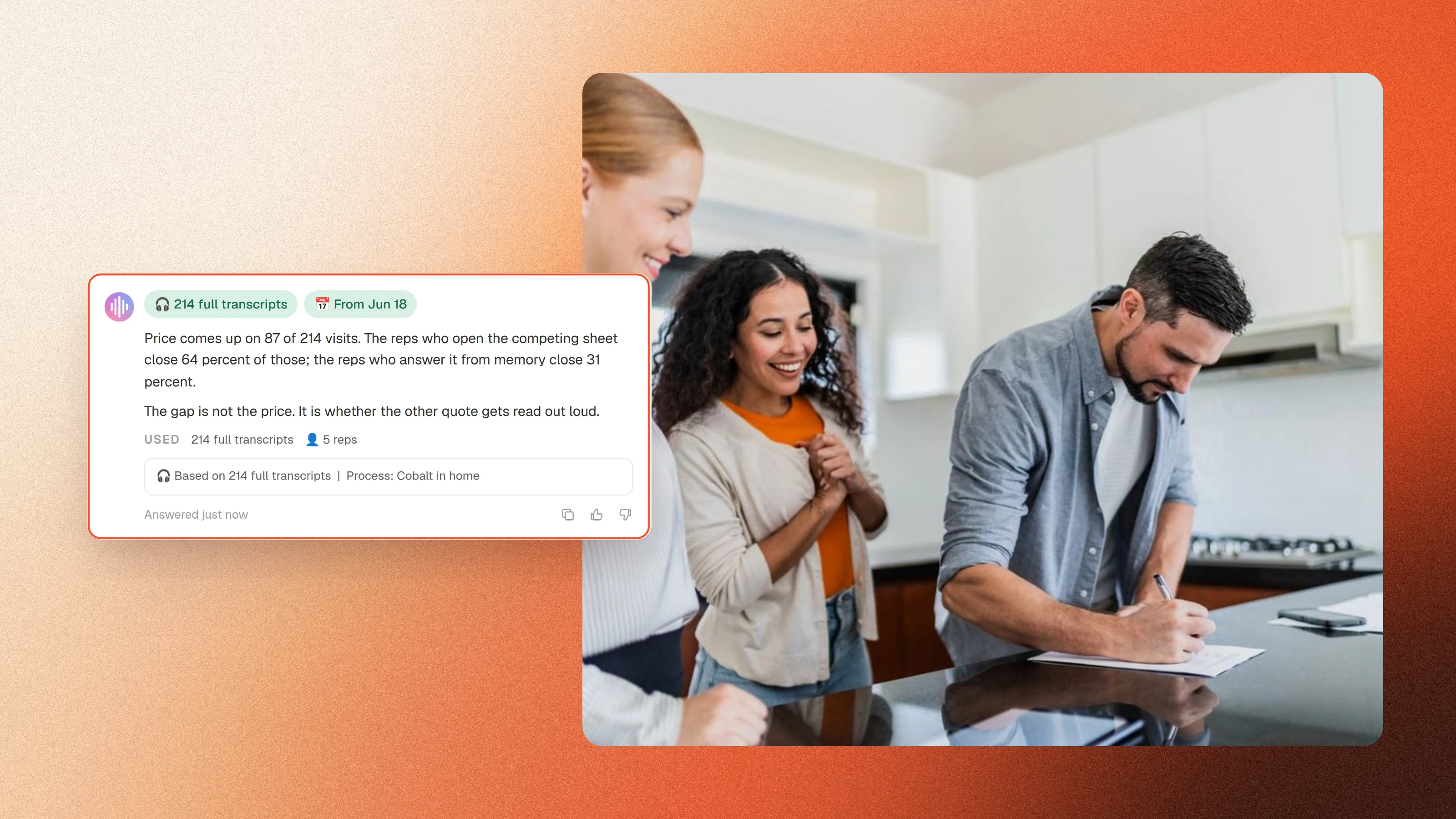
In SalesAsk, roleplays are scored on the same playbook as the rep's real visits. That detail matters more than the voice quality. If practice is graded on one rubric and the real appointment on another, the rep learns to pass the practice.
Why doesn't traditional roleplay stick?
Because nobody does enough of it. A manager who runs roleplay once a week on a Monday morning is doing better than most, and it's still one rep, one scenario, in front of the boss and the rest of the team. Reps perform. They give the answer they think the manager wants. The feedback is "more confident next time."
A script only becomes yours after you've said it out loud enough times that you stop reaching for it. Nobody gets that many reps in a Monday meeting.
The other problem is that the practice is generic. The objection in the training binder is "your price is too high." The objection your roofer actually heard last Tuesday was "my brother-in-law says we should wait for the insurance check," said by a homeowner who'd already decided. Those are different conversations.
Which roleplay scenarios matter most in each trade?
Start with the moments where your recorded visits show reps losing the room. If you don't record visits yet, this table is a reasonable first list. It pulls together scenarios we used to cover in separate trade posts.
| Trade | Scenario to practice first | What the AI homeowner pushes on |
|---|---|---|
| Roofing | The insurance and deductible conversation | "The adjuster hasn't come out yet. Why would we sign anything?" |
| HVAC | Repair or replace on an old system | "Can't you just fix it for this winter?" |
| Remodeling | The design meeting with one spouse missing | "Looks great, I'll show my husband tonight." |
| Windows and doors | Three quotes on the table | "The other company is a lot less for the same windows." |
| Home builders | The payment question at the round table | "That's more than our payment budget." |
| Any trade | Raising financing before the price | "We were planning to pay cash." (Then hesitates.) |
The last row earns its place. In SalesAsk's Kitchen Table Report, appointments where financing came up closed at 49%, against 38% where it didn't, across more than 1.3 million analyzed sales conversations. That's a correlation, and the report says so. It's still the cheapest sentence in in-home sales to practice, because reps skip it out of awkwardness, not ignorance.
What separates a good AI roleplay tool from a bad one?
Four things, in roughly this order.
- It knows your trade. A homeowner simulator that asks about "your SaaS onboarding" is useless to a plumber. The scenario library should cover permits, insurance claims, tear-off, financing, warranties, the dog barking in the back room.
- It scores against your steps. Upload your own process and the AI grades whether the rep did your discovery questions, your options presentation, your close. A generic "objection handling: 7/10" doesn't tell anyone what to change.
- It talks at the speed of a real person. A three-second pause before every reply gives the rep time to think that a homeowner never would.
- It connects to real visits. This is the one most tools are missing. If your coaching software hears that reps keep losing the room when the homeowner mentions a second quote, the next practice assignment should be that scenario, for those reps.
That fourth point is why SalesAsk runs roleplays next to Coach Dean, which reviews every recorded visit. Dean spots the pattern on real appointments, and the rep practices the fix before the next one.
What are the best AI roleplay tools for sales?
It depends on where your reps sell. The best-known roleplay products grew up around phone and video selling: SDRs booking meetings, account executives running discovery calls. If that's your team, those tools are built for you.
If your reps sell at the kitchen table, look for three things on the shortlist: scenarios written for in-home trades, scoring on your own sales steps, and a link between practice and recorded real appointments. Ask every vendor to run your hardest objection live in the demo, in your rep's words. You'll learn more in five minutes of that than from any feature grid.
We obviously think SalesAsk should be on that list for home services, home improvement and builders. You can see the AI roleplay product page for what it covers.
How do you roll it out without it becoming homework?
Managers first. If a sales manager hasn't done a take themselves, they'll assign roleplay the way people assign compliance training, and reps will treat it that way.
Then keep the assignment tiny and specific. One scenario per week, chosen from what went wrong on real visits, five minutes before the first appointment of the day. "Practice the second-quote objection twice before Thursday" gets done. "Use the roleplay tool more" doesn't.
Track two things for the first month: how many takes each rep does, and whether their score on that scenario climbs. After that, look at the real visits. Did the step you practiced start showing up?
Does practicing with AI actually change real appointments?
Honestly, we don't have a clean answer yet, and I'd be suspicious of anyone who says they do.
What we can see is narrower. When a rep practices a specific step and then records their real visits, you can check whether that step starts appearing in the real conversation. That's a much better test than a practice score going up, which mostly proves the rep got good at the simulator. Taylor Morrison's story on our site describes the same loop: reps role-play the tough moments, then use the phrasing that works on the next model home visit. Austin Lanford, a Community Sales Manager there, put the value of the coaching plainly: "It helps break things down and catch things that you might have missed."
Where roleplay clearly falls short: it can't teach a rep to read a room. A simulated homeowner doesn't glance at her husband before answering. The live visit, recorded and reviewed, is still where that gets coached.
FAQ
Is AI sales roleplay worth it for a small team?
For a team of three or four reps, the value is mostly in onboarding. A new rep can run the twenty most common objections fifty times before their first solo appointment, without taking a senior rep off the road.
How long should an AI roleplay session be?
Short. Three to five minutes per take, focused on one moment of the sale. Long end-to-end simulations are useful once a month, not daily.
Can AI roleplay use our own sales script?
In SalesAsk, yes. The scenarios and the scoring follow the process you already teach, the same one your real visits are scored against.
Does AI roleplay replace ride-alongs?
No. It replaces the practice part of training. Coaching on real appointments still needs the real appointment, which is what virtual ridealongs are for.
What's the difference between AI roleplay and AI sales coaching?
Roleplay is practice before the visit. AI sales coaching reviews the visit that already happened and tells the rep what to change. The two work best when the coaching decides what gets practiced.