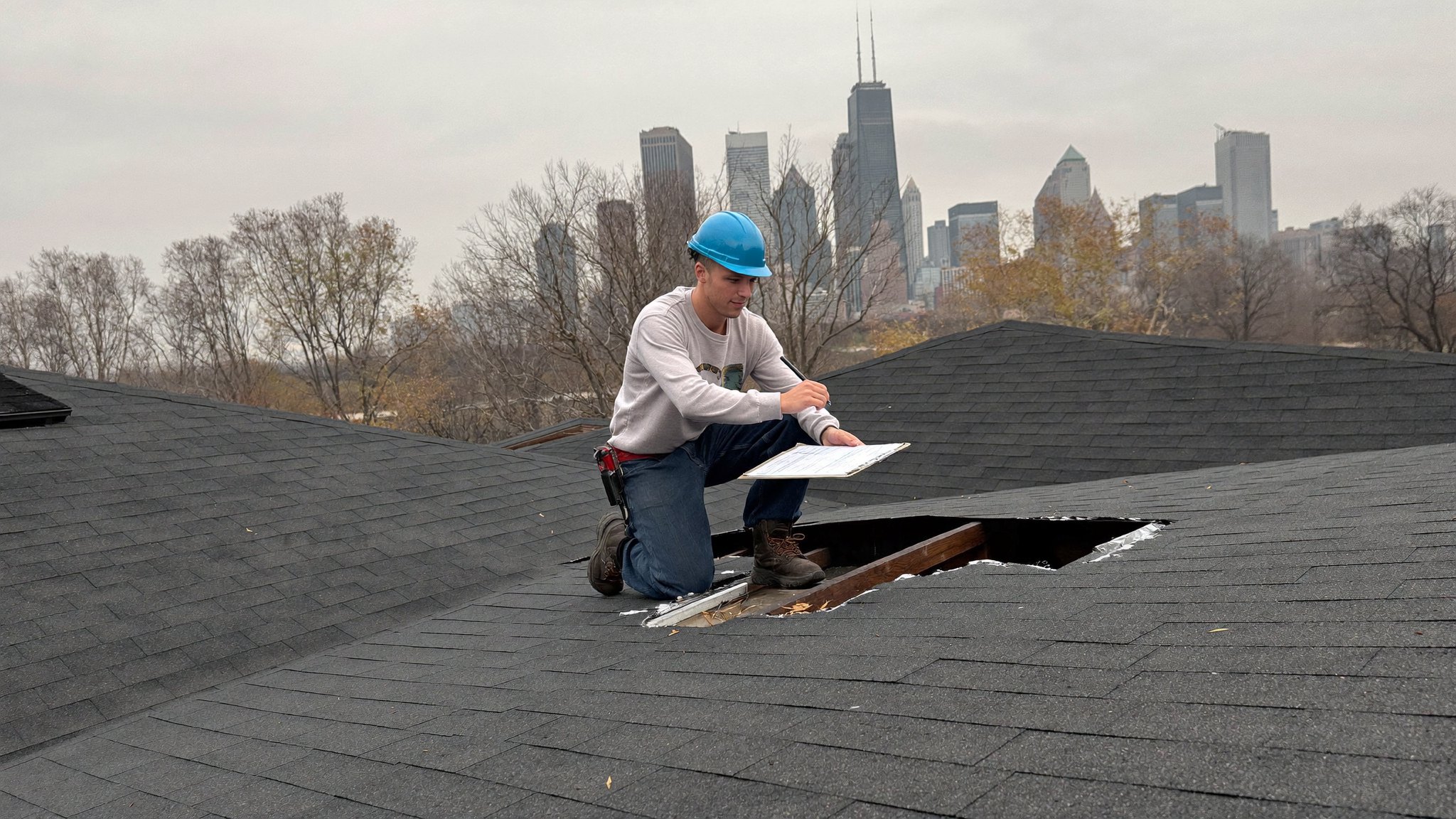
Chicago does not make roofing sales easy. You’re not selling to retirees in sunbelt markets who watched a storm roll through and genuinely don’t know the state of their roof. Chicago homeowners are sharp. They’ve dealt with contractors before. They’ve googled your company before you rang the bell. And if it’s storm season, which it is, from April through September, with hail events that can dump golf ball-sized ice across an entire zip code in 45 minutes. They’re already being knocked on by four of your competitors.
That’s the environment. Not hostile exactly, but compressed. High noise, high competition, and a very short decision window before the insurance check clears, the storm chaser from Indiana shows up, and your prospect chooses someone else.
The roofing contractors winning in Chicago right now aren’t the ones with the slickest pitch. They’re the ones whose reps understand the specific psychology of the post-storm homeowner in a midwestern city, and know how to handle it without flinching.
The Storm Window Is Real (and It Closes Fast)
Chicago sits in the northern edge of the U.S. hail belt. Most of its major roofing events happen in a concentrated band from late spring through early fall, driven by collisions between warm Gulf moisture and cold fronts pushing down from Canada. When a major hail event hits, say, the kind that drops quarter to golf-ball-size stones across the northwest suburbs, you have roughly 72 hours before the market gets saturated.
This creates a specific selling pressure that most generic sales training doesn’t account for: you can’t afford a long follow-up cycle, but you also can’t afford to rush a homeowner into a bad experience.
The best Chicago roofing reps develop what I’d call a compressed trust framework. They build rapport faster, they qualify faster, and they know exactly when to ask for the close and when to slow down. They understand that the homeowner who’s been knocked on by eight contractors in two days is exhausted and skeptical, not a great candidate for a high-pressure close, but a very good candidate for the rep who comes across as a calm, expert guide.
The Insurance Conversation Is Its Own Sales Skill
Somewhere around 60-70% of Chicago roofing jobs are insurance claims. That number spikes toward 90% immediately following major events. Which means that for most of your reps, most of their selling isn’t about price at all. It’s about handling the insurance process.
And this is where a lot of contractors leave money on the table.
Their reps are good at selling. They know how to present, how to handle objections, how to ask for the business. But the moment the homeowner says “I need to file with my insurance company first,” the rep goes quiet. They schedule a follow-up call. They wait. The storm chaser from out of state, who actually walks the homeowner through the insurance claim process in real time and positions themselves as a partner, gets the job.
Teaching your reps to be insurance-fluent is not optional in Chicago. It means they can:
- Explain what the adjuster is looking for and why it matters
- Help the homeowner document damage before the adjuster visit
- Be present during the inspection and advocate appropriately
- Explain the difference between ACV and RCV payouts, and what it means for the homeowner’s out-of-pocket cost
None of this is legal advice. All of it is education. And reps who can deliver it confidently position themselves as professionals, not just vendors.
North Side, South Side, Suburbs: The Market Isn’t Uniform
One thing that trips up contractors who expand into Chicago from other markets: the city doesn’t behave like a single market.
The north side of Chicago, Lincoln Park, Logan Square, Wicker Park, tends to skew younger, more research-oriented, more likely to read your Google reviews before you finish your inspection. These homeowners often want to understand the process in detail before they commit. Rushing them costs you the job.
The south suburbs, Orland Park, Tinley Park, Frankfort, are often older homeowners with more equity and more trust in contractors they’ve worked with before. They’re loyal, but that loyalty goes both ways: if you’ve earned it, you’ll get every job. If you burn them once, you’re done.
The far northwest suburbs, Schaumburg, Palatine, Hoffman Estates, are high-volume storm areas with a mix of demographics. A lot of newer construction (30-40 year old roofs now hitting the end of their life cycle), a lot of homeowners dealing with their first major insurance claim. High potential, but also high competition from storm chasers.
Your reps need to adjust, not just to individuals, but to these neighborhood-level dynamics. That’s hard to coach in a classroom. It develops through repetition, feedback, and being able to hear what’s actually happening in their conversations.
What Chicago Reps Get Wrong Most Often
We’ve talked with roofing contractors who use AI sales coaching across the region, and the patterns are consistent. The mistakes Chicago reps make aren’t unique, but they’re reliably predictable.
They over-explain the damage. Reps get into the weeds on technical specs, granule loss, bruising, hip and ridge deterioration, before they’ve established any emotional connection. The homeowner hears noise. The rep loses the room.
They treat the insurance process as someone else’s problem. “Call your insurance company and let me know” is a close-rate killer. It hands the relationship to an adjuster who has no stake in your outcome.
They don’t follow up with enough specificity. A follow-up call that says “just checking in” is not a follow-up. A follow-up that says “I saw the adjuster is scheduled for Tuesday. Here’s what I’d recommend you point out during the inspection” is a follow-up. The difference in close rate between these two approaches is not small.
They go quiet between the estimate and the decision. The gap between appointment and signed contract is where most Chicago roofing jobs are lost. Reps assume silence means the homeowner is thinking. Often, the homeowner just got called by someone else.
This is covered in depth in roofing sales training, step by step.
What Real Coaching Looks Like in This Market
The traditional solution to these problems is ride-alongs. Send a senior rep with the junior one for a few months. But ride-alongs don’t scale. You can’t ride along with everyone. And feedback that comes hours after a conversation, or the next morning, has already lost most of its value.
What’s changing the game for roofing contractors in Chicago is AI sales coaching that analyzes what’s actually happening in the conversation, in real time, and surfaces specific feedback that can be acted on immediately and reinforced across the team.
The goal isn’t to automate the human judgment out of roofing sales. It’s to make the feedback loop faster. A rep who finds out they’re losing control of the conversation at the insurance discussion doesn’t need a week to correct it, they need to know what happened, why it happened, and what to do differently at the next appointment.
That’s what’s working. Connell Roofing saw it firsthandhow they scaled coaching without adding ride-along hours is exactly the kind of model that translates to high-velocity, storm-season selling in a market like Chicago.
Building a Chicago Roofing Sales Team That Doesn’t Collapse Under Pressure
Storm season in Chicago is a sprint. Contractors who build a team capable of absorbing that sprint, running high volume, maintaining close rates, managing the insurance process professionally, win the season. Contractors who are constantly hiring and training mid-sprint fall apart.
The reps who survive and thrive in Chicago roofing sales have a few things in common: they’re disciplined about process even when the market is chaotic, they’re comfortable with the insurance conversation, and they’re in continuous contact with their customers between appointment and signed contract.
Those qualities don’t happen on their own. They get built through deliberate training, real feedback, and the willingness to look honestly at what’s going wrong in conversations before the pattern hardens into a habit.
If your team is heading into storm season, now is the time to build that foundation, not after you’ve already missed your close rate targets.
Related Topics: Chicago roofing sales training, storm season roofing sales, hail damage sales coaching, insurance claim roofing sales, Illinois roofing contractor training, AI roofing sales coaching, Midwest home services sales training

Related articles

Ready to convert
every conversation?
See exactly what’s holding your team back and fix it fast.
.avif)