Homeowners Are Asking ChatGPT About Your Quote

On this page
Your quote now gets a third opinion that has never seen the house. A homeowner can photograph a paper quote, paste it into ChatGPT and ask whether the price is fair, and 34% of U.S. adults have used ChatGPT, according to Pew Research Center. The fix is in the proposal: write it so the questions an AI raises are already answered on the page.
Key takeaways
- 34% of U.S. adults had used ChatGPT by mid-2025, about double the 2023 share (Pew Research Center).
- 59% of 1,224 U.S. consumers used generative AI for shopping, and one in four said ChatGPT's product recommendations beat Google's (Omnisend, July 2025).
- Nobody has published a survey on homeowners checking contractor quotes with AI. The numbers above are the nearest evidence.
- Appointments where financing was mentioned closed at 49%, against 38% where it wasn't, in the SalesAsk Kitchen Table Report. A flat quote carries none of that conversation.
- The proposal that holds up names the materials, explains the price difference, shows the monthly payment and includes photos of this house.
What happens to your quote after your rep leaves?
It gets audited, and the auditor can now be an AI with a confident opinion about your price. The older version of this is familiar. The spouse who missed the appointment reads the quote cold. The brother-in-law who "knows construction" weighs in over Sunday dinner. Two more bids arrive and all three get spread across the kitchen table.
The new version adds a step. The homeowner opens your PDF, drops it into ChatGPT and types something like: "Is this a fair price for an architectural shingle roof in Columbus? What's missing from this quote? What should I ask the contractor?" Back comes a tidy page of analysis, in the tone of a building inspector who has never owned a ladder.
How many homeowners use AI this way?
Nobody has measured it for contractor quotes, so the fair answer is: enough to plan for. Here is what has been measured.
| What was measured | Number | Source |
|---|---|---|
| U.S. adults who have used ChatGPT | 34%, about double 2023 | Pew Research Center, June 2025 |
| U.S. consumers using generative AI for shopping | 59% | Omnisend survey run by Cint, July 2025, 1,224 people |
| Using it for product research | 57% | Same survey |
| Say ChatGPT's product recommendations beat Google's | 1 in 4 | Same survey |
Those are shopping figures in general. A roof is the largest purchase many of these households will research this year, and I'd assume the people who research a blender with AI do the same with a five-figure roof.
What does ChatGPT tell homeowners about a contractor quote?
It gives a price range, a list of things your quote appears to be missing, and a set of questions that arrive in your rep's texts at nine at night. Run the exercise with one of your own quotes and you'll see the pattern.
- A cost range. It is built from broad averages, wide enough to park a dump trailer in. Wherever your number lands against it, you are now being measured against a benchmark nobody at your company has seen.
- An audit. One line for labor and materials gets flagged. An unnamed shingle, membrane or furnace model becomes a question mark. No timeline, no payment schedule and no warranty wording each become a bullet under "things to clarify before signing."
- A script. Ask it what to say to negotiate the price down and it drafts the message, polite and specific.
Is the analysis right? Often it isn't. It can't see the two layers of old shingle under the ridge. It doesn't know your county's permit costs, or that the cheaper shingle it suggested isn't rated for your wind zone. None of that helps you, because the homeowner can't tell a sharp audit from a confident guess. Doubt stalls a signature either way.
Why does a paper quote lose this audit?
Because a static document can't answer a follow-up question, and the thing answering in its place has never seen the house. Everything that sold the job was said out loud: the walk around the property, the moisture reading, the reason the cheap option fights the warranty, the financing math on the back of the folder.
The data says that conversation matters. Across all trades in the SalesAsk Kitchen Table Report, appointments where financing was mentioned closed at 49%, against 38% where it wasn't. That is a correlation, and it happens in the room.
Then the rep leaves, and almost none of it survives in the document. The quote that stays behind is names, numbers and a signature line. When the homeowner feeds that to an AI, the AI fills the gaps with generic context, because that is all it has. Your house gets compared with the average house. The quote loses because the price arrived without its reasoning.
Should you publish your prices so the AI gets them right?
Partly. Put your ranges and the reasons behind them where machines can read them, and keep exact numbers for the conversation where you can explain them.
The push toward open pricing is real. Pro Remodeler reported in August 2026 that Google had added an experimental "online estimates" button to near-me contractor searches. In the same article Marcus Sheridan put it bluntly: "Call for quote has become the middle finger of the internet." He says ads built around an interactive estimator convert 40 to 50% of clicks, against about 5% or less for generic ads. Those are his reported numbers, with no independent data behind them in the article.
I agree with the direction and I'd still draw a line. An honest range with the drivers explained ("a steep pitch adds cost, and here's why") gives the AI good data and earns the visit. An exact price for complex work is a different bet. I wouldn't take it for a kitchen remodel or a custom build, where the AI will hold your website's number against a quote written for a different house.
How do you write a proposal that survives an AI audit?
Assume every line will be cross-examined, and write the proposal so the questions are already answered.
- Name things. The brand of shingle, the model of heat pump, the thickness of the liner. Each named spec is a question the AI can't raise.
- Explain the difference in writing. One short paragraph: "You may see lower numbers online. Here is what those numbers leave out for a house like yours." Your rep says this at the table. The document should say it at midnight.
- Put the monthly payment in writing. It is the context a flat quote never carries into the AI conversation.
- Attach the evidence. Photos of the rotted decking, the cracked heat exchanger, the moisture readings. The AI reasons from averages. Your proposal should reason from this house.
- Send a page the homeowner returns to. A paper quote can't tell you it is being read, reopened or shared.
That last point is why we built HomePlan in SalesAsk. Each appointment becomes a plan page for the household, drafted from what was said at the table. The rep adds photos and approves it, and SalesAsk shows when the homeowner opens it and who they share it with.
How do you coach reps for the questions the AI sends back?
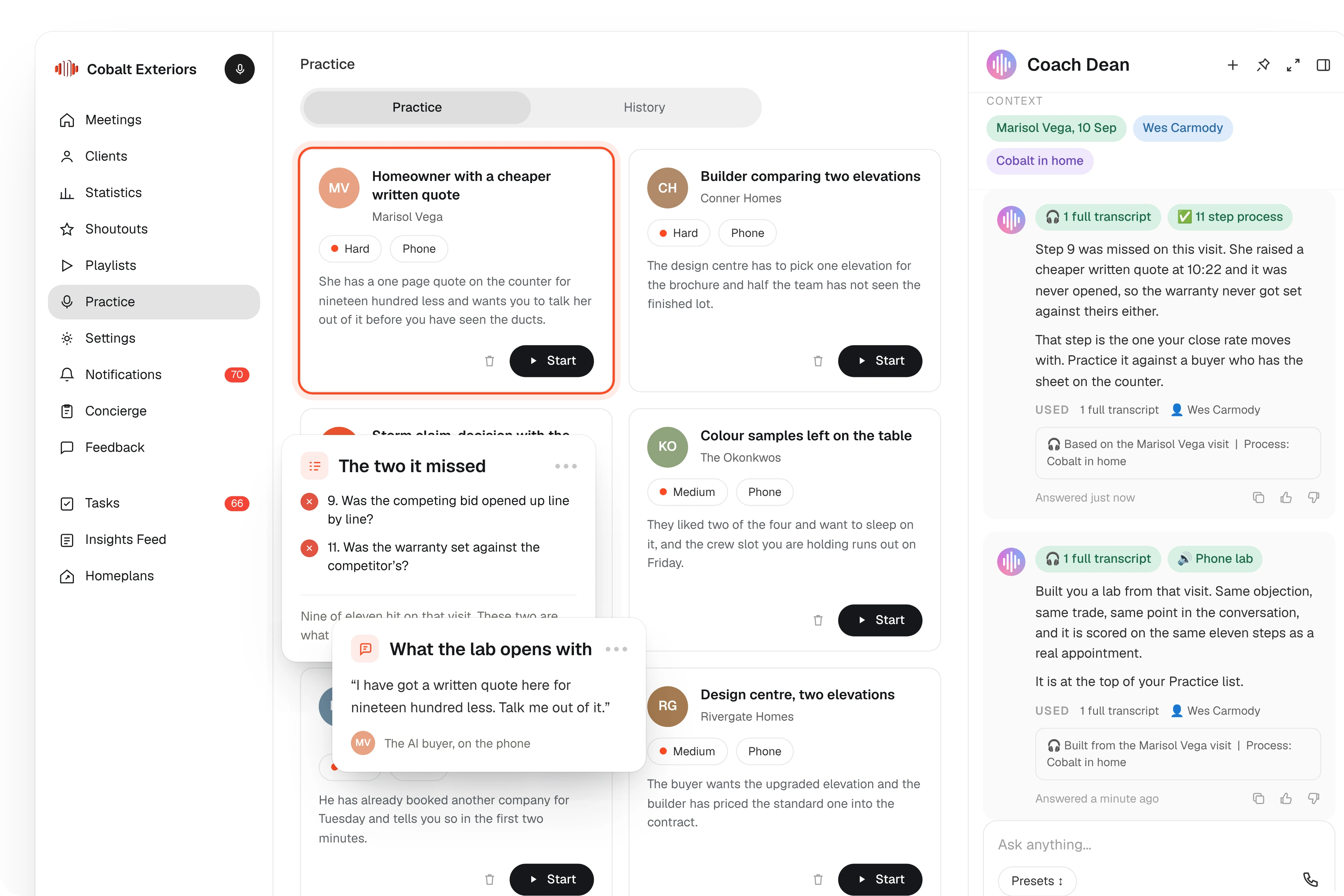
Use SalesAsk to rehearse them before the visit and hear them after it. The questions are predictable: what's missing, why is this higher, can you do it for less.
- Before the visit. The rep practices "ChatGPT says this should cost less" in an AI roleplay.
- During the visit. The rep records the appointment and can turn on live coaching.
- After the visit. The rep gets written feedback, and a manager can hear whether the materials were named and the financing was explained.
To hear how your reps explain a price today, book a SalesAsk demo.
What can't anyone tell you yet?
How often an AI verdict kills a deal. The symptom is common: a strong appointment, an engaged homeowner, then a silence the rep can't explain. A clean line from "ChatGPT said the price was high" to a lost job doesn't exist in our data or in anyone's published research.
So do the cheap test. Take the last quote you lost, paste it into ChatGPT and ask the three questions your homeowner asked: is this fair, what is missing, what should I push back on. Read the answer with your sales manager, and fix the quote template before the 2027 season.
Frequently asked questions
Do homeowners really paste contractor quotes into ChatGPT?
No survey has measured it for home improvement. What has been measured is that 34% of U.S. adults have used ChatGPT (Pew, 2025) and 59% of consumers in an Omnisend survey used generative AI for shopping. On a purchase this large, plan for it.
Can ChatGPT tell whether a quote is fair?
Only loosely. It works from broad cost averages and can't account for site conditions, local code or material grades. Its effect on the sale is doubt, and doubt is enough to stall a signature.
Should you lower the price when a homeowner says AI called it high?
No. Ask what the AI compared it against, then walk through the difference line by line: scope, materials, warranty and labor. A discount confirms the suspicion. An explanation answers it.
What is HomePlan?
HomePlan is the part of SalesAsk that turns an appointment into a plan page for the household. It carries the options, the photos and the payment path, and it shows the contractor when the page is opened and shared.
Sources
- Pew Research Center, "34% of U.S. adults have used ChatGPT, about double the share in 2023," June 2025
- Omnisend, "Nearly 60% of Americans use Gen AI tools for online shopping," August 2025
- Pro Remodeler, "How AI is Forcing Home Improvement to Get Honest About Pricing," August 2026
- SalesAsk Kitchen Table Report 2026: benchmarks (financing figures)
Dara Shabnam
Leads growth at SalesAsk and writes about in-home sales training and recording consent.
More posts byWritten by the SalesAsk team
SalesAsk records and coaches in-home sales conversations for home service, home improvement and home builder teams.
More posts