How Long Should a Contractor Quote Be Valid?
On this page
For home services work, 30 days is the default I'd defend for a contractor quote, with the reason for the date printed next to it. Shorten it only when your costs move faster than that. The date matters because it is the one thing on the quote still working after the rep drives away, and federal law already gives a homeowner three business days to cancel many sales made in the home.
Key takeaways
- Set the window from two things: how long your costs hold, and how long that kind of job takes a household to decide.
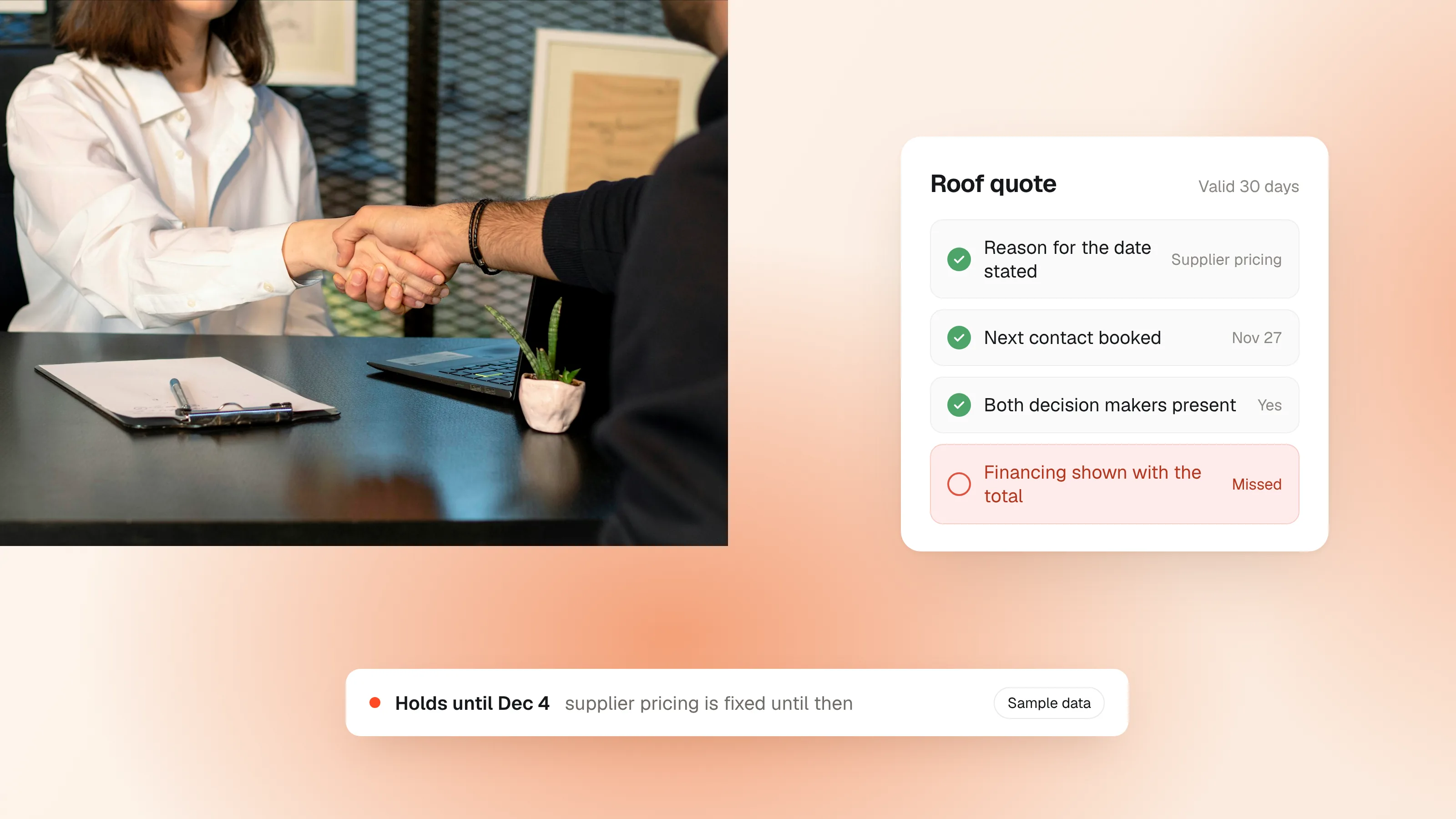
- State the reason for the date. "Good for 30 days because that's how long my supplier holds equipment pricing" earns trust. A bare date reads as a tactic.
- The FTC's Cooling-Off Rule gives buyers until midnight of the third business day to cancel many sales made at their home, so a "tonight only" price locks in very little.
- Under UCC 2-205, a merchant's signed firm offer for goods can be irrevocable for up to three months. Write the validity line as if you'll be held to it.
- Book the next contact before you leave, tied to the date. An expiration date printed on a PDF is not a next step.
How long should a contractor quote be valid?
Thirty days for replacement and remodel work, and shorter only when your costs move faster. That "pricing valid for 30 days" line sits at the bottom of a great many quotes, and when I ask owners why 30, the usual answer is that it was on the template.
Build the window from two things. The first is how long your input costs stay stable. The second is how long the buyer takes to decide. A water heater is decided in days because the house has no hot water. A kitchen remodel is decided over weeks, with a spouse, a folder of ideas and one brother-in-law with opinions. If your window is shorter than the real decision time for that job, you haven't created urgency. You've scheduled an awkward conversation.
Costs are the fair constraint. An equipment-heavy trade living through distributor price increases has a real reason to cap a quote at two or three weeks. A painting contractor whose main input is labor doesn't. Set the window at the longest period you'd keep the price without wincing, then say the reason out loud in the home.
Do expiration dates create urgency?
Only when the reason behind the date is real, and homeowners can tell the difference. Nobody has clean data on what a printed expiration date does to close rate, and that includes us. Too much else varies between the quote that closes and the quote that dies.
What I see in recorded visits is that the quotes that go quiet tend to be the ones that ended without a next step: no scheduled follow-up, no second visit, no decision date the homeowner named. That's my observation, and I don't have a figure for it. A date printed at the bottom of a PDF doesn't fill that gap, because the homeowner never agreed to it.
One kind of urgency works because it's true: a dated cost event. "The manufacturer's increase lands January 1, and I can hold this number until then" is information the homeowner is glad to have. If you're coaching reps on the price objection, teach the difference between a deadline you can explain and one you have to defend.
Should you ever offer a "tonight only" price?
No, and I'd retire it. Apart from what it does to trust, it runs into federal law. The FTC's Cooling-Off Rule gives buyers until midnight of the third business day to cancel many sales made at their home, and the seller has to tell them so at the time of sale and hand over cancellation forms.
The rule has exceptions that matter in the trades. It doesn't cover sales needed to meet an emergency, or work that results from the homeowner asking you out for a repair or maintenance visit, though items sold beyond that request are covered. States add their own rules. So check how it applies to your sales with a local attorney.
Where it does apply, the same-night discount locks in nothing. The homeowner can sign under pressure at 8 p.m. and cancel on Monday. If the price is real tonight, it should be real on Thursday.
Is a quote still binding after the date passes?
Generally no. An expired quote is an invitation to requote, and it doesn't oblige you to keep the old price. The details are state law, and I'm not a lawyer.
A quote is an offer, and an offer can lapse before it's accepted. The carve-out worth knowing is in the Uniform Commercial Code. Under section 2-205, a merchant's signed written offer to sell goods that says it will be held open can't be revoked during the time stated, up to three months. Residential contracting is usually a mix of goods and services, so where your quote falls is a question for a local attorney.
The practical point is simpler. Write the validity line as if you'll be held to it, because sometimes you will be. And the date is yours to extend. An extension is something you can give the homeowner at the moment they're deciding whether you're easy to work with.
What should happen during the validity window?
Selling. The window is the selling period, and it is often left empty. The appointment goes well, the rep leaves a quote valid for 30 days, and then there's one "just checking in" voicemail on day six. The homeowner collects two more bids, and the decision gets made in a conversation your rep never hears. Our guide to the three-bid window covers what to do while that's happening.
Use the date to set up the next contact before you leave the house: "You have this until the 4th. Want me to phone on the 27th so you have answers before it matters?" Now the deadline belongs to both of you.
None of this rescues a weak appointment. If the spouse wasn't home, no expiration date fixes that. Our guide to one-leg appointments covers what does.
Short window, long window, or no date at all?
Match the window to the job's real decision time and put a reason next to the date. This is where I'd start.
| Approach | What it tells the homeowner | Where it helps | Where it hurts |
|---|---|---|---|
| No expiration date | Low pressure, and no cost to waiting | Repair and service work decided in days | Replacement and remodel quotes that drift for months, then return after your costs moved |
| 30 to 45 days, reason stated | A professional with real costs | Replacement and remodel sales | Storm or emergency markets where costs reprice weekly |
| 7 to 14 days | Costs are volatile, or pressure dressed up as policy | Equipment quotes during announced price increases, and insurance work tied to an adjuster's timeline | Considered purchases, where the homeowner keeps a competitor's longer quote |
| Tonight only | Pressure | Nowhere I've seen | Trust, reviews, referrals and the deal |
What do you say when a homeowner comes back after the date?
Requote at current costs without apology, and keep the old number only when the gap is small enough to buy goodwill cheaply. The homeowner who phones on day 50 is buying.
Treat the expired quote as the start of a short conversation: "That pricing lapsed on the 4th. Let me reprice it today. I expect a good part of it to hold." If the difference is real, show which line moved and why. A new number with no explanation makes the first number look made up.
If quotes keep coming back expired, look at follow-up before you look at pricing. That is a habit you can coach.
How do you coach reps to use the date well?
Coach it in SalesAsk, where you can hear whether the reason for the date was said and whether a next step was booked. The coaching runs before, during and after the visit.
- Before. The rep practices stating the window and its reason in an AI roleplay.
- During. The rep records the appointment and can turn on live coaching.
- After. Written feedback shows whether the visit ended with a booked next contact, scored against your own sales steps.
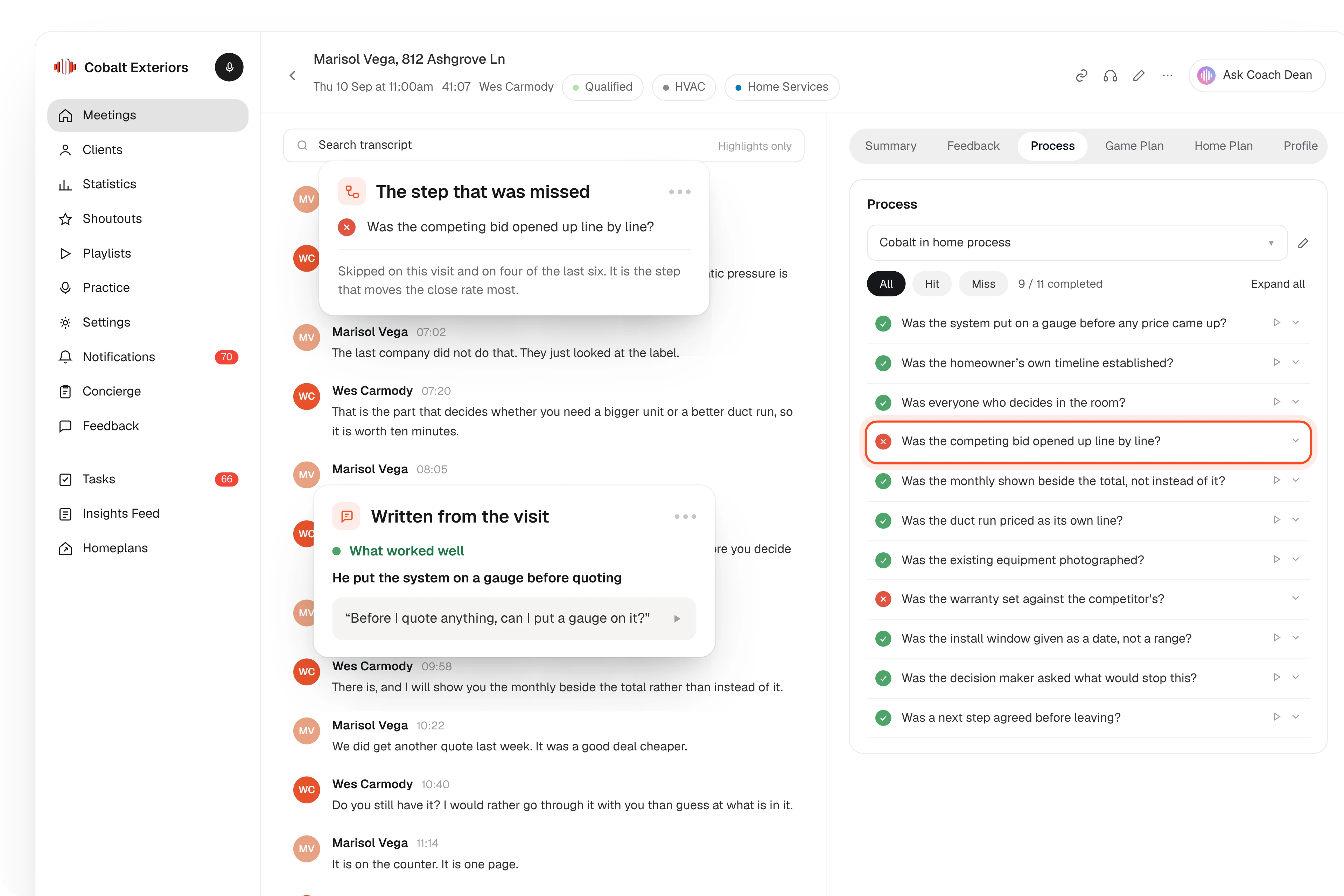
The date can also live somewhere the homeowner sees it again. HomePlan in SalesAsk turns the appointment into a plan page for the household, and shows you when they open it. To hear how your reps close out a visit today, book a SalesAsk demo.
Where does this advice fall short?
It's judgment on the selling side and general information on the legal side. I have no measured effect of validity windows on close rate, and the rules on cancellation and firm offers vary by state and by what you sell. Ask a local attorney before you change your paperwork.
For 2027, pick a window you can explain out loud, print the reason next to the date, and book the next contact before you leave the house.
Frequently asked questions
Should every quote carry an expiration date?
Replacement and remodel quotes should, with the reason stated. Small repair quotes decided on the spot don't need one, and putting dates on everything teaches your office to ignore them.
How do you extend a quote without making the date look fake?
Extend it before they ask, and tie it to their situation: "You mentioned the decision slips to December, so I'll hold pricing until the 15th." An extension you offer reads as flexibility. A date you never enforce reads as fiction.
Does this change for insurance and storm work?
Yes. Your window often follows the adjuster's timeline, and material costs after a major weather event can reprice in days. A shorter window is fair there, as long as you say why.
Is it legal to raise the price after a quote expires?
Once a quote has lapsed and nothing was signed, you are generally free to reprice. That is subject to state consumer protection law and to anything your own paperwork promised, so check with a local attorney.
Sources
Dara Shabnam
Leads growth at SalesAsk and writes about in-home sales training and recording consent.
More posts byWritten by the SalesAsk team
SalesAsk records and coaches in-home sales conversations for home service, home improvement and home builder teams.
More posts