How to Reopen Old Estimates Without Sounding Desperate
On this page
Reopen an old estimate with something specific the homeowner said at the appointment and one new fact, and never with "just checking in." The quote that went quiet is the cheapest revenue you'll touch this quarter, because the hard part already happened: a two-hour visit, a measured house and a priced proposal. Financing is the first new fact I'd reach for. Appointments where it was mentioned closed at 49%, against 38% where it wasn't, in the SalesAsk Kitchen Table Report.
Key takeaways
- Open the reopening call with the homeowner's own stall reason and one new fact: a date, a financing path or a change of scope.
- Appointments where financing was mentioned closed at 49%, against 38% where it wasn't (SalesAsk Kitchen Table Report). If the rep never raised it, that is the reason to phone.
- Speed research is about strangers. Harvard Business Review found firms that tried to contact a web lead within an hour were nearly seven times as likely to qualify it as those that waited an hour longer.
- Sort the pile by stall reason and deadline, with dollar size as the tiebreaker.
- The approach depends on a record of what was said in the home. It doesn't work on appointments nobody captured.
Why do good estimates go quiet?
The homeowner's calendar got in the way, and nobody made a decision. A family that booked three estimates in June was planning around kids at home, a vacation and a spouse who wanted one more bid. The project felt urgent and then the month got away from them. By the time they regrouped, phoning the contractor from eight weeks ago felt awkward, so they didn't.
I can't tell you what share of quiet quotes are stalled and what share are lost. Some of those homeowners hired someone else and some never had the money. The stalled ones are worth the work, because their reason to wait usually has an end date: the kitchen before Thanksgiving, the roof before the first freeze, the furnace before it fails on a holiday weekend.
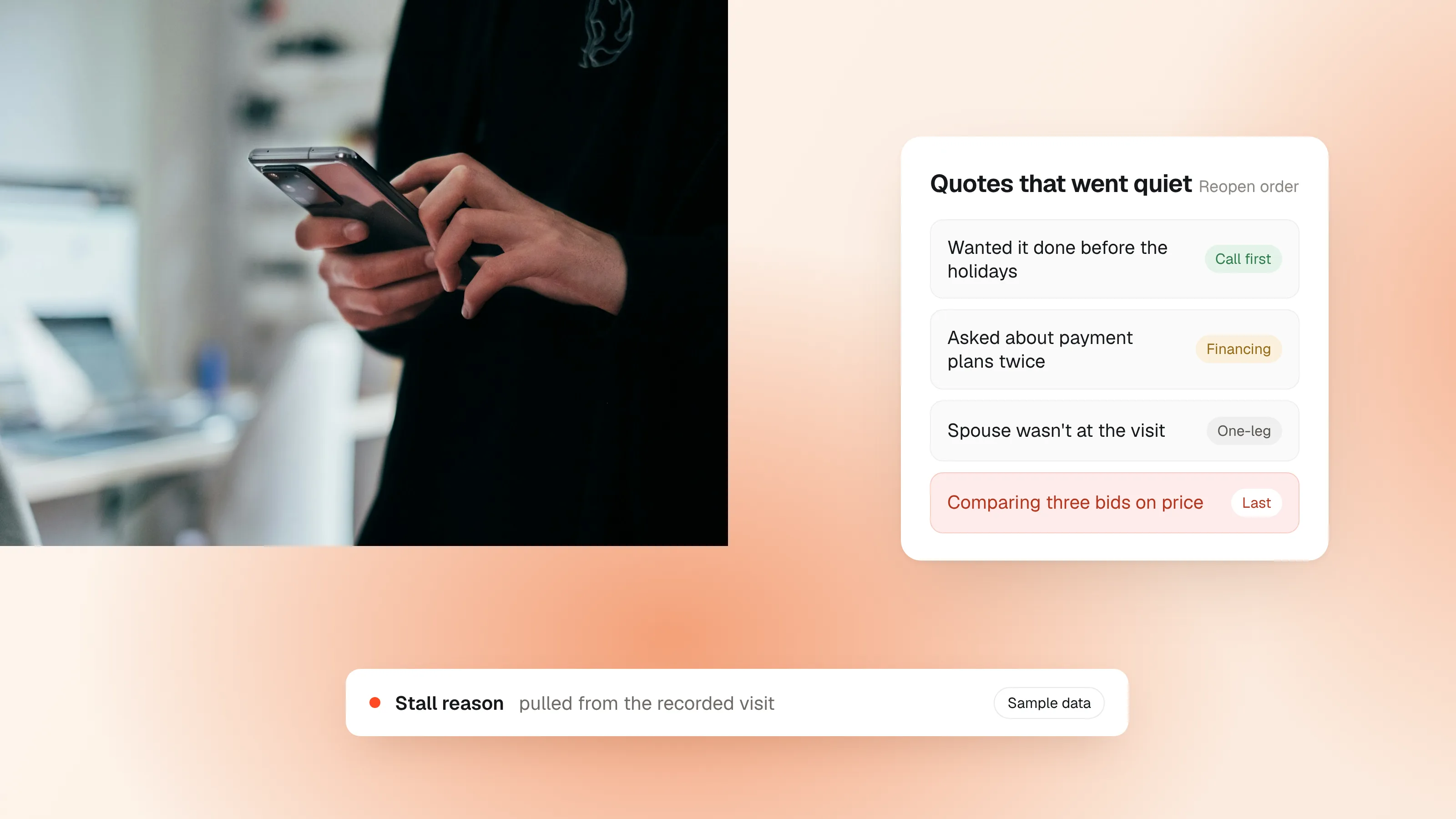
There's a second reason these deals die, and it sits on your side of the table. Reps avoid reopening old quotes because they don't remember the appointment. They remember the address and the price. They don't remember that the wife asked about payment plans twice, or that the decision was waiting on a father-in-law who "knows construction." So the conversation defaults to "just checking in."
Is a 90-day-old quote a dead lead or a warm one?
It's warmer than any lead you can buy, because discovery is done, trust is half built, and the only thing missing is a reason to talk again.
The lead business has taught contractors to prize speed, and for new leads that's right. The Harvard Business Review study of online sales leads found that firms trying to reach a lead within an hour were nearly seven times as likely to qualify it as those that tried an hour later, and more than sixty times as likely as those that waited a day or longer.
That research measures how fast a stranger's attention fades. A homeowner who spent two hours walking your rep through the house isn't a stranger. The project still exists, and the cracked heat exchanger didn't fix itself. What faded is momentum, and one good phone conversation can rebuild it.
Some quotes in the pile are gone. In my experience the ones least likely to reopen are the homeowners who said "we're getting this done this month" and then went quiet. They got it done with someone else. Write those off quickly.
What should you say when you reopen an old estimate?
Lead with something specific from the original appointment and add one piece of new information. "Just checking in" tells the homeowner you have nothing new and that you need the job more than they need the project.
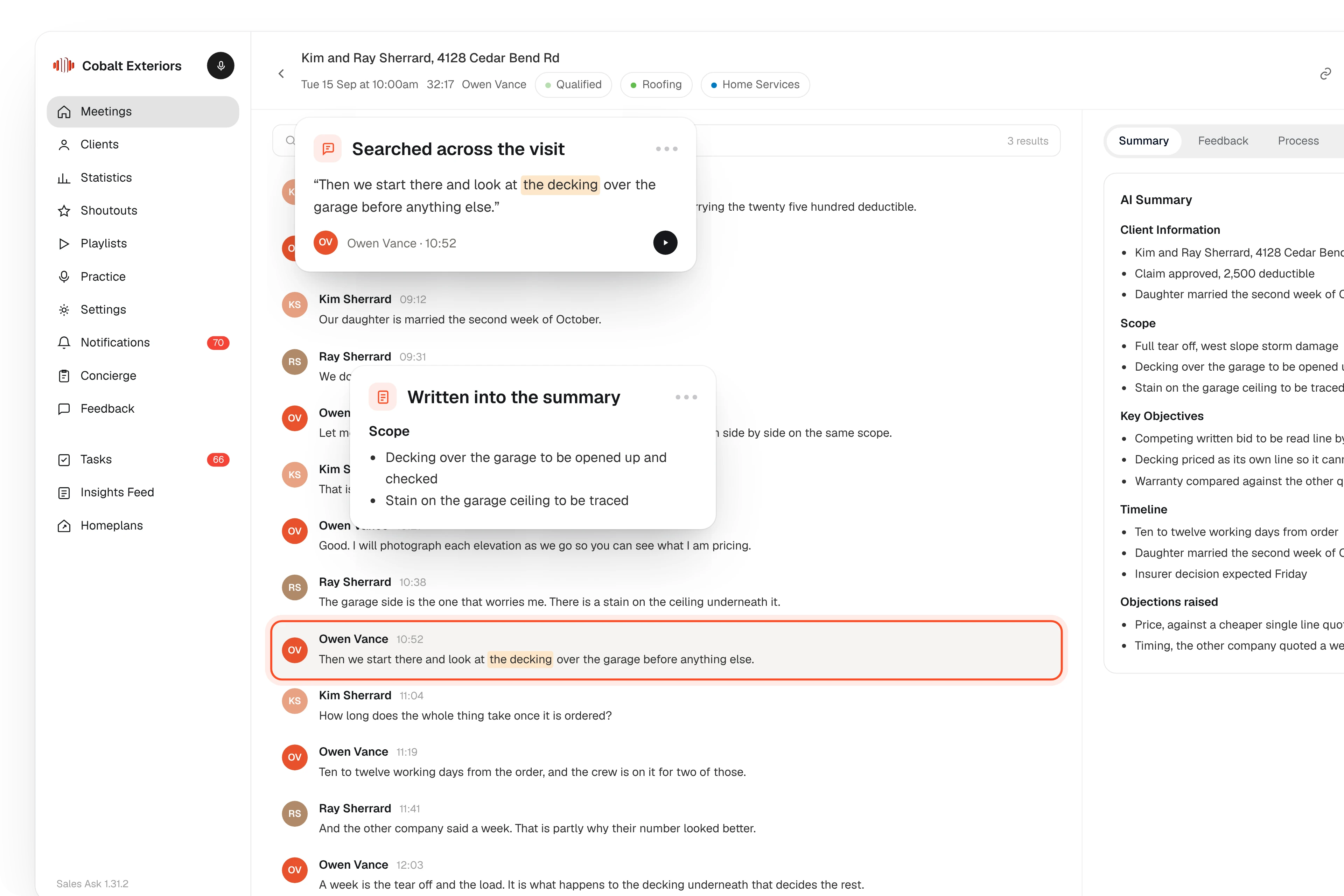
The alternative depends on knowing what happened at the appointment. If your reps record their visits in SalesAsk, the stall reason is usually in the transcript, because somebody says it out loud. "We need to see what the insurance says." "My husband thinks we should wait." "Can we do this in phases?"
- A comfort advisor: "When I was out in July you mentioned wanting one more season out of the unit. The installation calendar is filling, and I can still hold a slot for you."
- A roofer: "You were waiting on the adjuster when we last spoke. Did that come through? If the claim came back short, I have two ways to close the gap that we didn't discuss."
- A kitchen and bath designer: "You asked whether the island could be phase two. I priced that split this week. It moves about a third of the cost into next spring."
The new information in each is a deadline, a financing path or a change of scope. Financing comes first for me, because it's the topic reps skip. If the transcript shows your rep never raised it, you have your reason to phone.
The rep who ran the appointment should make the contact, prepared with the recording. The homeowner remembers a person.
How do you pick which quotes to reopen first?
Sort by stall reason and deadline, because the biggest quote in the pile is often the deadest one. This is the order I'd use:
- Quotes with a stated deadline: anything the homeowner tied to a holiday, the weather or a family event.
- Quotes stalled on financing.
- One-leg appointments, where the absent spouse still hasn't heard your presentation.
- Price shoppers.
There are two ways to run the reopening, and I've watched teams do both.
| The blitz | Reopening from the conversation | |
|---|---|---|
| What the rep brings | The price and a discount | The stall reason and one new fact |
| Who works it | Whoever has time, often the office | The rep who sat at the table, prepared with the recording |
| Time per attempt | Minutes. The whole list goes in two days | Real preparation per quote, so you sort first |
| Effect on margin | Teaches homeowners that silence earns a discount | Protects the price. Urgency comes from the homeowner's own deadline |
| What it needs | A phone | A record of what was said in the home |
| Weakness | Reads as desperate to your best prospects | Doesn't work on visits nobody recorded |
The blitz does produce revenue. Enough volume finds the homeowners who were about to phone you anyway. It gets there by discounting, and it tells your market that your first price was soft.
What happens after the conversation?
Send a refreshed proposal the same day, in a form that shows you whether it gets opened. The conversation rarely closes on the phone. Its job is to restart the decision, which means the homeowner is about to compare you again with whatever bids are still in a drawer.
A photographed paper quote from July doesn't help them pick you back up. That's the job of HomePlan in SalesAsk: the homeowner gets a plan page they can open at 9 p.m., and SalesAsk shows you when they open it and who they share it with.
Two rules for the refresh. If your original price still holds, say so and put a real date on how long it holds. If material costs moved, show it in the open: "Lumber moved since June, the new price is this, and here's the line that changed." A plain explanation keeps the trust that made the old quote worth reopening.
How do you train reps to reopen without "just checking in"?
Coach it in SalesAsk like any other part of the sale, before, during and after the visit. A rep practices the reopening conversation in an AI roleplay, with the stall reason in front of them. Live coaching is available on the visit that follows. Written feedback on the original recording shows whether a next step was ever set, which is the habit that keeps quotes from going quiet at all.
To see what your own quiet quotes have in common, book a SalesAsk demo.
Where does this stop working?
On appointments nobody captured. If your team wasn't recording, you're running the blitz like everyone else, and it will be fine and no better. You can't fix that after the fact. Start recording this quarter, and next quarter's pile will come with its reasons attached.
I also don't have a measured reopen rate to give you. Have each rep pick five stalled quotes with the clearest deadline, prepare from the recording, and make five contacts with one new fact each. Ten reopened conversations will tell you more than a benchmark would.
Frequently asked questions
How old is too old to follow up on an estimate?
For seasonal trades like HVAC and roofing, I'd work anything inside twelve months, because the need is usually still there. For remodels I'd stretch to eighteen, since kitchens get postponed more often than cancelled. Those are my rules of thumb, with no study behind them.
Should you resend the original quote or write a new one?
Refresh it. Keep the scope, update the price and the date, and add one visible improvement such as a financing option or a phased plan. A resent PDF tells the homeowner nothing has changed.
Is it better to phone, text or email to reopen an old quote?
Phone first, from the rep they met, and leave a specific voicemail if they don't pick up. Follow within the hour by text. Use email to deliver the refreshed proposal.
What if the homeowner already hired someone else?
Thank them and ask one question: "Out of curiosity, what tipped it?" Log the answer and leave on good terms. That answer tells you something about your own presentation that you can't get any other way.
Should you offer a discount to reactivate an old quote?
Not as an opener. If you need a concession to close, trade it for something real: a signed contract this week, a flexible installation date or a review after the job. A discount for silence teaches homeowners to go quiet.
Sources
Dara Shabnam
Leads growth at SalesAsk and writes about in-home sales training and recording consent.
More posts byWritten by the SalesAsk team
SalesAsk records and coaches in-home sales conversations for home service, home improvement and home builder teams.
More posts