The contract change that saved a design-build company: Moe Abbas on Built With Purpose
On this page
The change that kept Moe Abbas’s design-build company alive was one line in the contract. Instead of billing homeowners when each stage of the work was finished, the company started collecting at the start of each stage and held the last 10% back until the end. Moe told Chris Fay on the Built With Purpose podcast that the switch took the business from $200,000 in the bank against $400,000 owed to the other way round.
Moe is the CEO of SalesAsk today, and most of the hour is about the years before it: selling door to door as a kid, losing his savings on a commercial job he underbid, and growing a residential design-build company across the country. If you own a contracting business, the parts on cash flow, when to quit an idea and who to hire are the ones to keep.
Key takeaways
- Collect at the start of each milestone, not the end, and hold 10% back until the job is done. Moe says it flipped his company from owing $400,000 with $200,000 in the bank to the reverse.
- Design-build secures the build pipeline, because the projects in design now are the builds you can plan for next.
- Residential was easier to win and easier to get paid on than commercial, because you can sit down with the person paying.
- “You can’t make a market.” Moe stayed with two ideas too long, and one stalled near $2 million in revenue because customers kept leaving.
- Concentration builds wealth and diversification protects it. Moe moves between the two on purpose.
- Of everything an owner does, hiring well decides the most.
The job he underbid
Moe’s first construction company started with a favor. A friend who worked at a gym knew the person choosing a contractor for a commercial fit-out and told Moe they could get him the job. Moe bid around $500,000 on work he now says should have been a $2 million bid. He had no network, couldn’t read plans, and put the $60,000 he had saved from earlier work into the project. He lost all of it.
The night it sank in, he was on site alone at two in the morning, knocking down a 12 foot cinder block wall with his hands bleeding. “There’s gotta be a better way,” he remembers thinking. For him the better way was residential.
Why residential worked
His reasons were practical. In residential you can talk to the client, the contracts are smaller, the risk is easier to manage and you get paid. It also suited the one skill he had. Moe had been selling since he was a kid, chocolates door to door at 12. At 18 he was a phone technician knocking on doors in Palm Beach. He remembers one in a gated community, a big house with a yacht out back. Expecting a celebrity, he was met at the door by a frail man of about 60, and they ended up chatting.
He did about $1 million in his first year from classified ads and his own selling. When search was new he picked up SEO early and used it for leads. He was about 20, so he hired his friends, most of them just out of university, and paid them on commission to start. At one point a dozen childhood friends were working out of a basement office and Moe was working out of the closet. The company kept doubling until it reached about $5 million.
The contract change that funded the growth
Moe looked at the market and saw one leader doing something no one else in residential did: design-build. He copied the model for a simple reason. The design work tells you which builds are coming, which is the closest thing a contractor gets to a forecast.
Cash was still the problem. “I’d run out of cash all the time,” he said. At one point the company had about $200,000 in the bank, owed $400,000 and had roughly a month left. The fix he describes as a very small shift in the contract. New customers were told the company couldn’t fund their project. If they wanted their spot held, they paid at the start of each milestone, the company did the work and funded the next stage from there, and the last 10% was held back until completion.
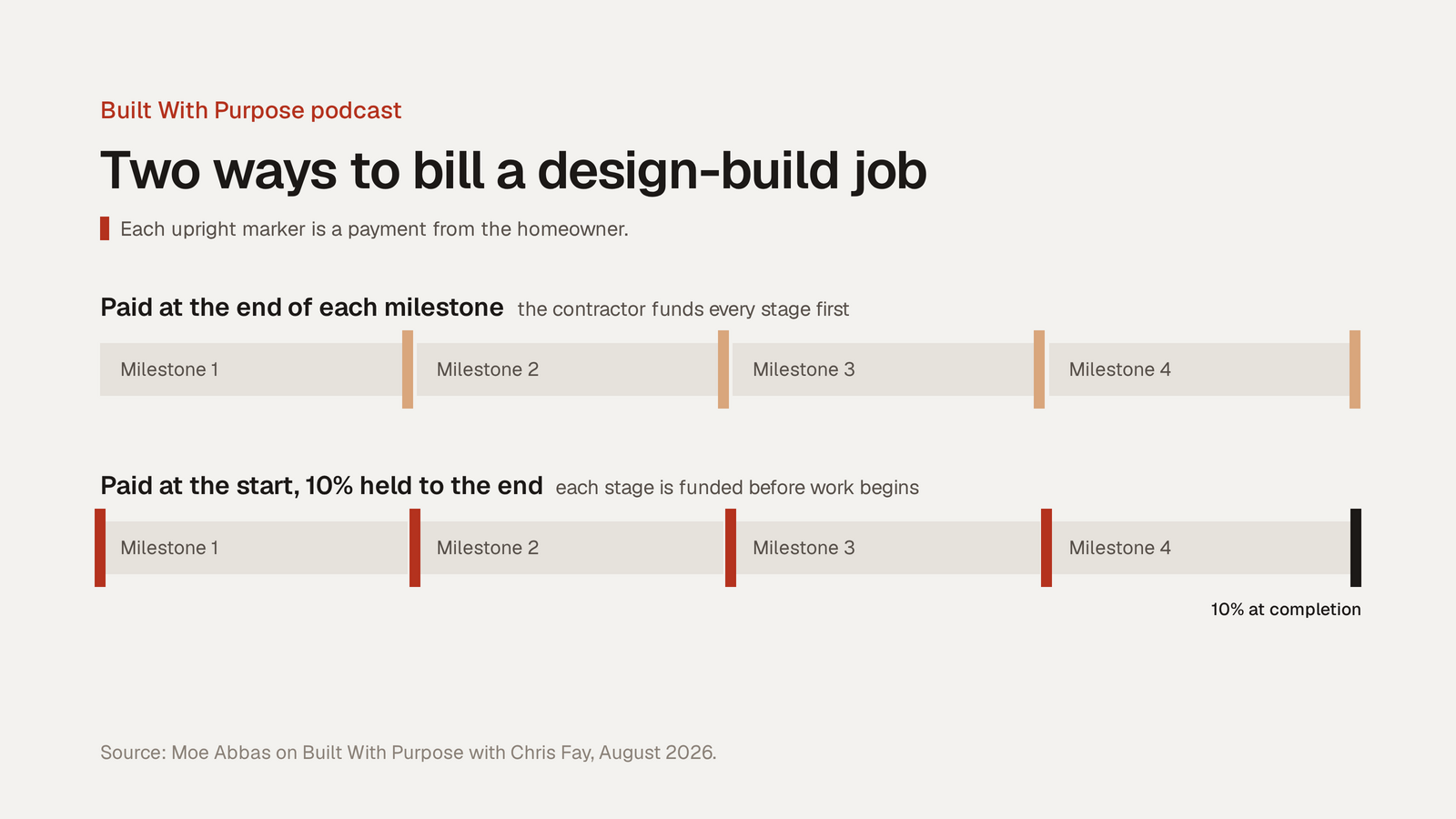
“Immediately your cash position changes,” he said, and nobody was doing it at the time. He was also clear about the catch. Money collected at the start of a milestone is the client’s deposit, so you have to be careful with it. There is risk in treating it as yours.
When tenacity is the mistake
Moe calls entrepreneurship “a game of pain tolerance,” and the rule he lives by is “don’t die”: keep the company breathing long enough to fix what’s wrong. He once left a technology business for three months to go back and clean up one of his construction companies because it was the one with the cash.
He also admits that tenacity cost him twice. “You can’t make a market happen,” he said. You can move a product toward a market, but if nobody is buying, working harder won’t create buyers. His second tech company got stuck at around $2 million in revenue because too many customers left each year. The fix was a new business model, he didn’t want to make it, and he kept going for about two years longer than he should have. “Good is the enemy of great” is how he sums it up now.
Concentrate, then protect
On risk, with several companies to his name, Moe set Andrew Carnegie’s advice to put all your eggs in one basket and watch it closely against Ray Dalio’s case for diversification. His answer is to use both. Concentrate on the one business that can be your big amplifier, and diversify enough that if it fails, your family is still fine.
What decides the outcome
Asked for the one thing listeners should take away, Moe narrowed an owner’s job to a short list. You have to make decisions, and you have to recruit. Recruiting is the one he puts first. “If you get really good at hiring, that’ll define the entire outcome of your company,” he said. Owners with mediocre people spend their week talking about why those people aren’t performing.
Where SalesAsk fits
Moe described SalesAsk on the show as visibility into the kitchen table conversation, because that is where a contracting company’s money is made or lost. SalesAsk records in-home sales appointments for home improvement and design-build teams, scores each one against your process, writes the game plan and follow-up, and syncs it all to your CRM. Reps get an AI coach for role-play before the appointment, live guidance during it if you turn it on, and feedback after, and managers can coach from the recording. See it on a real appointment when you book a demo.
FAQ
What does billing at the start of a milestone mean?
The homeowner pays for each stage of the job before that stage begins, instead of after it is finished. Moe paired it with a 10% holdback paid at completion. It means the contractor is no longer funding the work out of its own cash.
Why does design-build help a contractor’s cash flow?
The design phase shows which builds are coming and when, so you can plan crews and cash ahead. Moe adopted it after watching the one company in his market already doing it.
Is it risky to collect deposits up front?
Moe said there is risk in it. Billing at the start of each milestone left his company with extra cash, but that cash is client deposits, so you have to be careful with it.
Who hosts Built With Purpose?
Chris Fay hosts the podcast. Moe’s episode came out on August 25, 2026, and the full video is on this page, just above the key takeaways.
Sources
- Built With Purpose podcast, “Chewing Glass and Staring Into the Abyss: The Real Cost of Entrepreneurship | Moe Abbas,” hosted by Chris Fay, August 25, 2026, watch on YouTube.
Dara Shabnam
Leads growth at SalesAsk and writes about in-home sales training and recording consent.
More posts byWritten by the SalesAsk team
SalesAsk records and coaches in-home sales conversations for home service, home improvement and home builder teams.
More posts