Online Sales Counselor Training: The Builder's Most Undercoached Seat

On this page
Online sales counselor training should teach one job: turning an inquiry into a kept appointment with the right onsite agent. In the Q2 2026 benchmarks Do You Convert published from its builder programs, online sales had a hand in 51% of total sales on average, and 59% in the top programs. That makes the online sales counselor, the OSC, one of the most important seats in a builder's sales team, and it is often the one nobody listens to.
Key takeaways
- Do You Convert's Q2 2026 benchmarks put lead-to-appointment at 49% on average and 58% for top programs, and appointment-to-sale at 22% and 24%. The report states no sample size.
- The gap between average and top is nine points on setting the appointment and two points on closing it. The difference between programs is on the phone.
- 20% of appointments in that report came from aged leads already in the database.
- Harvard Business Review found firms that tried to reach a web lead within an hour were nearly seven times as likely to qualify it as those that waited an hour longer.
- The handoff to the onsite agent is where what the OSC learned gets lost. SalesAsk coaches the model home visit that follows.
What does an online sales counselor do?
An OSC is the builder's first human contact for web forms, portal inquiries and sign calls, and the job is turning that inquiry into a kept appointment at the right community. Builders keep renaming the role: online sales concierge, internet sales manager, new home specialist.
The OSC owns the stretch of the sale before anyone walks into the model home. They answer the 9:40 p.m. inquiry from a couple on a phone in bed. They know which communities have quick move-ins and which are selling dirt. They keep the interest list warm for the community that opens in March.
They don't sell the house. The house is sold in person, at the community, by the onsite agent. The OSC sells the appointment, and the discipline to stop there is a large part of the craft. An OSC who tries to close a home over the phone ends up arguing price per square foot with a stranger.
What do good OSC numbers look like?
About half of leads set an appointment in an average program, and closer to six in ten in a top one. Those are the Q2 2026 figures Do You Convert published in July 2026.
| Metric | Average programs | Top programs |
|---|---|---|
| Lead to appointment | 49% | 58% |
| Appointment to sale | 22% | 24% |
| Share of total sales with online sales involved | 51% | 59% |
Two things stand out. The gap between average and top is nine points on appointment setting and two points on appointment-to-sale, so the variation in this role is on the phone. And the average lead-to-appointment rate was 40% a year earlier, so these programs improved nine points in a hard housing market. The same report says 20% of appointments came from aged leads already in the database.
Read the numbers with care. They come from the programs of a firm that coaches this exact role, and the report gives no sample size or method. Treat 49% as a high bar for average. If your program sets appointments from a third of its leads, the likelier explanation is that nobody is coaching it.
Why does speed matter so much for the OSC?
Because web leads go cold by the hour. Harvard Business Review's study of lead response found that firms trying to contact a lead within the first hour were nearly seven times as likely to qualify it as firms that waited one hour more.
Nothing else in home building fades that fast. A homesite keeps its value through a week of indecision. A web lead is a person who probably filled in three builders' forms in the same sitting.
After-hours chat and automated first replies are useful as placeholders. They catch the 9:40 p.m. inquiry and promise a person in the morning. Speed gets you into the conversation, and a person still has to set the appointment.
What separates an average appointment setter from a strong one?
A short list of phone habits that stay hidden because no manager hears the conversations. These are the ones I'd listen for.
- They sell the visit. Ask a strong OSC "what are your prices like?" and a question comes back: what has the buyer seen already, what is pushing the move, who else gets a vote. A weak one answers with a price, the buyer says thanks, and the lead goes to voicemail.
- They ask for a day and a time. "Come out whenever, we're open seven days" is an invitation to visit no one.
- They work the aged list as a lead source. A fifth of appointments from the database doesn't come from a monthly newsletter. It comes from phoning the family who went quiet in April the week their homesite is released.
- They text like a person. A large part of the job now happens in a thread, and a buyer can tell a pasted template by the second message.
These are my observations and not measured findings. The measured part is the spread itself: in the SalesAsk Kitchen Table Report, top and bottom reps sit 25 to 35 points apart on close rate in in-person appointments.
Where does the handoff to the onsite agent break?
Between the last phone conversation and the model home door, where what the OSC learned about the buyer sits in a CRM note the onsite agent skims while the buyer is parking.
Picture it. The OSC spends forty minutes across three conversations learning that a family is moving for a school district, that the down payment is waiting on a house sale in another state, and that the husband is nervous about a long build. Then the onsite agent opens with the tour speech everyone gets, and the family repeats their whole story to a company that already knew it.
Part of the fix is a weekly fifteen-minute meeting where the OSC briefs onsite agents on upcoming appointments. The other part is what the buyer holds between the phone conversation and the visit: the two floor plans they shortlisted, the school boundary map, the payment math. Our guide to new home sales training covers the onsite half.
How do you coach the OSC and the visit that follows?
Review the conversations themselves, on both sides of the handoff. The OSC's side is the easier one to start. The phone conversations happen on a business line that can be recorded with a disclosure, and the texts already sit in the CRM. Review one conversation end to end each week with the OSC in the room. That beats managing by appointments set and kept.
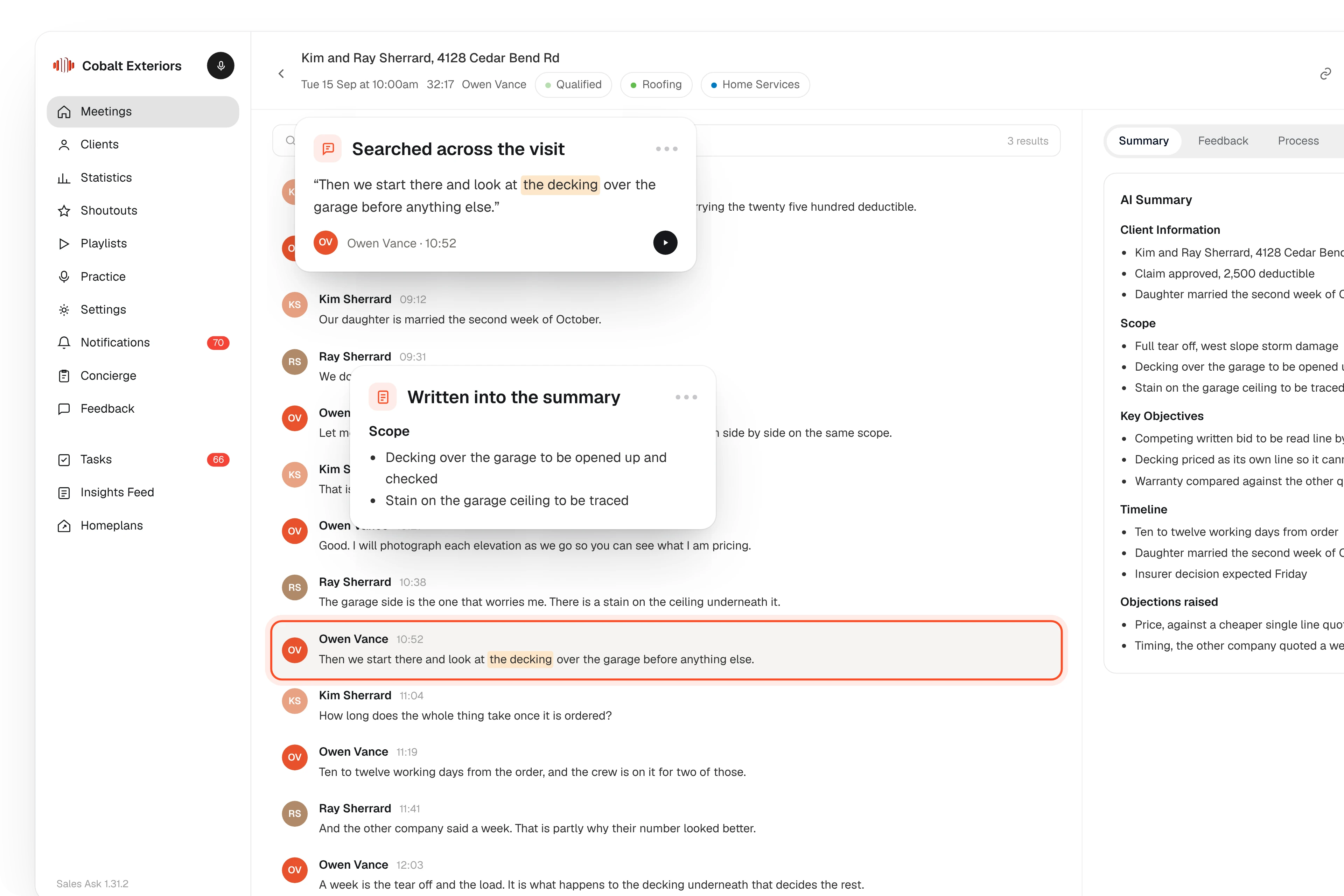
The onsite side is where SalesAsk fits. SalesAsk records and scores in-person sales conversations, including the model home visit the OSC booked, against the builder's own sales steps. The coaching runs before, during and after the visit: the onsite agent practices in an AI roleplay, can turn on live coaching, and gets written feedback afterward. A manager can hear whether the agent used what the OSC passed along.
See how SalesAsk works for home builders, or book a SalesAsk demo.
Where does coaching stop helping?
At structure. If your OSC covers nine communities across two metros and also runs the builder's Instagram, no review schedule rescues that calendar.
A builder selling a couple of dozen homes a year may not need a dedicated OSC at all. An owner who answers every lead within the hour can do the job. I don't have a figure for where the cutover is, and I'd distrust anyone who names one.
Where would you start on Monday?
Pull ten recorded OSC conversations and count two things: how many ended with a request for a specific day and time, and how many times the OSC answered a price question with a question. Then read the handoff notes for the last ten kept appointments and ask your onsite agents which ones they used. That tells you whether you have a lead problem or a coaching problem before the 2027 selling season.
Frequently asked questions
What is the difference between an online sales counselor and an onsite sales agent?
The OSC works the phone, email and text queue and sells the appointment. The onsite agent works the community and sells the home. The handoff between them deserves as much management attention as either seat.
Is the OSC role only for large production builders?
The function is needed everywhere, and the dedicated seat is not. Every builder needs someone accountable for answering leads fast and turning them into visits. Whether that is a full-time OSC or a disciplined owner depends on lead volume.
Should OSCs phone or text?
Both, led by what the buyer used first. A web form gets a phone call and a text, and a text gets a text back. Coach the text threads as well as the phone conversations.
How do aged leads fit into an OSC's week?
As a scheduled lead source. The Q2 2026 benchmarks put a fifth of appointments from leads already in the database, and that only happens when database follow-up is on the calendar with the same standing as new-lead response.
Will AI chatbots replace the OSC?
The after-hours first reply is already partly automated. The judgment is the job: which community fits, which buyer is serious, when to stop nurturing and ask for the visit. Those are conversation skills, and coaching the person is the better use of AI.
Sources
Dara Shabnam
Leads growth at SalesAsk and writes about in-home sales training and recording consent.
More posts byWritten by the SalesAsk team
SalesAsk records and coaches in-home sales conversations for home service, home improvement and home builder teams.
More posts