How to Stop Cancellations After the Homeowner Signs

On this page
You stop cancellations by making sure the homeowner leaves the table holding their own reasons for buying, and by staying in touch through the three business days they have to cancel. Under the FTC's Cooling-Off Rule, a buyer can cancel most sales of $25 or more made in their home until midnight of the third business day. A cancellation is usually a sales problem that surfaced three days late, and you can work on it like one.
I'm a marketer and not a lawyer. Check your paperwork with an attorney in the states where you sell.
Key takeaways
- The federal window runs to midnight of the third business day. Saturdays count. Sundays and federal holidays don't.
- The reasons homeowners give for rescinding were all present during the appointment: price, value, pressure and disbelief in the discounts.
- Before you leave, ask the homeowner to say why this was the right decision for them.
- Phone the next day with the next steps. Silence leaves the doubt nowhere to go.
- The rescission benchmarks people quote come from a 2005 article with no stated sample. Use your own rate by rep.
Why do homeowners cancel after they sign?
Mostly because the decision was never fully made at the table, and the quiet days afterward give the doubt somewhere to go.
The pattern is familiar. Signed Thursday night at the kitchen table. Handshakes, a folder left on the counter, a wave from the porch. Then a voicemail on Monday from the husband that sounds a little too formal, and the cancellation form arrives two days later.
Sales trainer Dave Yoho wrote about surveys that asked home improvement customers why they rescinded. The answers included "price too high," "don't see the value" and "not competitive with other prices received." Customers also said they felt pressured and didn't believe the discounts. None of those reasons appeared after the rep left. Each one was in the room during the presentation, unspoken, while the agreement was being signed.
A signature is a weaker signal than we like to admit. People sign to end a long evening. They sign because the rep is likable and saying no at your own kitchen table is uncomfortable. Then the truck pulls away, and the conversation the couple has at 10:30 that night is the one that decides the sale.
What does the three-day cancellation window say?
The FTC's Cooling-Off Rule lets a buyer cancel most sales of $25 or more made at their home until midnight of the third business day after the sale. No reason is required.
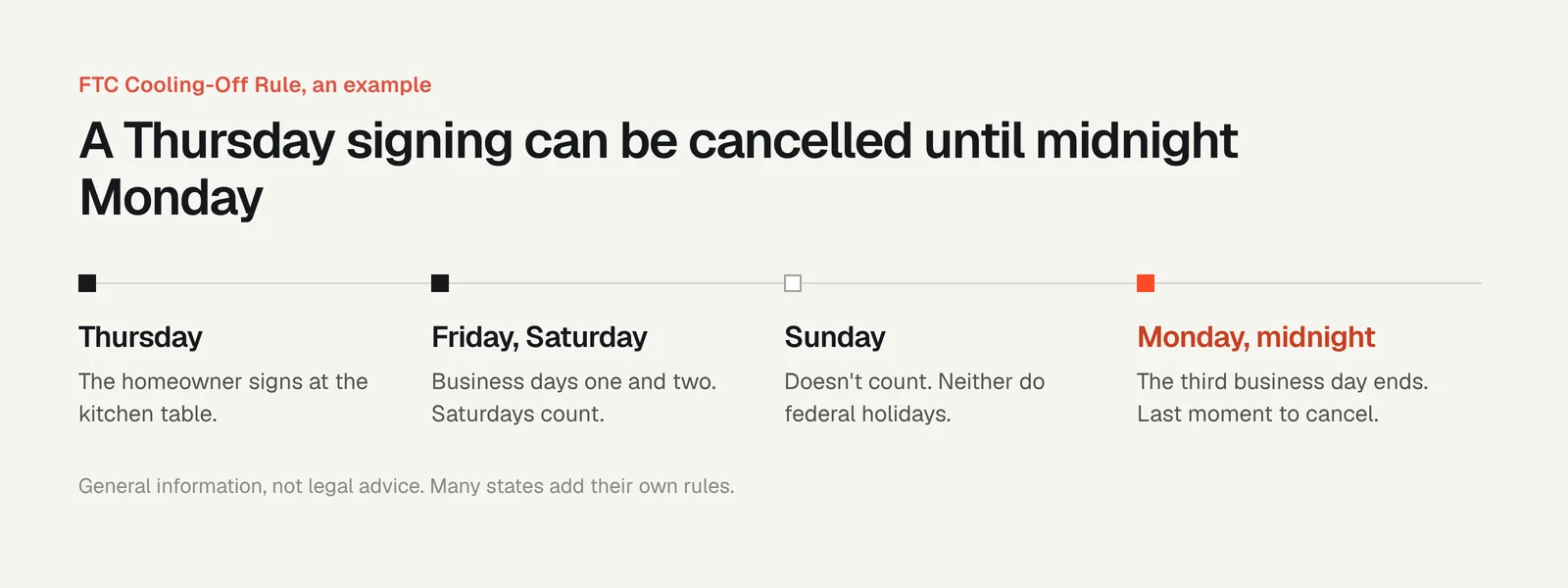
- Saturdays count as business days. Sundays and federal holidays don't. A Thursday signing can be cancelled until midnight Monday.
- The seller has to tell the buyer about the right at the time of sale and give two copies of a cancellation form.
- Some visits are exempt. Emergencies, and a visit the buyer requested to repair or maintain something they own, fall outside the rule. What you sell beyond that requested work is another matter, so ask your attorney.
The paperwork matters. California's consumer guidance says that when the seller doesn't give the required notices, the buyer's right to cancel "continues beyond the initial three-day period until the required disclosures are made." The buyer may cancel at any time until three business days after the seller has complied, which the guide notes could be weeks or months later.
Many states have their own home solicitation laws on top of the federal rule. If you sell in more than one state, your cancellation paperwork deserves the same attention your contracts get.
What is a normal cancellation rate?
There isn't a current published benchmark I'd trust. The figures usually quoted come from Yoho's 2005 article in the Journal of Light Construction, which gave no sample or method.
| Average contract size | Yoho's 2005 guidance |
|---|---|
| $4,000 or less | Above 2% or 3% is unacceptable |
| $5,000 to $10,000 | Rescissions range from 4% to 10% |
| $15,000 to $25,000 | Rates vary, and it isn't uncommon for them to exceed 20% |
Those contract sizes are twenty years old, so read the table as a shape: the rate climbs with the size of the decision. Two other observations from the same article still ring true. High-need products such as a roof replacement or an HVAC system rescind at a much lower rate than sunrooms or decks. And products bought after much shopping have low rescission rates, because the comparison happened before the signature.
His conclusion is the useful part: high rescission rates are caused by errors in the sales process.
How do you keep a sale sold after you leave the driveway?
Make sure the homeowner is holding their own reasons for buying when the doubt arrives on night two. Four habits do most of the work.
- Have them say it back. "Walk me through what made this the right decision for you two" feels awkward once. A homeowner who has stated their reasons out loud will defend the purchase to a brother-in-law on Saturday.
- Leave something that argues your case. A stapled quote on the fridge says one thing over and over: the number. A plan the couple can reopen on a phone, with the options they compared and photos of their own house, makes your case at 10:30 at night when you can't.
- Phone on day one. Most reps go quiet through the window on the theory that contact invites trouble. The trouble is already in the house. A short conversation about the measure date and who shows up next gives second thoughts somewhere to go.
- Never use the window to close. "You can always cancel if you change your mind" buys a signature tonight and a cancellation later. Yoho wrote that those who use rescission as a means to close "end up destroying their sales methodology."
You also don't want a zero cancellation rate. A deal that needed three price drops and a tonight-only discount to close probably should end in the window. The goal is narrower: stop losing the jobs where the fit was right and the doubt was answerable.
How does SalesAsk help reduce cancellations?
SalesAsk records the appointment, so when a cancellation comes in, the manager can go back to the conversation that produced it. Listen for what the rescission surveys predict: a price that moved more than once, financing never raised, an objection that was talked past.
Add "homeowner states their reasons" and "cancellation forms explained" to your sales steps, and each visit is scored on whether they happened. HomePlan gives the couple a plan page built from the recording to reopen during the three days, and shows you each open and share.
The coaching runs before, during and after the visit: an AI roleplay on the price conversation, optional live coaching, and written feedback afterward. To see it on your own appointments, book a SalesAsk demo.
What haven't we measured?
We haven't published cancellation data. I can't tell you which behaviors in a recorded visit predict a rescission, or how much a day-one phone conversation reduces them. The habits above come from Yoho's survey reasons and from common sense about the window.
Start with your own numbers. Sort your last 90 days of cancellations by rep and by ticket size. They are rarely spread evenly, and two reps with the same close rate can have very different three-day windows.
Frequently asked questions
Do weekends count toward the three days?
Saturdays count as business days under the federal rule. Sundays and federal holidays don't. State rules can differ, so check yours.
What happens if we never gave the cancellation forms?
In California, the window stays open until three business days after you comply, according to the state's consumer guidance. Other states have their own rules. Ask your attorney, because defective paperwork can leave a job cancellable long after the work begins.
Should we start work during the three-day window?
There is a tradeoff. Starting fast builds momentum, and what you spend inside the window is exposed if the buyer cancels. Many contractors use those days for measuring and scheduling. Get your attorney's view on emergencies and waivers in your state.
Is "you can always cancel later" an acceptable way to get a signature?
It produces signatures and then cancellations. You are postponing the real objection to a moment when you aren't in the room. Bring the hesitation out at the table.
Sources
- Federal Trade Commission, "Buyer's Remorse: The FTC's Cooling-Off Rule May Help".
- California Department of Consumer Affairs, Legal Guide K-9: Consumers' Rights to Cancel Home Solicitation Contracts, September 2010.
- Dave Yoho, "Canceled Cancellations," Journal of Light Construction, February 7, 2005. No survey sample stated.
Dara Shabnam
Leads growth at SalesAsk and writes about in-home sales training and recording consent.
More posts byWritten by the SalesAsk team
SalesAsk records and coaches in-home sales conversations for home service, home improvement and home builder teams.
More posts