What's a Good Close Rate for In-Home Sales? Contractor Benchmarks (2027)

On this page
A good close rate for in-home sales depends on the lead source: published guides put referrals above 50%, paid ad leads under 20% and outbound leads at 20 to 30%. None of those figures comes with a published method. The number worth more is the spread inside your own team, which runs 25 to 35 points of close rate between top and bottom reps in SalesAsk's analysis of 1.3 million+ sales conversations.
Key takeaways
- Lead source moves close rate more than almost anything a rep does. Compare like with like.
- Published benchmarks disagree by 50 points because they use different denominators and rarely state a method.
- The rep gap inside one company is 25 to 35 points on close rate in the Kitchen Table Report.
- Appointments where financing came up closed at 49%, against 38% where it didn't.
- Measure closed jobs over appointments that sat, by lead source, and hold the definition for two quarters.
What close rate should a contractor expect?
Expect a different number for each lead source. Hook Agency's guide for contractors says a referral closing rate should be over 50%, that leads responding to ads can drop under 20%, and that outbound should land between 20 and 30%. It also gives a floor: below 15% in any scenario points to a sales problem.
Read those bands together. The same rep, running the same kitchen table conversation, will close a referral at more than double the rate of a paid lead. When your close rate moves from one quarter to the next, check the mix of who booked the appointments before you look at the sales team.
This is why a single target number misleads. A company that shifts spend from referral nurture to paid search will watch its close rate fall while nothing about the selling got worse.
Why do published close rate benchmarks disagree?
Because almost nobody defines the denominator, and few say where the numbers came from. One contractor marketing guide says ad leads close under 20%. An HVAC benchmarks page says the residential service average is 65 to 75%. Both describe someone selling in a home, and they sit 50 points apart.
Take the HVAC figures. MarginPlug, which sells software to HVAC businesses, puts residential service close rates at 65 to 75%, top performers at 82 to 88%, and system replacement presented on a repair visit at 35 to 52%. The segments are sensible. The page names no survey, sample or time period, so treat the figures as a starting hypothesis.
The denominator matters as much. Is your close rate closed jobs over leads received, over appointments booked, or over appointments that sat? Count a no-show as a loss and the number can swing a long way. A no-heat emergency in January nearly closes itself, and it lifts a service close rate that tells you nothing about a competitive replacement quote.
Builders are a separate case. Their yes is a reservation or a contract appointment, not a same-day signature. Do You Convert reported that its top-performing builder programs turned 22% of appointments into sales in the first quarter of 2026, without publishing the sample.
What do the published bands look like by situation?
They look like this, with the source and its limits beside each one.
| Situation | Published band | Source and caveat |
|---|---|---|
| Referral lead, any trade | Above 50% | Hook Agency. No data source stated |
| Paid ad response lead | Under 20% | Hook Agency. No data source stated |
| Outbound lead | 20 to 30% | Hook Agency. No data source stated |
| HVAC residential service | 65 to 75% | MarginPlug. No method published |
| HVAC replacement presented on a repair visit | 35 to 52% | MarginPlug. No method published |
| Any trade, warning floor | Below 15% | Hook Agency. A sign of a sales problem |
| Contractor quotes issued, median company | 38.1% | Level, 794 specialty-trade companies. Period not stated |
The last row is the only one here with a stated dataset. Level, which sells finance services to contractors, found the median company converted 38.1% of quotes issued and the 75th percentile converted 47.7%. That counts every quote, including repeat customers, so it isn't an in-home sales rate either.
If your number sits inside the matching band, the published data has little more to teach you. What matters next is inside your own team.
Which benchmark tells you the most?
The spread between your top and bottom reps tells you more than your distance from any industry average. In SalesAsk's analysis of 1.3 million+ sales conversations, that gap ran 25 to 35 points on close rate. Twenty-five is the low end. On a team averaging in the thirties, the rep at the top closes roughly twice as often as the rep at the bottom.
The spread is worth more than a benchmark because it is measured on your leads, your market and your prices. The Kitchen Table Report puts the full gap at $585,000 a year for a 10-truck operation, about $58,500 per truck. Treat that as a ceiling. Close a third of it and it is still roughly $195,000.
One behavior behind the spread is easy to check. Appointments where financing came up closed at 49%, against 38% where it never did. That is a correlation, and reps who raise financing may simply be better reps. Most owners still don't know which of their reps raise it, because nobody can sit in every home.
How does SalesAsk show you the spread?
SalesAsk records each visit and scores it against your own sales steps, so you can see which steps the bottom of the board skips and the top doesn't. The process heatmap shows step hit rate by rep and team, and you can compare anyone against your top closer.
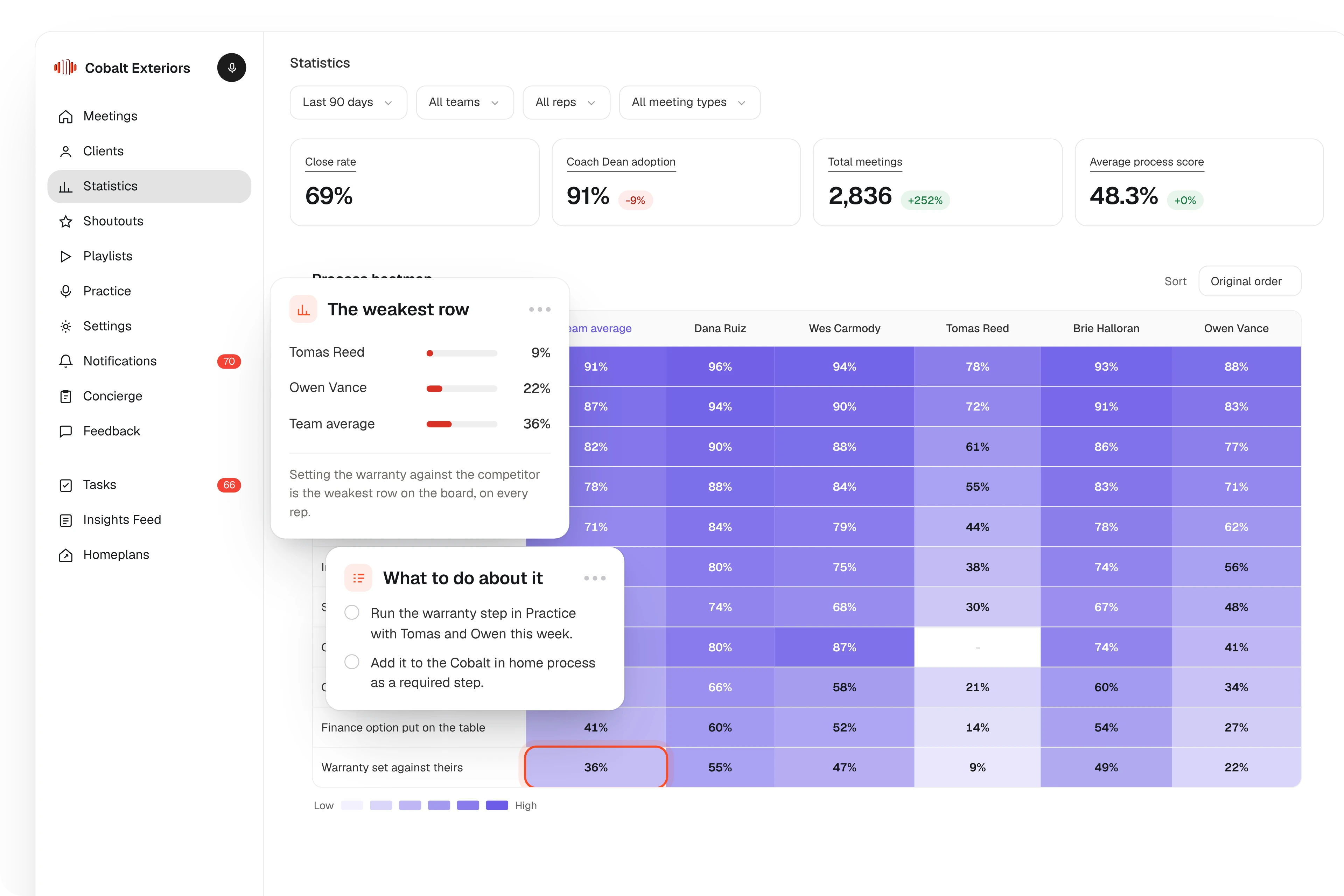
From there the coaching runs before, during and after the appointment: an AI roleplay on the missed step, optional live coaching in the visit, and written feedback on the rep's phone afterward. Connected to ServiceTitan or Housecall Pro, coaching is matched to job revenue. To see the spread on your own team, book a SalesAsk demo.
How do you measure close rate so the number means something?
Pick one denominator, cut by lead source, and hold the definition still for at least two quarters.
- Use appointments that sat. Closed jobs over appointments where the rep and homeowner met. Booking problems and selling problems need different fixes.
- Cut by lead source. One line each for referrals, paid leads and outbound, per rep.
- Hold it still. A definition that shifts is how a team hits any target it wants.
- Don't average it back. A 32% company close rate that contains a 48 and a 17 is three facts.
Where do these benchmarks fall short?
Every published band above lacks a method except Level's, and Level measures quotes, not sales appointments. We haven't published close rate by trade yet. It is on the Kitchen Table Report's list, along with the rep gap per trade.
Spread analysis also needs volume. A two-truck shop where the owner runs every appointment has no team to compare, and a rep who ran eleven appointments last month has a close rate that is mostly noise. With small numbers, coach behaviors and leave the percentages alone.
Frequently asked questions
Is a 30% close rate good for a roofing company?
It depends on the lead source. On paid or canvassed leads, 30% of sat appointments sits above the published bands. On referrals it falls short of them. Ask the question again with the lead source attached.
Why is my close rate dropping when my reps haven't changed?
Check your lead mix first. A shift toward paid leads, a new lead vendor or a seasonal dip in referrals will move the blended number with no change in selling skill.
Can a close rate be too high?
Hook Agency says closing rates above 50% can mean you aren't charging enough. Its guide doesn't square that with its own 50% referral band, so I'd treat it as a prompt to check your margins and not a rule.
How many appointments before a rep's close rate means anything?
More than a month's worth for most reps. There is no agreed threshold, and small samples are where reps get wrongly promoted and wrongly fired. Look at a full quarter before drawing a conclusion.
Sources
- Hook Agency, "Closing Rate for Contractors: What's a Good Sales Closing Rate?", November 2026. No data source stated.
- MarginPlug, "HVAC Close Rate Benchmark 2026", April 15, 2026. No method stated.
- Level, "The 7-Day Rule: Why Stale Quotes Kill Contractor Revenue", updated November 7, 2026. Level Index dataset of 794 contractor companies.
- SalesAsk, The Kitchen Table Report 2026, Benchmarks, for the rep gap, the $585,000 estimate and the Do You Convert figure, and The Conversation for the financing close rates.
Dara Shabnam
Leads growth at SalesAsk and writes about in-home sales training and recording consent.
More posts byWritten by the SalesAsk team
SalesAsk records and coaches in-home sales conversations for home service, home improvement and home builder teams.
More posts