The Follow-Up Text After the Estimate: What to Send When the Phone Goes to Voicemail

On this page
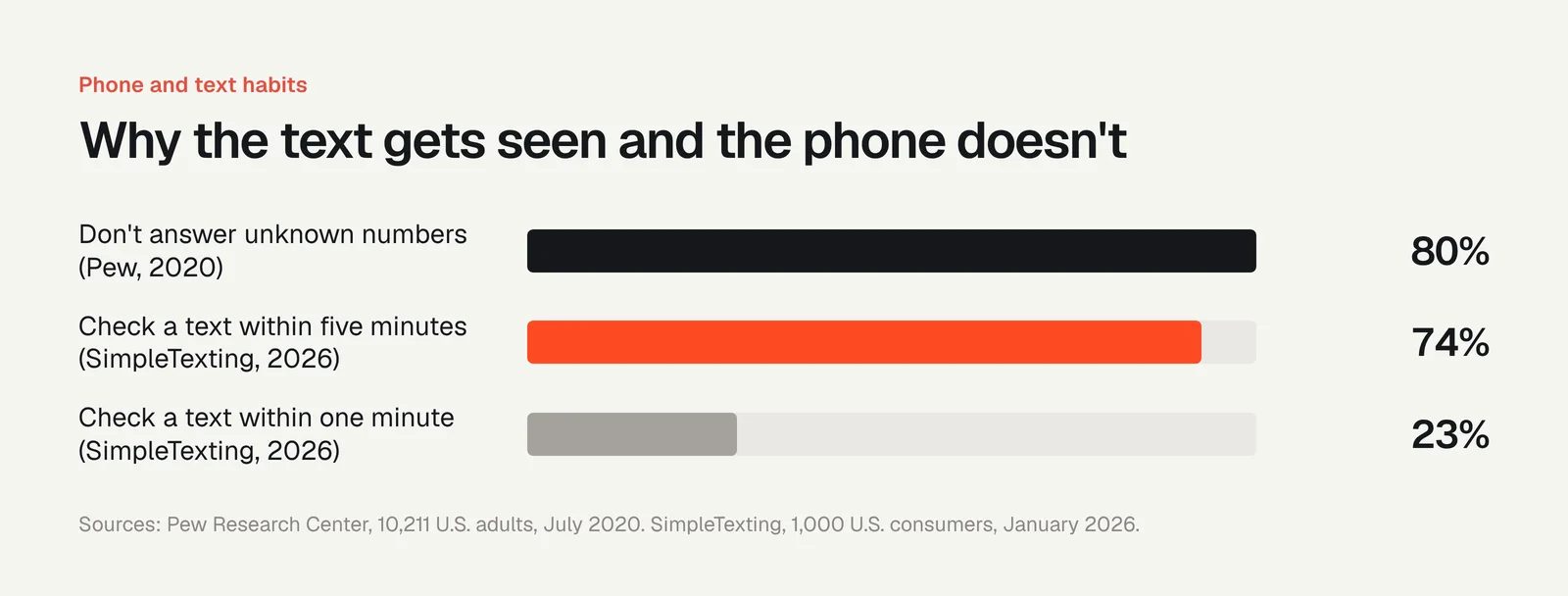
Send the first follow-up text the same evening as the estimate, from the rep's own number, with a link to the full plan. Homeowners screen the phone: eight in ten Americans say they generally don't answer a cellphone when an unknown number rings, according to Pew Research. To the homeowner who spent ninety minutes with your rep yesterday, his follow-up from the truck is an unknown number.
Key takeaways
- 80% of Americans don't generally answer unknown numbers, in Pew's 2020 survey of 10,211 adults.
- 74% of consumers check a text notification within five minutes, in SimpleTexting's 2026 survey of 1,000 consumers.
- Every text should give the homeowner something: a link, an answer, a photo or a number she asked for.
- Four or five texts across two weeks is enough. End with one that makes "no" easy to say.
- Get consent to text when the appointment is booked, and honor a stop request at once.
Why do homeowners read texts and ignore the phone?
Because the ringing phone has become the channel of strangers. Pew Research surveyed 10,211 U.S. adults in July 2020 and found that eight in ten don't generally answer a cellphone when an unknown number rings. 67% said they let it ring and check the voicemail if one is left.
Texts get looked at quickly. SimpleTexting, which sells a business texting platform, surveyed 1,000 U.S. consumers in January 2026. 23% said they check a text notification within a minute and 74% within five minutes. That measures checking the notification and not replying, and it comes from a texting vendor.
Think about what each channel asks. A phone conversation demands ten minutes now, in the workday, with a salesperson she suspects will push for a decision. A text asks for nothing. She can read it at the stove and answer at 9:40 after the kids are down.
This varies by buyer. Property managers and commercial accounts still pick up. Some retirees prefer the phone and find a contractor's text too familiar. Read the customer. The homeowner who texted your office to confirm the appointment has told you her channel.
When should the first text go out?
The same evening as the appointment, while your rep is still the person who was in her house. Most homeowners gather several bids, and the days right after your visit are when your presentation is freshest. Our post on how long homeowners take to decide has the data.
The first text has a second job. It opens the thread. Once she has replied even once, the rep's number has a name attached, and every later message arrives from a known contact.
Send it from the rep's own number. The homeowner met Marcus. A message from Marcus continues a relationship. A message from a five-digit short code starts a spam folder.
What should the follow-up text say?
It should give her something. That one test removes "Hi, just checking in to see if you've made a decision," which takes and doesn't give.
Here is the same-evening version:
Hi Dana, Marcus from Hearth Mechanical. Here's everything from today in one place: your three options, the attic photos and the monthly payment on each. [link] If it were my house I'd do the middle one, and I put a note in there explaining why. Text me here with anything.
And day three, if she asked about the warranty during the visit:
Dana, you asked what happens if the compressor fails in year 8. I checked: here is what's covered for parts and for labor, and for how long. I added it to your plan so it's in writing.
Neither message asks "any thoughts?" or invents a deadline. The rep is being useful in writing, which is the whole strategy.
What does a texting cadence look like?
It looks like four or five texts across two weeks, each carrying something new.
| When | The text | What it does |
|---|---|---|
| Same evening | Recap with the link to the full plan and photos | Opens the thread while the visit is fresh |
| Day 2 or 3 | The answer to a question she raised | Shows the rep listened, and helps her explain it to her spouse |
| Day 5 to 7 | One new fact: the monthly payment, an install date, a photo from a similar job | Brings the quote back up without asking for a decision |
| Day 10 to 14 | "No pressure either way. I'm closing out my schedule for the month. Want me to hold your spot or let it go?" | A real question with two acceptable answers |
| Next season | "Heating season's here. If the timing works better now, I'm glad to update the numbers." | Keeps the thread open at almost no cost |
The day 10 message matters more than it looks. A homeowner who has gone quiet often feels a little guilty about it, and that turns into avoidance. A message that permits "no" gets replies that cheerful nudges don't. Some replies will be "we went another way." That is useful too: the rep stops chasing and the pipeline gets accurate.
I wouldn't automate all of it. The day 5 text only works if it says something true about her project. Automate the reminder to send it and let the rep write it. These timings are my recommendation. Nobody has published response rates for texts after an in-home quote.
What should the link in the text open?
A page built for the decision, and SalesAsk's HomePlan is the one we'd use. A text is a poor place for a five-figure decision. Forty words, no layout, no photos of her attic. Its job is to earn one tap.
What happens after the tap is where most contractors lose it. The link opens a scan of a paper quote, pinched and zoomed on a phone. HomePlan builds a plan page from the recording of the appointment: the recap, findings, scope, options and next steps, checked and approved by the rep before it goes out.
The household can forward the link, approve from the page, or tap "Not ready yet" and say why. You see each open and share, so when Dana opens it twice on Tuesday night, the day 5 text has a reason to exist. SalesAsk also drafts the follow-up message itself from the recording.
The appointment is coached as well: roleplay before it, optional live coaching during it, and written feedback after. To see a plan and a drafted follow-up from one of your own visits, book a SalesAsk demo.
Do you need permission to text homeowners?
Yes. Ask for it when the appointment is booked, in writing, with a line such as "You agree we may contact you about your project by phone or text." Federal rules on unwanted texts are enforced by the FCC, and states add their own.
Three habits keep you out of trouble. Get the consent line onto your booking form. Stop the moment someone asks you to. And ask whoever runs your phone system whether your business numbers need to be registered with the carriers, because unregistered numbers sending volume can be filtered. I'm a marketer and not a lawyer, so have an attorney check your wording.
Where does texting fall short?
A link can't rescue a weak appointment. If the rep never made the case in the house, no plan page makes it afterward.
The evidence is also about texts in general. Pew's survey is from 2020 and is about unknown numbers, and SimpleTexting's is a vendor survey about notifications. Neither studied contractor follow-up. Try it on your own open estimates and count the replies.
Frequently asked questions
Should the text come from the rep's phone or the company number?
The rep's. The homeowner has a relationship with the person who was in her house. Use the company number for appointment confirmations and keep the follow-up thread personal.
What if the homeowner never replies?
Finish the sequence, end with the message that permits a no, then drop to a seasonal note. Silence after that is an answer. Chasing past it spends the goodwill you'd want when her system fails next July.
Should the price go in the text itself?
Not as a bare number. A figure with no context forwards badly. Put the price one tap away, next to the options, the monthly payment and the reasons.
How fast should a rep reply when the homeowner texts back?
Within the hour if possible, even if the answer is "good question, I'll confirm in the morning." A fast reply shows her what service after the contract will feel like.
Sources
- Pew Research Center, "Most Americans don't answer cellphone calls from unknown numbers," December 14, 2020. 10,211 U.S. adults, surveyed July 13 to 19, 2020.
- SimpleTexting, texting and SMS marketing statistics, May 26, 2026. 1,000 U.S. consumers, surveyed January 7 to 8, 2026.
- Federal Communications Commission, consumer guide to unwanted robocalls and texts.
Dara Shabnam
Leads growth at SalesAsk and writes about in-home sales training and recording consent.
More posts byWritten by the SalesAsk team
SalesAsk records and coaches in-home sales conversations for home service, home improvement and home builder teams.
More posts