Selling Furnace Replacements on No-Heat Calls Without Pressure

On this page
On a no-heat call, the technician sells a furnace replacement without pressure by fixing the order of the visit: diagnose first, price the repair, and offer replacement only when the furnace's age, repair cost and history support it. Carrier's own guidance is to consider replacement when a repair approaches 50% of the cost of a new unit, or when a furnace older than 10 to 15 years needs a significant repair. Everything else in this playbook is about how the tech says that in a cold house.
If you want to hear how your technicians handle the repair or replace conversation, book a SalesAsk demo.
Key takeaways
- Carrier says to consider replacement when repair costs approach 50% of the value of a new unit.
- Carrier puts a new furnace's typical lifespan at 15 to 20 years, and flags a furnace older than 10 to 15 years that needs a significant repair.
- A furnace a qualified professional has found unsafe should not be operated. That is a safety conversation, and it comes before any sales conversation.
- The median HVAC appointment in SalesAsk's Kitchen Table Report runs 42.2 minutes.
- Appointments where financing comes up close at 49%, against 38% where it never does. That is a correlation across trades.
What should a technician do first on a no-heat call?
The technician should find out why there is no heat and whether the furnace is safe, before any talk of replacement. The homeowner called about a cold house. A tech who opens with the age of the furnace has answered a question nobody asked.
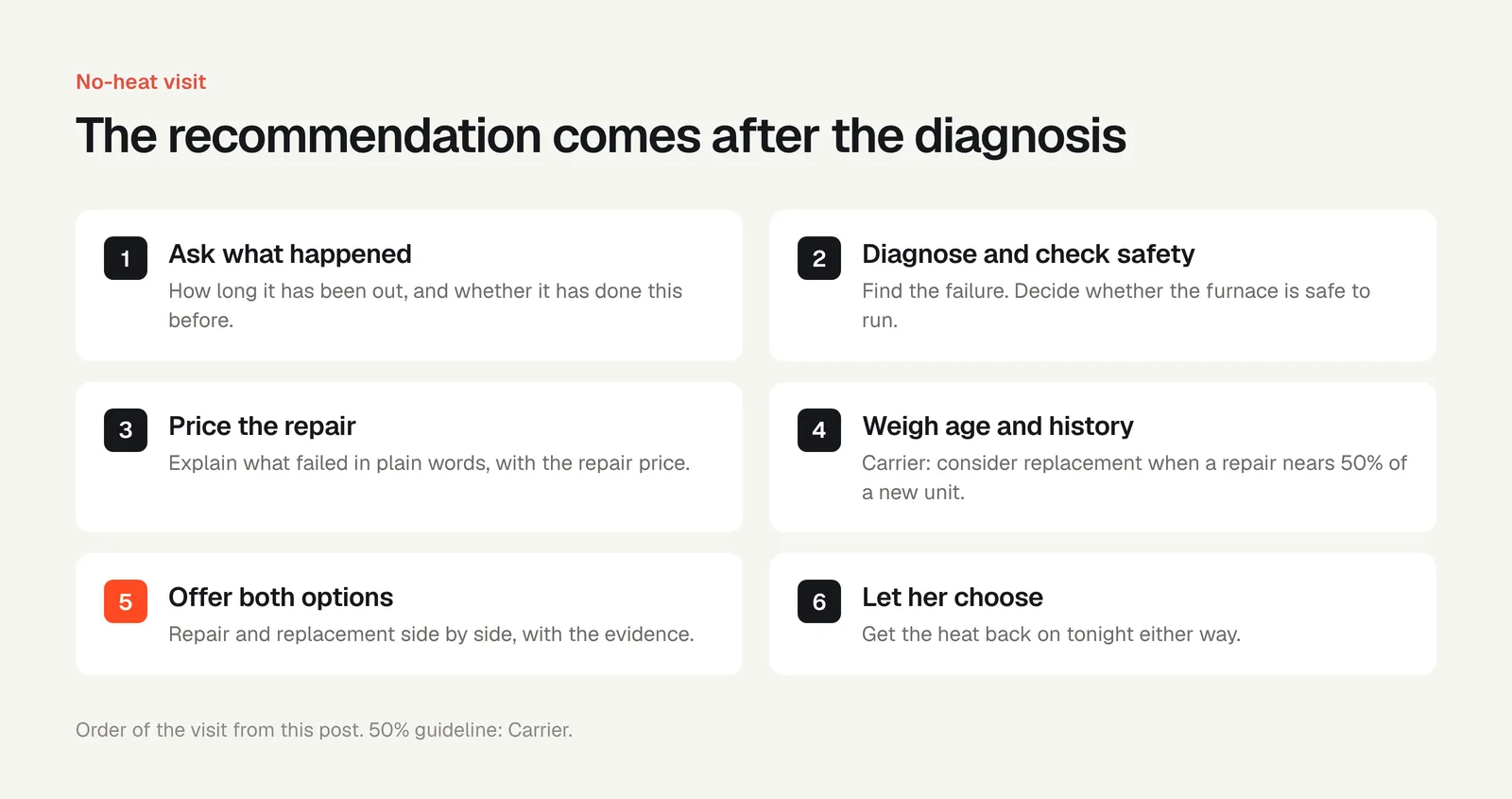
A workable order for the visit:
- Ask what happened and when. How long has it been out, has it done this before, who is home.
- Diagnose the failure.
- Check whether the furnace is safe to run.
- Explain what failed in plain words and give the repair price.
- Look at age, condition and repair history.
- If those support it, offer to show what replacement would look like next to the repair.
- Let the homeowner choose, and get the heat back on tonight either way if you can.
The recommendation comes after the diagnosis in that list, and the homeowner can see that it does. That order is most of what "no pressure" means in practice.
When should a tech recommend replacing the furnace over repairing it?
A tech should raise replacement when several signs overlap, and one of them is usually the size of the repair. Carrier's guidance to homeowners uses a 50% rule: if the repair costs half or more of a brand-new system, replacement deserves a serious look.
The arithmetic is simple enough to do on the tablet in front of the homeowner. Divide the repair price by the replacement price. A repair that comes to a quarter of the replacement on a ten-year-old furnace with no history is a repair. The same repair at more than half, on a furnace with two breakdowns behind it, is a different conversation.
| What the tech finds | What Carrier's guidance says | What to offer |
|---|---|---|
| Repair is a small share of replacement cost, furnace in sound condition | Repair does not change the furnace's rated efficiency, and it is the lower upfront cost | The repair |
| Furnace is more than 10 to 15 years old and needs a significant repair | Listed as a sign to consider replacement | Repair and replacement, side by side |
| Repair approaches 50% of a new unit | Consider replacement | Both, with the percentage shown |
| Frequent breakdowns | Can be a sign the furnace is near the end of its service life | Both, with the repair history written out |
| Cracked or damaged heat exchanger, or a combustion problem | Deserves particular attention; do not operate a furnace found unsafe | Safety first, then the options |
The 50% figure is a guideline. A homeowner who is selling the house in the spring may reasonably repair a furnace the rule says to replace, and the tech should say so.
How do you explain repair versus replacement without sounding pushy?
Lay out both options with the evidence and say out loud that either one is fine. Something like: "Here's what failed and what it costs to fix. The furnace is about sixteen years old and this is the second repair in two winters. I can fix it today, or I can show you what a new one would look like, and you can decide."
That sentence has no "you need." It gives the homeowner the same facts the tech is looking at. Homeowners are braced for the upsell on a visit like this, and the surprise of not getting one is what earns the next ten minutes.
A cracked heat exchanger is its own case. Carrier tells homeowners not to operate a furnace a qualified professional has determined is unsafe. The tech should show what he found, explain why it matters, and separate that clearly from any conversation about what to buy. If the tech isn't certain, he should say that and get a second set of eyes on it. A homeowner who believes the safety call was honest will listen to what comes after it.
How do you create urgency on a no-heat call without scaring the homeowner?
You don't need to create any. The house is cold, and that is all the urgency the visit needs. The tech's job is to take pressure off: get temporary heat going or make the repair, and give the homeowner room to decide about the bigger purchase.
What crosses the line is easy to hear on a recording. "This could fail any day" with nothing to back it. "The price is only good tonight." A safety warning that gets vaguer the more the homeowner asks about it. If the furnace can be made to run safely, tell her so, even though it makes the replacement easier to postpone. She will be buying a furnace from someone within a few years, and she'll remember which tech told her the truth in January.
If she wants to think about it, ask what part she wants to think through. Price, timing, another estimate and a spouse who isn't home are four different problems. Our post on HVAC quote follow-up in the first 72 hours covers what to send after the truck leaves.
Should the technician price the replacement or hand off to a comfort advisor?
Either can work, and the handoff is where the opportunity can fall apart. If the tech prices it, he needs real options and a payment to show. If a comfort advisor comes out, the homeowner should not have to repeat what she already told the tech in the basement.
For the handoff version, the tech's last job on the visit is to book the next conversation before leaving and pass along what he learned: the furnace's age, what failed, what the homeowner said about her plans for the house. Our tech-generated leads playbook covers how to set that up and how to count it.
Whoever presents the price should bring up the payment. In the Kitchen Table Report, SalesAsk's analysis of 1.3 million+ sales conversations, appointments where financing comes up close at 49%, against 38% where it never does. That is a correlation across trades, and a homeowner facing a furnace she didn't plan to buy this month is the person a monthly number helps most.
How do you coach technicians on no-heat calls?
Coach them on the order of the visit, using their own recorded visits. SalesAsk records the conversation on the tech's phone, including in a basement with no signal, and scores it against your company's steps, so a service manager can see who offers both options and who only quotes the repair.
Technicians didn't sign up to sell, and most of them are uneasy about this conversation in particular. Practice helps more than a meeting does. A manager can build the sixteen-year-old-furnace scenario as an AI roleplay from a real transcript and have each tech run it before heating season, scored on the same steps as a live visit. During the visit, SalesAsk can send a nudge to the tech's Apple Watch as an option. Afterward the tech gets a score and written feedback while the visit is still fresh.
The median HVAC appointment in the Kitchen Table Report is 42.2 minutes. A no-heat visit has a diagnosis inside it as well, so the repair or replace conversation may get ten of those minutes. That is why the wording is worth practicing.
Where does this playbook stop?
It stops at the diagnosis. Nothing here tells a tech whether a specific furnace is safe or worth repairing; that takes a qualified technician and the manufacturer's guidance for that unit. The 50% rule and the age ranges are Carrier's advice to homeowners, and other manufacturers may put the lines elsewhere. We also have not measured how many no-heat visits in our data ended in a replacement, so I can't give you a benchmark for it. Count your own: no-heat visits on older furnaces, how many heard both options, and how many chose each.
Frequently asked questions
Is there a dollar rule for when to replace a furnace?
Not one that holds across markets, since equipment and installation costs vary too much. A percentage travels better. Carrier suggests considering replacement when the repair approaches 50% of the cost of a new unit, weighed with age, condition and repair history.
How old is too old to repair a furnace?
Age alone doesn't decide it. Carrier gives a typical lifespan of 15 to 20 years for a new furnace and flags units older than 10 to 15 years that need a significant repair. A well-kept older furnace with a small repair can be worth fixing.
Should every no-heat call include a replacement quote?
No. If the furnace is in sound shape and the repair is small, quoting a replacement nobody asked for costs the tech his credibility. Offer it when the age, the repair size or the history gives a reason, and say what the reason is.
What if the homeowner just wants the heat back on tonight?
Then get the heat back on. Make the repair if it is safe to, leave the replacement information in writing, and agree on a day to talk. Pushing a major purchase on someone who is cold and stressed is how a company loses the customer along with the sale.
Sources
- Carrier: Furnace Replacement Cost vs. Furnace Repair Cost (50% rule, age and lifespan, heat exchanger and safety, repair history, efficiency)
- SalesAsk: Kitchen Table Report benchmarks (appointment length by trade)
- SalesAsk: The Kitchen Table Report 2026 (financing and close rate)
Dara Shabnam
Leads growth at SalesAsk and writes about in-home sales training and recording consent.
More posts byWritten by the SalesAsk team
SalesAsk records and coaches in-home sales conversations for home service, home improvement and home builder teams.
More posts