Tech Generated Leads: Your Best HVAC Lead Source Drives a Service Van
On this page
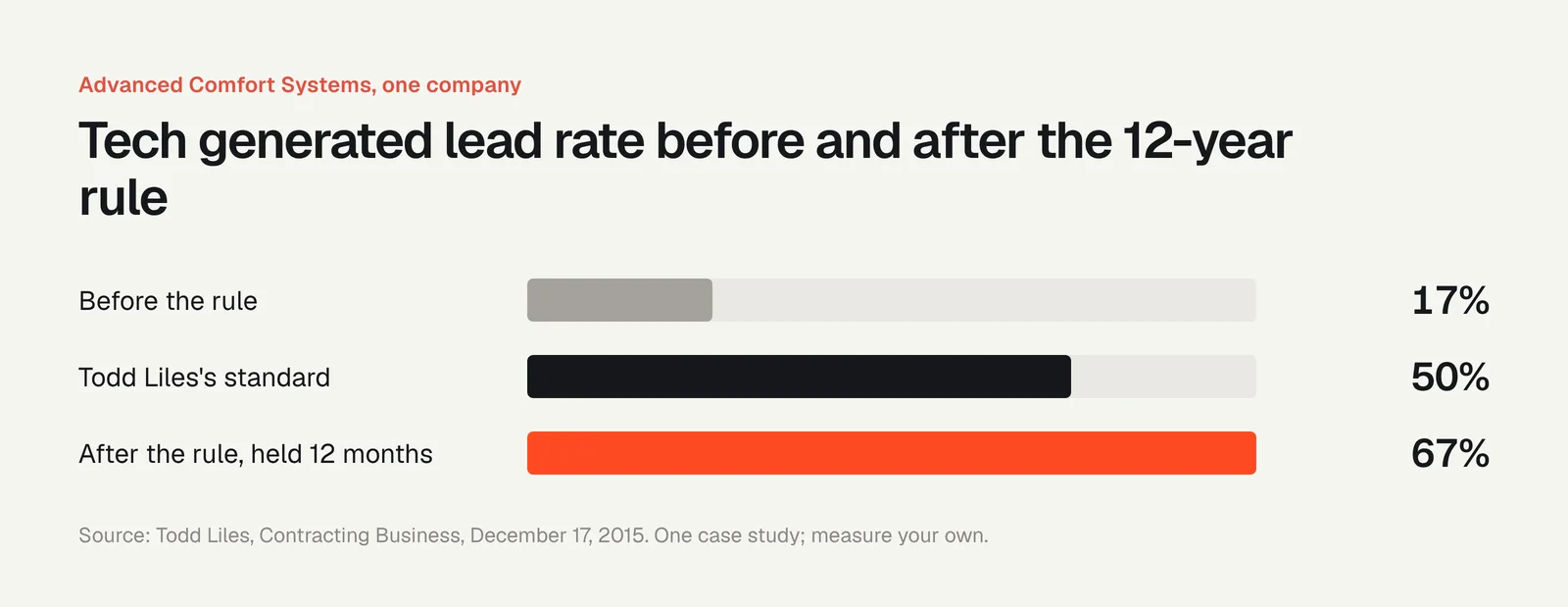
A tech generated lead is a service technician handing a replacement opportunity to a comfort advisor, and a good rate is about half of the visits where the system is past your age threshold. The best documented case is Advanced Comfort Systems of Hickory, North Carolina, which went from 17% to 67% of qualifying visits and added $1.1 million in the next 12 months, as trainer Todd Liles reported in Contracting Business. The change was a rule the techs voted on themselves.
Key takeaways
- Measure leads set against qualifying visits: systems older than a threshold your techs agree on.
- Liles recommends 50% as the standard. The Hickory company held 67% for 12 months.
- Good techs avoid setting leads when the program is framed as selling. Frame it as telling the homeowner the truth about an old system.
- Pay a small spiff on the handoff, and tell the tech what happened afterward.
- Book the comfort advisor's visit before the tech leaves the driveway.
What is a tech generated lead?
It is a replacement or major upgrade opportunity that a service or maintenance tech identifies and hands to a comfort advisor. Shops call it a tech lead, a turnover or a TGL. It has nothing to do with employee attrition, which is the other meaning of "turnover" you'll find when you search.
The play is old. The tech on a no-cool visit sees the system is past its useful life, says so, and asks whether the homeowner would like someone to come out and go through options. You already paid for the truck roll, and the homeowner already trusts the person in their basement.
| Marketed lead | Tech generated lead | |
|---|---|---|
| What you paid | Ad spend, every time | A truck roll you already billed |
| Trust | A stranger from the internet | The person who just fixed their heat |
| Competition | The homeowner is likely collecting bids | Often no other contractor knows yet |
| Timing | Whenever the ad ran | The moment the problem is live |
| Who books the visit | The office, later | The tech, in the home, now |
What is a good turnover rate for HVAC service techs?
About 50% of qualifying visits is the standard Todd Liles recommends, and he calls it the "line in the sand." The numbers come from one company. Advanced Comfort Systems ran its previous 12 months of service visits through an age filter and found a lead rate of 17%. After adopting the rule below, it reached 67% and held it for 12 months.
The rule is the opposite of a sales technique. The techs voted, anonymously, on the system age past which a homeowner deserves to hear their options. The average came out to 12 years. That became the line: a system older than the line gets the conversation every time, because the techs decided a homeowner with an old condenser has a right to the information.
Your rate depends on the denominator. A shop measuring against all service visits will post a lower number than one measuring against qualifying visits. Pick one definition, write it down and don't change it mid-year. This is also one case study from 2011 and 2012, so treat 17% and 67% as reference points and measure your own.
Why won't good techs set leads?
Because they see themselves as mechanics, and the program keeps telling them it is about sales. Many shops have a senior tech, often the best diagnostician in the company, who has set two leads all year. Ask why and you hear "I'm not going to push equipment on people."
That sentence assumes a turnover is a push. The assumption usually comes from how the program was introduced: a spiff announced at a Monday meeting, a leads-per-month target, a leaderboard. Nothing in that framing said diagnosis.
There is a quieter reason too. Techs rarely hear what happened. They set a lead in February, the comfort advisor runs it, and nobody tells the tech whether the family got a new system.
What do the best turnover conversations sound like?
They sound like a diagnosis said out loud, with the homeowner invited to decide. The weak version gives an opinion: "This thing is on its last legs. You should just replace it." The homeowner hears a pitch.
The strong version gives evidence and hands over the decision: "Your compressor is drawing more amps than it's rated for, and this is the second repair in two years. I can fix today's problem either way. Given the age, would it help if one of our project people showed you what replacement looks like, so you have real numbers before the next breakdown?"
The facts are the same. The homeowner reaches the conclusion. The tech shouldn't quote a price, because the comfort advisor then inherits a number set by someone who hasn't scoped the job.
How does SalesAsk help coach the handoff?
SalesAsk records the service visit from the tech's phone, so a manager can hear the turnover conversation and not only count it. A leaderboard shows who set leads. A recording shows what was said.
Take the minute where a senior tech earns a yes and play it at the service meeting. The techs who say they aren't salespeople hear that the best turnover in the company contains no selling. Add "offered options on systems past the threshold" to the steps each visit is scored on, and you can see who skips it.
The coaching covers the tech before the visit with an AI roleplay of the conversation, during it with optional live nudges, and afterward with written feedback. General Air Conditioning & Plumbing uses SalesAsk across five teams, field technicians included. To hear your own techs' handoffs, book a SalesAsk demo.
Should you pay spiffs for tech generated leads?
Yes, on the handoff, and keep them small. A large spiff paid only on closed jobs teaches techs to pre-sell and quote rough prices in the basement. Paying nothing signals that the behavior doesn't matter.
- Pay a small, fast spiff on the lead being set, so the tech's job ends cleanly at the handoff.
- Report every outcome back. "The Hendersons went with the heat pump, and the monthly payment made it work."
- Review real handoff recordings in service meetings, so the standard is about words.
One problem nobody has fully solved: once turnovers are measured, a few techs will invent them, flagging systems with years left. A hard age threshold catches most of that. If you run service on billable-hours pressure and add lead quotas on top, no coaching tool fixes the incentive you've built.
What happens after the tech leaves?
The lead cools. The homeowner said yes in a moment of trust, standing next to the person who found the problem. Each day before the comfort advisor's visit, a spouse weighs in or a brother-in-law knows a guy.
Book the advisor's visit before the tech pulls out, with an introduction by name: "Marcus handles these projects. He's who I'd want at my mom's house." Send the tech's notes with the lead: the system age, the amp draw, what the homeowner said.
When the advisor arrives, the money conversation matters. In the Kitchen Table Report, appointments where financing came up closed at 49%, against 38% where it didn't. That is a correlation, and it is the first habit I'd check.
If I ran a two-truck shop, I'd skip most of this and keep the threshold vote and the warm handoff. A formal program is for teams where the owner can no longer ride with every tech.
Frequently asked questions
How do I start tracking turnover rate?
Add two fields to every service ticket: system age, and whether a lead was offered. Qualifying visits are tickets past your age threshold. The rate is leads set divided by qualifying visits. A spreadsheet is enough for months.
Do tech generated leads close better than marketed leads?
Most contractors believe so, and the trust argument supports it. I haven't seen an independent published benchmark. Tag the lead source on every closed job for a quarter and compare your own numbers.
Does recording service visits make techs act differently?
At first, the same way it does with sales reps. Lead with coaching and show techs their good moments first. Tell the homeowner at the start, and check our state recording guide for consent rules.
Where do I start on Monday?
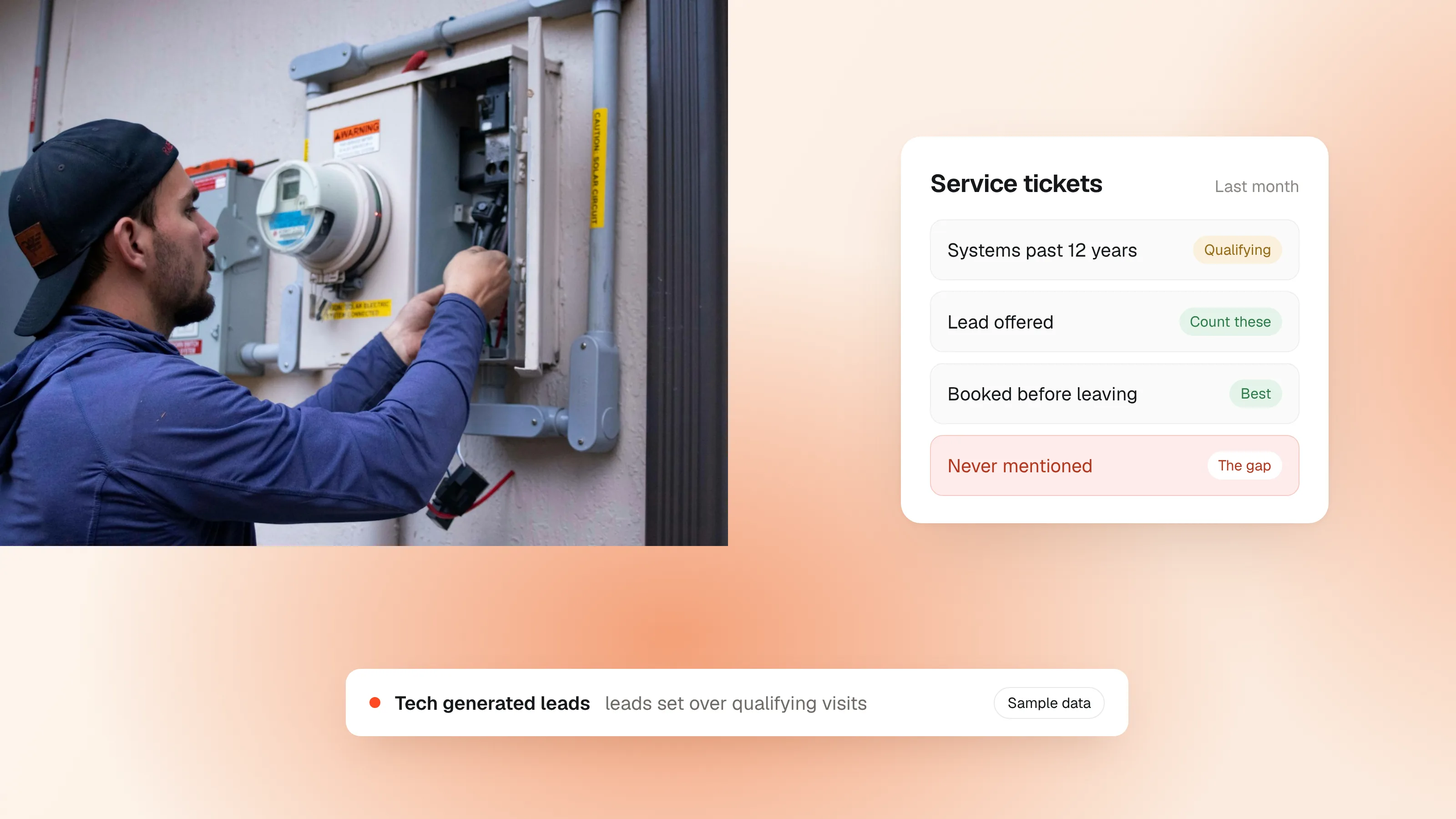
Pull last month's service tickets. Count the ones with systems past 12 years, then count how many produced a lead. That is your baseline. Then let your techs vote on the age threshold in private and announce the average as their standard.
Sources
- Todd Liles, "The Easiest Path to HVAC Technician-Generated Leads," Contracting Business, December 17, 2015.
- SalesAsk, The Kitchen Table Report 2026, The Conversation, for the financing close rates.
- SalesAsk customer story: General Air Conditioning & Plumbing.
Dara Shabnam
Leads growth at SalesAsk and writes about in-home sales training and recording consent.
More posts byWritten by the SalesAsk team
SalesAsk records and coaches in-home sales conversations for home service, home improvement and home builder teams.
More posts