Ask for the sale: Moe Abbas on Build It To Sell It with Lance Bachmann
On this page
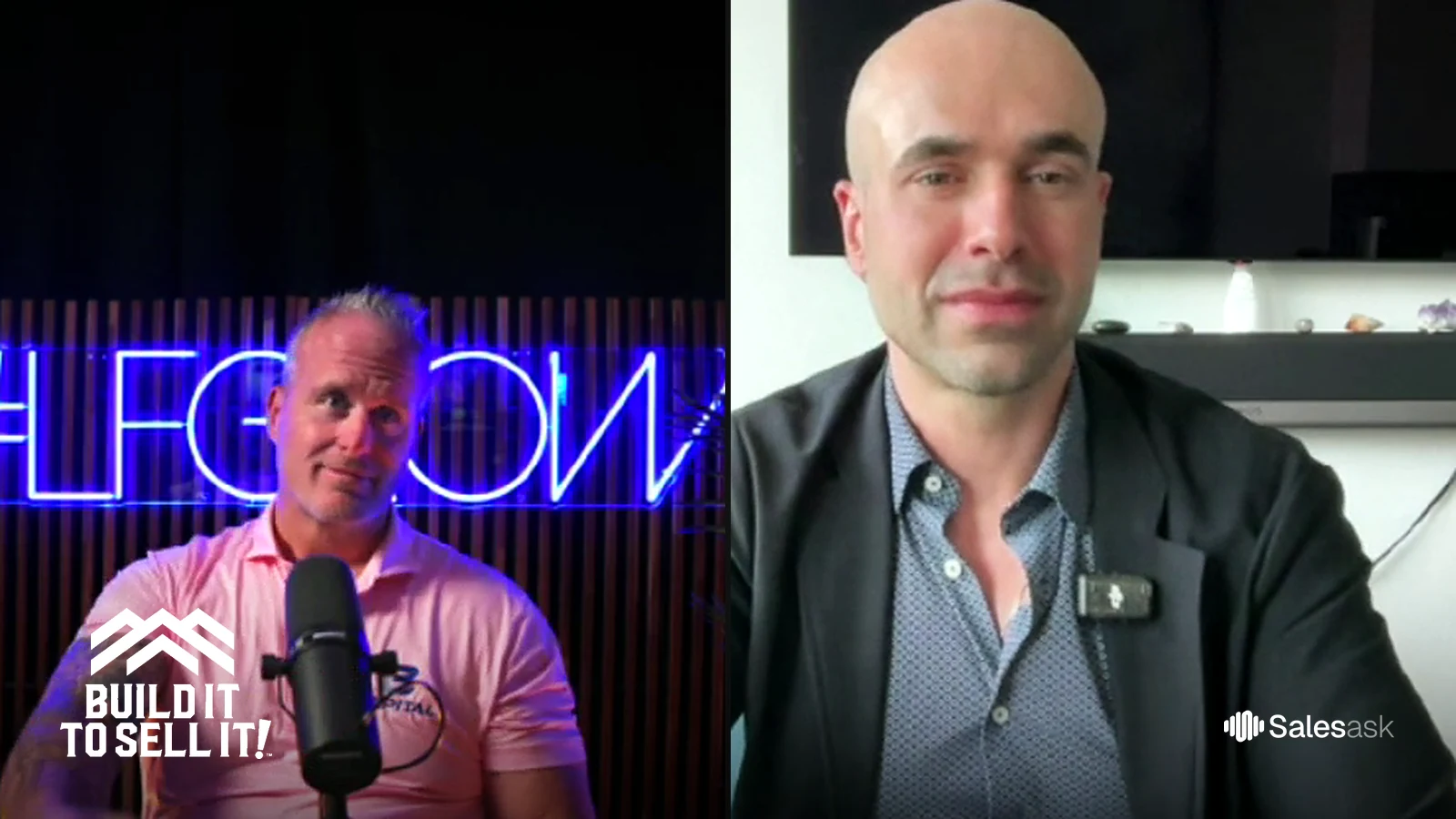
Lance Bachmann asked Moe Abbas to play the homeowner, then ran a close on him live. Moe pushed back on price, Lance worked him down to a 9% discount with the job booked inside 48 hours, and Moe said he might add one of Lance’s lines to his own pitch. That role-play comes near the end of Moe’s episode of Build It To Sell It, Lance’s podcast about growing home service companies and selling them.
Moe has been in the trades since he was 19, starting door to door. He now has three design-build companies, run by partners, that do about $40 million combined, and he’s the founder and CEO of SalesAsk. The show was still called Exit Rich when they recorded.
Key takeaways
- Moe’s companies earn a higher profit percentage at $20 million than they did at $5 million, because the controller and office they paid for early don’t grow as fast as sales.
- The owners who grow fastest aren’t always the most organized. In Moe’s experience they decide quickly.
- Rapport is overrated, he says. Trust is what you need, and he wants it in about three minutes.
- By Moe’s count, 73% of meetings that don’t close on the first visit never close.
- AI coaching won’t remove the sales manager. It takes over the first layer of coaching so the manager can do the rest.
The $2 million to $5 million stretch
Moe breaks growth into stages: zero to $1 million, $1 million to about $5 million, $5 million to $8 or $9 million, and $20 million and up, which he called “a whole other beast.” At $1 to $2 million he ran everything out of Starbucks and his truck, meeting customers and micromanaging every job himself.
Getting past $2 million meant hiring, and he warned that the next stretch usually isn’t profitable. You pay for a base level of infrastructure, like a financial controller and an office, before sales are big enough to carry it. Then it flips. The controller who helped at $3 million is the same person at $10 million, and the office doesn’t need to be four times bigger. “We’re making more as a percentage-based profit doing 20 million than we were at 5 million,” he said.
Lance calls every business under $5 million the swamp. He also explained why he doesn’t push his own companies to $100 million: he’d rather take them from a few million to $25, $30 or $40 million and sell, giving up a little on the multiple to exit sooner. Moe called that the local maximum, the point where a slightly better valuation would mean working five times harder.
Fast beats tidy
Lance asked what separates the owners who scale. Moe has worked with hundreds of SalesAsk customers. Some are hyper organized, some are a bit sloppy, and the sloppy ones are sometimes growing faster. The common thread is speed. Some owners buy, onboard and book their team inside the first meeting. Others overthink it and stall.
He hires the same way, judging people by how fast they execute, and said what slows most owners down is a limiting belief: waiting for the right people, systems, money or confidence. He told a story about the landlord of one of his buildings, who owned a big piece of the real estate around Ottawa and solved every problem Moe raised on the spot, with one shout upstairs to his controller or one phone call.
At SalesAsk, if a feature takes more than a week or two to build, Moe questions it.
The recipe and the baker
Lance’s view is that great salespeople are coached, not born. Moe agreed and split selling in two. The process is the recipe. A good baker can make a great cake once and a slightly different one the next time. “It’s only until you have a process in place that you can consistently make a great cake.” The salesmanship is the baker, and a baker who has made tens of thousands of cakes can go off script and still get it right.
Lance’s version is McDonald’s fries, which taste the same in every country he’s been to because the process is the same everywhere.
Moe added a warning about leaning on the process alone. A rep can check every box and still sound robotic, think too hard and lose the homeowner’s trust. He also said the title of his book, The One Meeting Close Blueprint, is a bit of a misnomer. The aim is sales velocity. He doesn’t always try to get the whole sale in the first meeting.
Moe’s close, step by step
- Pre-frame the visit. Tell the homeowner the plan up front: understand the project, build an estimate if it fits, sign it off, then book the build team. When they say yes to that, they’ve agreed to the path.
- Earn trust fast. Park well, look sharp, set the agenda and say something specific about their house, like how the insulation was done or why that type of roof is on it. His test of competence is whether you can explain your product in a sentence, a paragraph and a chapter.
- Do more discovery than feels natural. Why did you call us? How long has it been going on? Who else lives here? Have you talked to anyone else? Do you care more about looks or price? Most reps spend too long chatting and not long enough here.
- Let them picture the result. On a roof, show a photo of what it could look like and when it could be done.
- Show three options, a good, better and best. Most people pick the middle, and the top one anchors the price. Moe admitted he sometimes skips this and goes straight to the one he thinks fits.
- Ask for the close, then stop. “Stop talking. Stop. Shut your mouth. Go get a signature.”
- Onboard them. Get the job scheduled and stay in touch so the contract doesn’t cancel.
Why reps don’t ask
Asking is the step Moe sees skipped most, and his explanation is about pipeline. “People don’t want to ask because if they don’t ask, they haven’t gotten a no. And if it’s not a no, it’s a maybe. And if it’s a maybe, it stays in their pipeline.” Most of that pipeline, he said, is fake. The homeowner has just thought through the problem with you, and they’ll never be as motivated to buy as they are right then.
Asking also brings the objection out. Moe asks whether they’re good to move forward, and if not, “what’s holding you back right now?”
Then Lance tried it, after admitting he’d never done home services himself. Playing the rep, he asked Moe whether there was any reason his company wouldn’t give him a five-star experience, then pointed to 500 Google reviews and 50 video testimonials, in character, as proof of how they treat people. Moe pushed back on a price 20% above the other bid. Lance said 20% was his whole profit, offered to try for 7 or 8%, and asked to get on the schedule within 48 hours. Moe said he’d do it in 48 hours for 9%, and Lance took it. Afterward Lance pointed out he’d never gone below the 10% margin he gives his salespeople.
The line Moe wanted to keep was the one about reviews: past behavior is the best indicator of future behavior, so show the homeowner how you’ve treated everyone else. Lance said he was probably stumbling and fumbling on a podcast tens of thousands of people would hear, and that it only gets better the more you do it.
Is the sales manager done?
Lance thinks so. He spent years in passenger seats on ride-alongs, and now his team listens to 15 to 40 calls a day without leaving the office. Moe went further, then pulled it back. Sales is a conversation between a rep and a client, and sales management is a conversation between a rep and a manager, which is exactly what large language models are built for. He said very few SalesAsk customers do much coaching themselves now because they rely on Coach Dean for it.
He doesn’t think the role goes away, though. The AI surfaces the insights and does the first level of coaching. The manager checks that work, spot checks calls, holds the team accountable, hires, sets targets and gets more time with the reps instead of grind work that never scaled.
Where SalesAsk fits
SalesAsk listens to the conversation between your rep and the homeowner, checks it against your process and coaches the rep after every visit through Coach Dean. Reps can practice the close beforehand with AI role-play, and managers can review visits with virtual ride-alongs. Moe’s full playbook is in The One Meeting Close Blueprint, and he goes deeper on discovery in his Contractor Evolution episode. See how it works for roofing companies, or book a demo.
FAQ
Who is Lance Bachmann?
He hosts Build It To Sell It, which was called Exit Rich when Moe recorded his episode. He partners with small home service businesses, grows them and sells them, and said on the episode he’s done it six times.
What does Moe mean by the one meeting close?
It’s the name of his book, and he calls the title a bit of a misnomer. The point is sales velocity: set up the visit so the homeowner can decide that day, without forcing every deal on the first meeting.
Do jobs that don’t close on the first visit come back?
Most don’t, by Moe’s numbers. He said 73% of meetings that don’t close on the first visit never close, which is why he wants reps to ask before they leave.
Does AI sales coaching replace the sales manager?
Not in Moe’s view. The AI does the first level of coaching and surfaces what to look at. The manager still verifies, holds people accountable, hires and builds the relationship with each rep.
Where can I watch the full episode?
The full episode is on this page, just above the key takeaways.
Sources
- Build It To Sell It with Lance Bachmann (then called Exit Rich), “Moe on SalesAsk and Scaling Home Services with AI-Driven Coaching,” recorded in 2025, watch on YouTube.
Dara Shabnam
Leads growth at SalesAsk and writes about in-home sales training and recording consent.
More posts byWritten by the SalesAsk team
SalesAsk records and coaches in-home sales conversations for home service, home improvement and home builder teams.
More posts