Is It Legal to Record In-Home Sales Visits? The Contractor's State-by-State Guide

On this page
Recording an in-home sales visit is legal in every state when the consent rule of the state you are standing in is met. Federal law needs one participant's consent, and your rep is a participant. About eleven states are stricter and require everyone's consent, and Oregon requires that everyone in an in-person conversation be told. The policy that works everywhere is to ask at the door on every visit.
I'm a marketer and not a lawyer. This is general information, recording law changes, and you should confirm your policy with an attorney in the states where you sell.
Key takeaways
- Federal law (18 U.S.C. 2511) allows a recording when one party to the conversation consents.
- The Reporters Committee for Freedom of the Press lists about eleven all-party states: California, Delaware, Florida, Illinois, Maryland, Massachusetts, Michigan, Montana, New Hampshire, Pennsylvania and Washington.
- Oregon's statute requires that all participants in a conversation be specifically informed before it is recorded.
- Florida makes unlawful interception a third-degree felony. California allows a civil suit for $5,000 per violation or three times actual damages, whichever is greater.
- One policy covers every state: disclose at the door, ask again when someone new joins, and stop when anyone objects.
Is it legal to record an in-home sales visit?
Yes, in every state, as long as you meet that state's consent rule. Federal law sets the floor. Under 18 U.S.C. 2511(2)(d), it isn't unlawful to record a conversation when the person recording is a party to it or one party has consented, unless the recording is made to commit a crime or a tort.
States can be stricter, and several are. Picture a storm crew that works Georgia in June and follows a hurricane into Florida. Nothing about the conversation at the kitchen table changes, and the law does. Florida's statute allows a recording only when all parties have given prior consent.
An in-home visit is also a conversation inside a private residence. I'd treat that as the setting where a homeowner's expectation of privacy is at its highest, and plan for it.
Which states require everyone in the room to consent?
About eleven, according to the Reporters Committee's recording guide, with a few states that treat phone and in-person conversations differently.
| Category | States, per the Reporters Committee guide | What it means at the kitchen table |
|---|---|---|
| All-party consent | California, Delaware, Florida, Illinois, Maryland, Massachusetts, Michigan, Montana, New Hampshire, Pennsylvania, Washington | Get everyone's agreement before the recorder starts |
| Different rules for phone and in person | Oregon is stricter in person. Connecticut and Nevada are stricter on the phone | A phone chart won't tell you the in-person rule. Check both |
| One-party consent | The remaining states, under their own laws or the federal rule | The rep's consent is enough in law. Telling the homeowner is still the better practice |
Oregon is the one that surprises people. ORS 165.540 treats phone conversations on a one-participant basis, and it prohibits recording a conversation unless all participants are specifically informed. If your reps sell in Portland, the disclosure is the statute.
The guide notes that Michigan's rule applies at least to recordings made by someone outside the conversation, and the details there are argued over. I'd run all-party disclosure in Michigan and not rest a company policy on the narrower reading.
State lists like this one go out of date. Use it to know where to look, and have your attorney confirm the states on your service map.
What happens when the spouse walks in halfway through?
In an all-party state, treat a new person joining the conversation as a new party whose consent you don't have yet. The rep discloses at the door, the wife agrees, and forty minutes later the husband comes home and sits down to hear the price.
The fix takes five seconds: "Just so you know, I've been recording our conversation with your wife's okay so I don't miss any details. Are you good with that?" Asking also shows a skeptical second decision maker that you have nothing to hide. Our guide to one-leg appointments covers the rest of that moment.
What should a multi-state contractor's recording policy be?
Disclose on every visit in every state. A policy that depends on reps remembering which side of a state line they parked on will fail sooner or later, and it will fail in the expensive direction.
Storm restoration companies follow weather across state lines. Franchise groups run branches in one-party and all-party states at once. A rep who moves from the Atlanta branch to the Orlando branch brings her habits along, and the habit you want her to bring is the disclosure.
There's a commercial reason too. A plain disclosure reads as confidence: nothing said at this table will be misremembered. I don't have a refusal rate to give you, and I won't guess at one.
When a homeowner says no, don't record. Note the refusal, run the appointment, and coach that rep from the visits that were recorded.
How does SalesAsk help with consent?
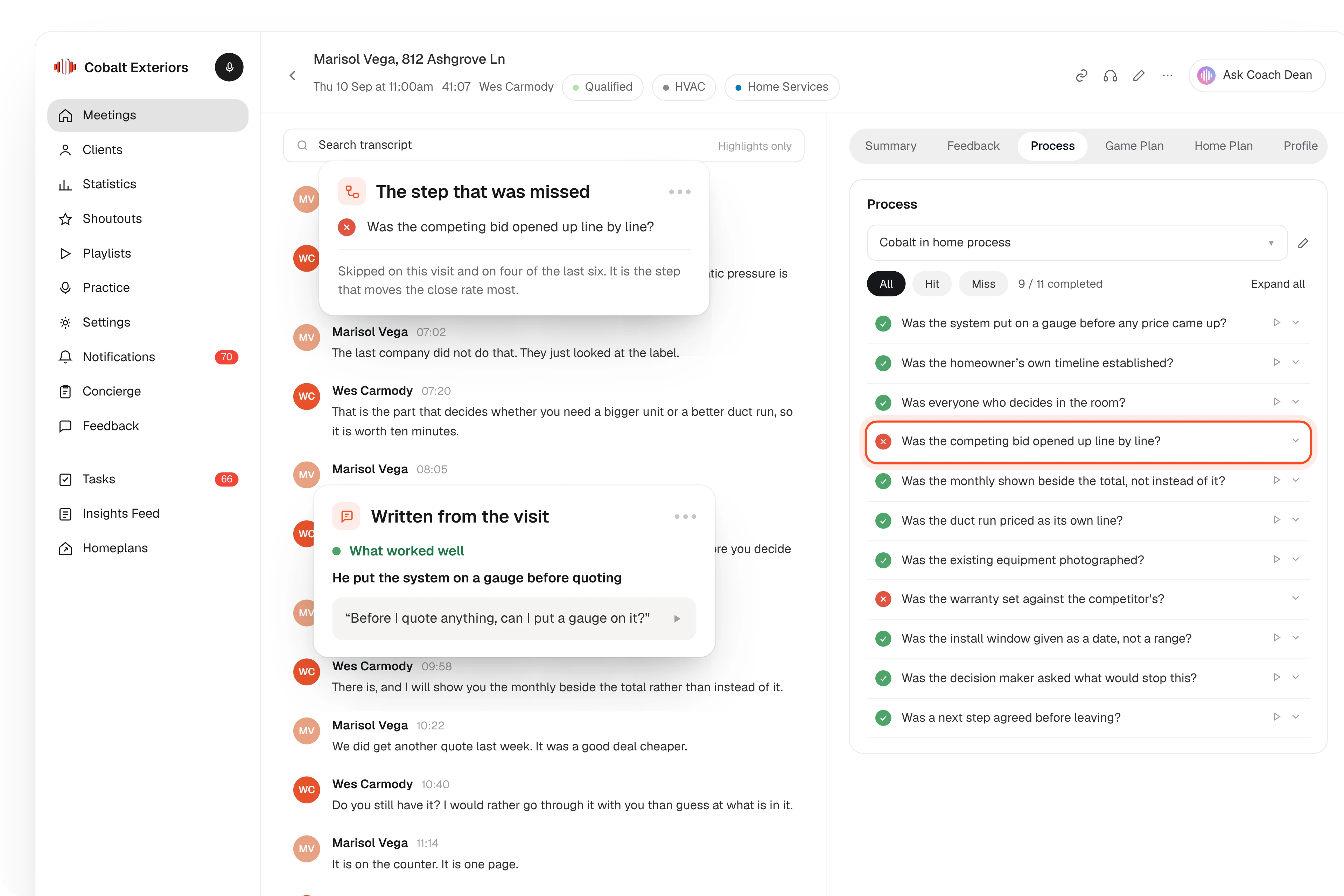
SalesAsk makes the disclosure a step you can check on every recorded visit. If "ask before recording" is the first step of your sales process, each visit is scored on whether it happened.
The coaching covers the ask before, during and after the visit. A rep practices the disclosure line in an AI roleplay, including the moment the spouse walks in. Live coaching is available during the visit. Written feedback afterward shows whether the ask was made at the door.
If reps are nervous about the ask, that's a wording problem you can fix. We covered the wording in how to tell homeowners you're recording and the rollout in getting reps to record. To see the disclosure step scored on your own visits, book a SalesAsk demo.
What are the penalties if a rep gets it wrong?
Depending on the state, an unlawful recording can be a crime, a civil payout, or both. Two examples from the statutes:
- Florida. Violating the interception statute is a felony of the third degree.
- California. Penal Code 637.2 lets an injured person sue for $5,000 per violation or three times actual damages, whichever is greater, and says actual damages aren't required to bring the action.
The statutes understate the practical cost. Home services runs on referrals and reviews, and a post saying a company secretly recorded someone in their own home does damage in any state. That's the case for disclosure even where the law lets you stay silent.
Where does this guide stop?
At the edge of what I checked. I read the federal, Florida, Oregon and California statutes and the Reporters Committee's state list. I haven't read every state's statute or the court decisions that interpret them, and several states have exceptions this guide doesn't cover.
It also covers recording consent only. What you do with the recording afterward, including how long you keep it and who can listen, is a separate privacy question for your attorney. Our recording consent and privacy guide covers the basics.
Frequently asked questions
My rep consented. Isn't that one party?
Yes, and in one-party states that is why the rep's consent is enough in law. All-party states require more: the rep's consent doesn't cover the homeowner.
What if the homeowner asks mid-visit to stop recording?
Stop. Arguing about it turns a small moment into the story they tell their neighbors. The appointment matters more than the file.
What about the phone conversation that books the appointment?
Phone conversations have their own rules, and they don't always match the in-person rule in the same state. The Reporters Committee guide lists Connecticut and Nevada as all-party on the phone. If your office phones into an all-party state, disclose on the phone too, and ask your attorney about conversations that cross state lines.
Does consent have to be in writing?
Ask your attorney for your states. In practice, a verbal yes captured at the start of the recording gives you a record of the agreement.
Sources
Dara Shabnam
Leads growth at SalesAsk and writes about in-home sales training and recording consent.
More posts byWritten by the SalesAsk team
SalesAsk records and coaches in-home sales conversations for home service, home improvement and home builder teams.
More posts