Sales Film Review: How In-Home Teams Coach Off the Tape

On this page
A sales film review is a standing 30-minute team session that breaks down two recorded appointments, one win and one loss, at a single coachable moment. It works because of arithmetic. Eight reps running twenty appointments a week, at the 51-minute median in the SalesAsk Kitchen Table Report, put about 136 hours of customer conversation on the books. The manager coaching them has maybe two.
Key takeaways
- The format: 30 minutes, every week, two clips of three to five minutes, one moment.
- Eight reps at twenty appointments a week produce about 136 hours of conversation, using the 51-minute median appointment in the Kitchen Table Report.
- Top and bottom reps sit 25 to 35 points apart on close rate, across the 1.3 million+ sales conversations SalesAsk analyzed.
- Appointments where financing was mentioned closed at 49%, against 38% where it wasn't, so the financing mention earns a session of its own.
- Reps nominate their own losses. The day a recording is used as a public autopsy, reps stop recording.
What is a sales film review?
It's a half hour where the whole team watches two plays from last week and argues about them. Football teams settled this decades ago, and door-to-door roofing crews already borrowed the word. They call it film.
Each part of the format blocks a common failure. Thirty minutes on a fixed day, because coaching that waits for things to calm down happens four times a year. Two clips, because a team can hold two plays in its head and compare them. One moment, because "let's review Jake's appointment" produces opinions about Jake, while "let's watch the ten seconds after the price landed" produces a behavior anyone can copy on Tuesday.
Film review is a different job from quality assurance. Nobody is grading every appointment in the room, because no manager can review every recording. SalesAsk does that part: it scores each recorded visit against your sales steps and shows where discovery ended or financing never came up. The half hour is for the part software can't do, which is a room full of reps deciding together what good sounds like.
Why run film instead of another ride-along?
A ride-along coaches one rep on one appointment, and a film session coaches the whole roster on the same play in the same half hour. I still want managers in trucks sometimes. A day in the passenger seat shows things no recording catches: how a rep reads the driveway, how they handle the dog, whether the tablet comes out too early. New reps need that, and the virtual ride-along guide covers what should stay in person.
As the only coaching method, the ride-along fails on arithmetic. It's one manager, one rep and one day, and the appointment the manager sees isn't the rep's usual one. Everyone sells better with the boss on the couch. A recording shows you Tuesday afternoon when nobody is watching.
| Format | Best at | Cost | Who improves |
|---|---|---|---|
| In-truck ride-along | Trust, live correction, context the mic misses | A full manager day per rep | One rep |
| One-on-one review of a recording | Fixing a private, personal habit | 30 to 45 minutes per rep per week | One rep |
| Team film session | Setting a shared standard for one moment | 30 minutes per week in total | The roster |
What do you watch in 30 minutes?
Two clips of three to five minutes each, both showing the same moment, and nothing else. The fastest way to kill a film session is to scrub through a 90-minute kitchen remodel appointment live, hunting for something to say. Pick the moment and pull the timestamps before the meeting.
The moments worth a rotation, in the order I'd run them:
- The end of discovery. Who ended it, the rep or the homeowner, and what question never got asked.
- The ten seconds after the price lands. The silence gets heavy and the rep starts negotiating against himself.
- The financing mention. Whether it happened, and who raised it. In the Kitchen Table Report, appointments where financing was mentioned closed at 49%, against 38% where it wasn't.
- The options. One number on the page, or three the homeowner can choose between.
- The ask. Some lost appointments contain no close attempt at all, and the recording settles that argument in seconds.
End every session the same way. Each rep names the one thing they'll do differently this week, out loud, in a sentence. The next session opens by checking it against new recordings.
Why is one moment worth a whole session?
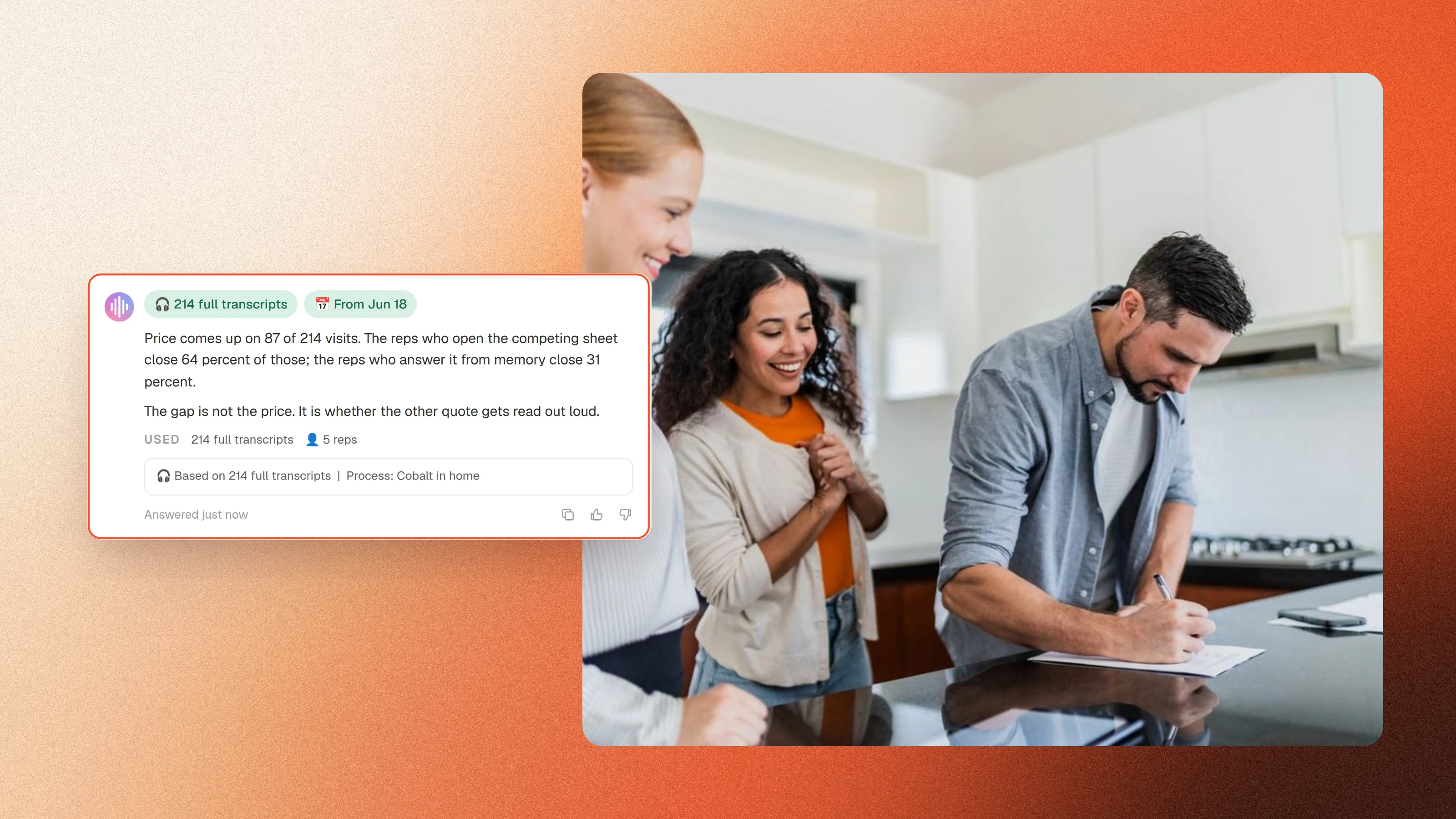
Because the gap between reps is large and it lives in moments like these. Top and bottom reps sit 25 to 35 points apart on close rate in the Kitchen Table Report, selling the same price book.
I read that spread as an information problem more than a talent problem, and that is my reading, not something the data proves. The bottom rep has never heard what the top rep's price moment sounds like. Film review is the cheapest way I know to pass that along.
How do you keep reps from dreading it?
Reps nominate their own loss clips, the manager supplies the wins, and the session critiques one repeatable behavior, never a person. Every team I've seen hate film review hated it for the same reason: someone used the recording as a public autopsy. After that you lose more than the meeting. You lose the recordings, because reps stop recording the day the tape becomes a weapon.
- Wins get named. Losses stay anonymous unless the rep volunteers. Reps want to know what went wrong on the deal that stung, so they volunteer once the room feels safe.
- The manager goes first. Show your own old appointment, including the cringe.
- New hires watch for their first month. Their job in the room is to steal.
- Praise names the behavior. "Listen to how long she waits after the number" travels. "Sarah is a rock star" doesn't.
Open with a shoutout. Thirty seconds of someone's best moment from last week sets the tone that recordings are where credit lives.
How does SalesAsk fit into a film session?
SalesAsk finds the clips and coaches each rep between sessions. Scoring every recorded visit against your steps tells the manager which two visits to pull, and playlists hold the clips for the room.
The team session sets the standard. SalesAsk carries it to each rep before, during and after the next visit: an AI roleplay to practice the moment the room just watched, live coaching in the home as an option, and written feedback afterward.
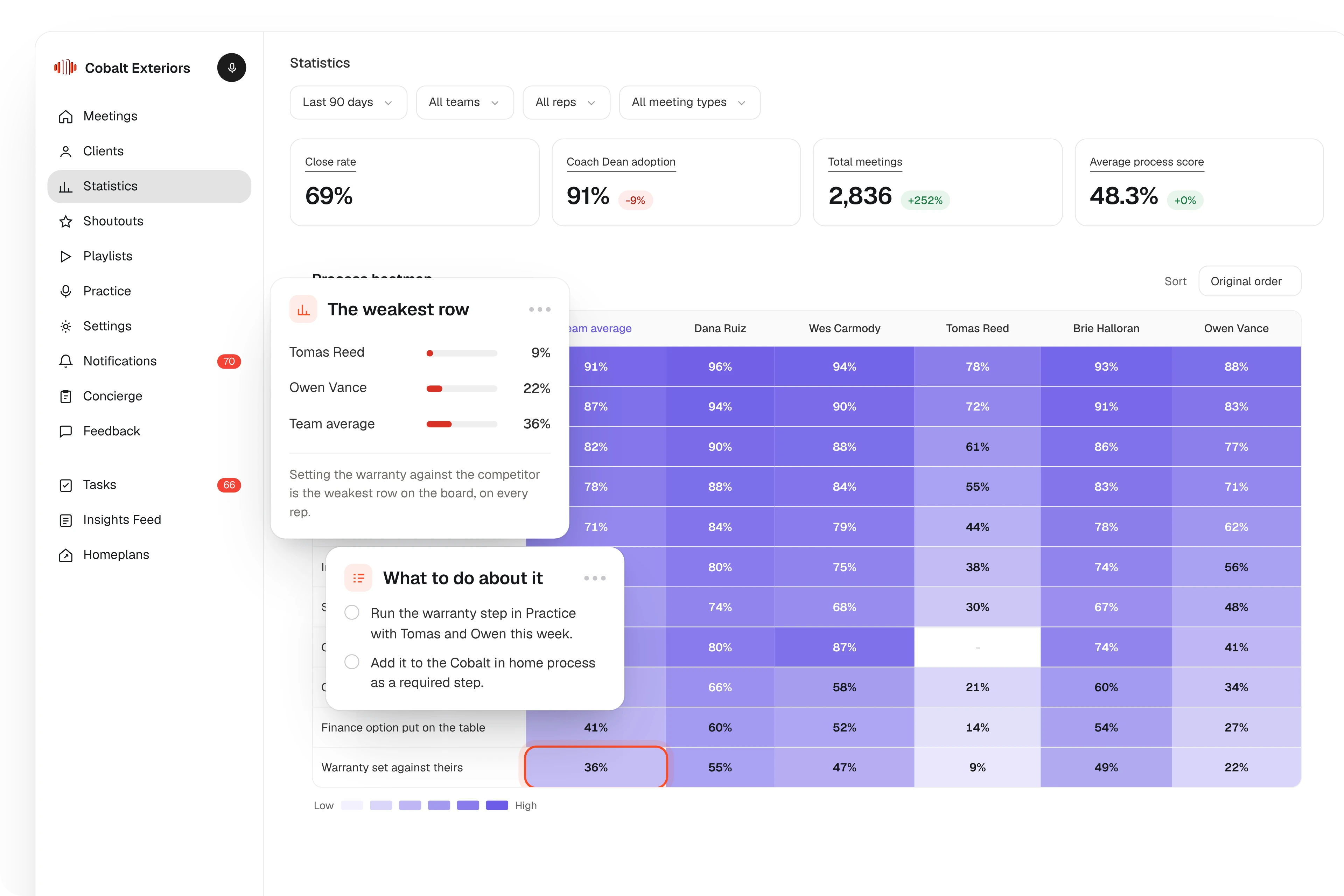
To see how it would pick clips from your own team's visits, book a SalesAsk demo.
What won't film review fix?
It won't fix low recording adoption, a thin lead week, or a rep who shouldn't be in sales.
Film review sits downstream of recording. If your reps capture two appointments a week, you're reviewing a highlight reel of their best behavior. Fix adoption first.
I'd also expect the gains to show up at the bottom of the roster first, since your top closer is the one producing the win clips. I don't have data on how long the improvement lasts. The teams I've watched keep moving are the ones that keep rotating moments, and I wouldn't call that proven.
Where do you start this Friday?
Pull one win and one loss from last week, both cut to the ten seconds after the price. Book 30 minutes, play them back to back, and ask the room one question: what did the homeowner do differently? Run that exact session four Fridays in a row before you change anything. The format is boring on purpose.
Frequently asked questions
How often should you run film review?
Weekly. Every other week is where the habit dies, because one skipped session leaves a month between the reps and the recordings. If a week is brutal, run ten minutes with one clip before you cancel.
Should it be a team session or one-on-one?
Both, for different jobs. The team session sets the standard. The one-on-one fixes the private habit a rep would rather not work on in public.
How long should a clip be?
Three to five minutes. If you need ten, you picked a topic and not a moment. Tighten it until the clip contains one decision.
What about the rep who refuses to be shown?
Honor it for losses. Their wins are still fair game with their name on them. In my experience the holdout joins within a month of watching everyone else get coached.
Do you need to tell homeowners the visit is recorded?
Yes. Handle consent before the first clip ever plays, and check the rules in your state. Our guide on how to tell homeowners you're recording covers the wording.
Sources
- SalesAsk Kitchen Table Report 2026: benchmarks (appointment length, financing figures and the close-rate gap between reps)
Dara Shabnam
Leads growth at SalesAsk and writes about in-home sales training and recording consent.
More posts byWritten by the SalesAsk team
SalesAsk records and coaches in-home sales conversations for home service, home improvement and home builder teams.
More posts