Sales Scorecard for In-Home Sales: A Template You Can Use Tomorrow

On this page
A sales scorecard for in-home sales lists the steps your best rep takes on every appointment and scores each one yes, partial or no, with the moment from the conversation as evidence. The template below has 14 steps, from the recording disclosure to the booked next step. Copy it, cut the steps your team doesn't use, and score three appointments tomorrow.
Key takeaways
- The template has 14 steps, each scored 2, 1 or 0 with a quote and a timestamp as evidence. The maximum is 50 points.
- Payment before the total carries the heaviest weight. Appointments where financing was mentioned closed at 49%, against 38% where it wasn't, in the SalesAsk Kitchen Table Report.
- The median in-home appointment runs 51 minutes, so scoring by hand works for about three appointments a week.
- Top and bottom reps sit 25 to 35 points apart on close rate. Appointment scores show which steps make up that gap on your team.
- Scorecards reward box-ticking if you read only the number. Read the evidence column.
What is a sales scorecard?
It's a record of whether the steps of your sales process happened, and the term covers two different things.
- An appointment scorecard grades one conversation against your process. Did discovery happen? Were options shown? Was there a clear ask?
- A rep scorecard tracks results over time: close rate, average ticket, appointments run.
You need both, and they answer different questions. The rep scorecard tells you who's behind. The appointment scorecard tells you why.
The template is built the way SalesAsk scores visits: against the sales process a company already teaches, step by step, with a quote and a timestamp behind each score. A grade like "rapport: 7 out of 10" tells a rep nothing. "You gave the price at minute 31 and hadn't asked who else was quoting" tells him what to change.
What does an in-home sales scorecard template look like?
Fourteen steps, each scored 2 (done well), 1 (partly done) or 0 (missed). Write down the line from the appointment that justifies the score. If you can't point to a moment, it's a 0.
| # | Step | What "done" sounds like | Weight |
|---|---|---|---|
| 1 | Introduction and recording disclosure | "Before we start, I record our conversation so I get the details right. Is that okay?" | x1 |
| 2 | Agenda for the visit | "I'll look at everything first, then we'll sit down and go through options." | x1 |
| 3 | Why now | "What made you get in touch this month?" | x2 |
| 4 | What they've already ruled out | "Have you looked at anything you didn't like?" | x2 |
| 5 | Who else is quoting | "Who else are you talking to, and when?" | x2 |
| 6 | Who decides | "Is anyone else part of this decision?" | x2 |
| 7 | Walkthrough shown, not just done | Photos on the homeowner's phone, problem explained in plain words | x1 |
| 8 | Needs recapped before presenting | "So the upstairs is the problem, and you want it done before your mother moves in." | x2 |
| 9 | Two or three options | Options presented, top one first | x2 |
| 10 | Recommendation tied to their words | "Given what you said about the upstairs, I'd go with the middle one." | x1 |
| 11 | Payment before the total | Monthly figure raised before or with the total, not after a flinch | x3 |
| 12 | Objection clarified, then answered | "When you say think about it, is it the price, the timing or us?" | x2 |
| 13 | Clear ask | "Which option do you want to go with?" | x2 |
| 14 | Next step booked | A date and time, or a signature | x2 |
The maximum score is 50: the weights add to 25, times 2 points. Express it as a percentage so appointments compare fairly.
Step 11 carries the heaviest weight for a reason. In SalesAsk's Kitchen Table Report, appointments where financing came up closed at 49%, against 38% where it didn't. The report says plainly that this is a correlation. It's the only weight here that rests on data, so it gets the largest one. If your own results say something else, change it.
How do you score an appointment with it?
- Listen to the whole appointment once at 1.5x speed, or read the transcript. Don't score on the first pass.
- Go step by step and find the moment for each. Write the timestamp and the line.
- Score 2, 1 or 0. Partial means the step happened late or weakly. Discovery questions asked after the price is a 1.
- Pick one step to coach. Choose the one that, fixed, would have changed this appointment. That isn't always the lowest score.
- Tell the rep within a day, with the timestamp, so he can hear it himself.
Scoring by hand means listening to the appointment again, and the median in-home appointment in our report runs 51 minutes. That's fine for three appointments a week. It doesn't work for every appointment on a ten-rep team, which is how a scorecard ends up in a drawer.
How does SalesAsk score appointments?
SalesAsk scores each recorded visit against your own steps, with the evidence attached, so the manager's time goes to step four: choosing what to coach. The same steps run through the coaching before, during and after the visit. A rep practices in an AI roleplay scored on them, can turn on live coaching in the home, and gets the written scorecard afterward.
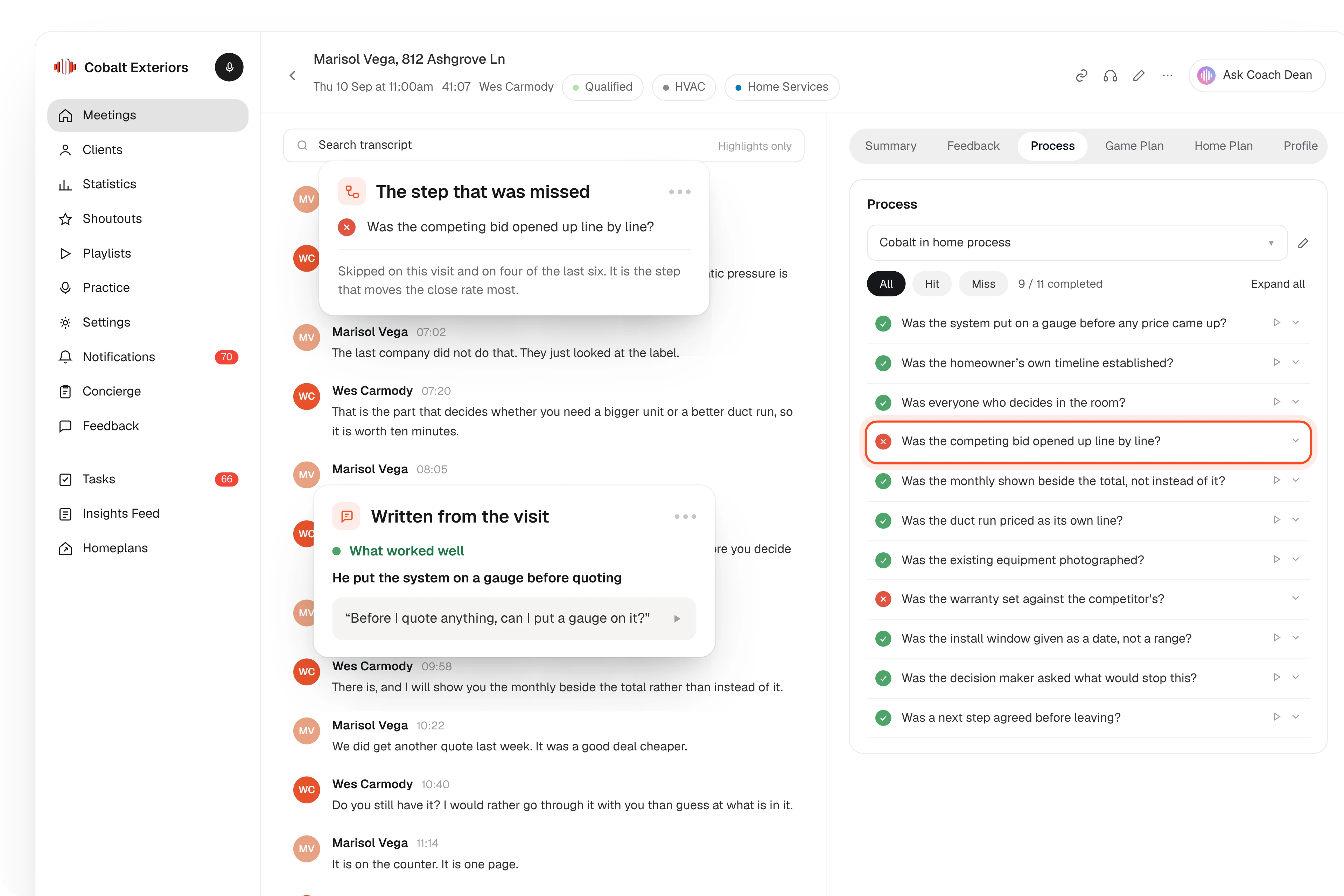
To see the template running on your own recorded visits, book a SalesAsk demo, or read how virtual ride-alongs use the same scores.
What does a scored appointment look like?
Here's an example I wrote for illustration, built on a pattern that comes up in kitchen remodels. It is not a real customer's appointment.
| Step | Score | Evidence |
|---|---|---|
| 5. Who else is quoting | 0 | Never asked. Homeowner mentioned "the other company" at 52:10 and the rep didn't follow up |
| 6. Who decides | 1 | Asked at 48:00, after the price. Husband not present |
| 9. Two or three options | 2 | Three cabinet lines shown, premium first, 31:40 |
| 11. Payment before total | 0 | Total given at 44:15. Monthly payment raised at 46:30 after "that's a lot" |
| 14. Next step booked | 1 | "I'll send it over" with no date |
The coaching note follows from the evidence: "Ask who else is quoting and who decides before the walkthrough. Put the monthly figure on the same page as the total." Both changes can be checked on the next appointment.
How should you build the rep scorecard?
Monthly, per rep, with five lines.
| Metric | Why it's on the card |
|---|---|
| Appointments run | Context for everything else |
| Close rate | The outcome |
| Average contract value | Whether options are being shown |
| Average appointment score | Whether the process is happening |
| Lowest-scoring step | What to coach next month |
Put the last two next to close rate. In the Kitchen Table Report the close-rate gap between top and bottom reps runs 25 to 35 points. The appointment scores tell you which steps make up that gap on your team.
Why do scorecards work when they're built on steps?
Because reps can act on a step. They can't act on "be more confident."
At J.S. Brown and Co., a design-build remodeler in Ohio, reps had been sitting in the 70s and 80s on the weekly recap and getting few exceptional-meeting call-outs. President Monica Lewis now gets quite a few. "It's great to see that percentage go up and know that they're confidently presenting what needs to be talked about: the process, our company, all of that." The full account is in the J.S. Brown story.
The steps have to be yours. At Mr. Roofing, COO Mark Schmidt cared about whether reps ran the company's own approach: "It's very customizable. It accurately captures how well they're conforming to the Mr. Roofing way." And Anthony, Sales Manager at 5 Star Disaster Services, said SalesAsk can "pull out the steps that should have happened, highlight areas we can improve, and give us real-time feedback we can actually act on."
Where do sales scorecards mislead?
They reward box-ticking. A rep who asks "who else are you talking to?" in a flat voice and moves on gets the same 2 as one who asks it and listens. Read the evidence column along with the number.
The weights are a judgment call. Only the payment weight rests on our data, and that is a correlation, with no proof that the step causes the close. Revisit the weights each quarter against your own results.
A perfect score doesn't guarantee a sale either. Some homeowners were never going to buy. If a rep scores in the 90s and still doesn't close, look at the leads before you look at the rep.
Frequently asked questions
What should be on a sales scorecard?
For appointments, the steps of your sales process, each scored with evidence. For reps, appointments run, close rate, average ticket and average appointment score.
How many steps should a sales scorecard have?
Between 10 and 15 for an in-home appointment. With fewer you miss steps that matter, and with more nobody scores it the same way twice.
Should reps see their own scorecards?
Yes, and before anyone else does. A rep who sees his own score first treats it as feedback. One who hears it from a manager first treats it as surveillance.
How often should you score appointments?
Every appointment, if SalesAsk does the scoring. If you're scoring by hand, three per rep per week is enough to see patterns.
Can you use this scorecard for phone sales?
You can use a good part of it. Drop the walkthrough step and adjust the recording disclosure to your state's rules for phone conversations.
Sources
- SalesAsk Kitchen Table Report 2026: benchmarks (appointment length, financing figures and the close-rate gap between reps)
- J.S. Brown and Co. customer story
- Mr. Roofing customer story
- 5 Star Disaster Services customer story
Dara Shabnam
Leads growth at SalesAsk and writes about in-home sales training and recording consent.
More posts byWritten by the SalesAsk team
SalesAsk records and coaches in-home sales conversations for home service, home improvement and home builder teams.
More posts