"Call Us After the Holidays": The Objection That Hands You a Deadline

On this page
Answer "call us after the holidays" by separating the decision from the disruption: get the yes now, and schedule the work for whenever it bothers the household least. It is the one stall that arrives with a deadline attached, because guests come on a known date and the year ends on one. The National Retail Federation forecasts $1.013 trillion in holiday retail sales for November and December 2026, so your quote is competing with the season's budget more than with another contractor.
Key takeaways
- The same sentence has four meanings: money, a hosting deadline, scheduling, or a polite no. Find out which before you answer.
- Ask who is coming for the holidays. Some "after the holidays" projects turn out to be before-the-holidays projects.
- When December is the wrong month for the work, take the decision in December and book the first January slot.
- Appointments where financing came up closed at 49%, against 38% where it didn't, in the Kitchen Table Report.
- Some deferrals are real. A rep who keeps pushing a family that has decided to wait spends goodwill in the season when neighbors compare notes.
What does "call us after the holidays" mean?
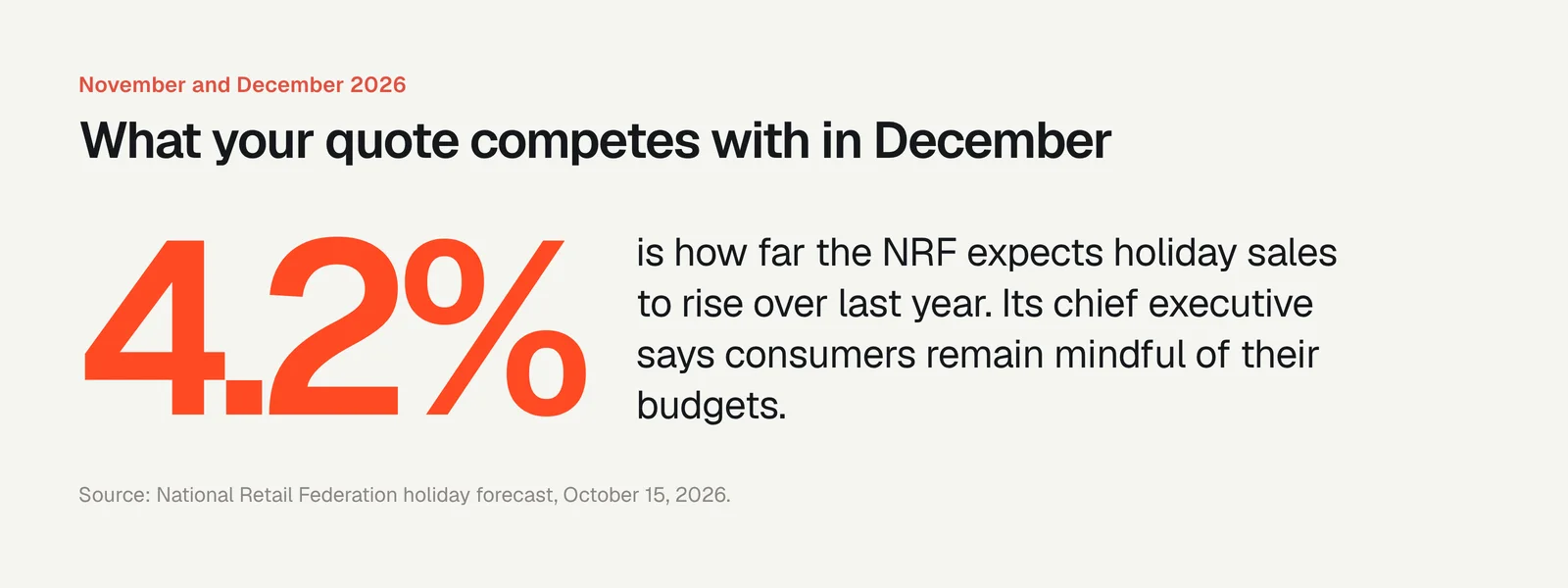
It usually means the household's money and attention are committed to the season, and only sometimes that they want to hear from you in January. The NRF's forecast for November and December 2026 is 4.2% above last year, and its chief executive says consumers "remain mindful of their budgets." In December your bathroom remodel competes with plane tickets, gifts and a dinner for eleven.
Sometimes the house really is about to fill with in-laws, and a demo crew in the hall bath is unbearable. The sentence is the same and the meaning underneath is different.
| What they say | What it usually means | What to do |
|---|---|---|
| "Call us after the holidays," right after the price | The money is spoken for this quarter | Raise the monthly payment, then separate the decision from the payment |
| "We've got family coming in" | A hosting deadline | Ask whether the work can finish before the guests arrive |
| "We don't want a construction zone at Christmas" | Scheduling, not price | Decide now, book the first January slot, lock scope and price |
| "January, once things settle down" | A polite "we're not ready" | Find out what is missing |
Only one of those four is really about the calendar.
Why is January a bad month to be remembered?
Because the homeowner who waited doesn't come back into your pipeline in January. They come back into the market.
A deferred project changes over the holidays. The homeowner talks to a brother-in-law who knows a guy. A neighbor at a party mentions what they paid. A new-year promotion from another company lands in the inbox on January 2. By the time your rep phones on January 6, the quote from November is the oldest document in the conversation.
Your own costs may have moved by then too, which leaves the rep honoring an old number or reopening the price with a customer who was already hesitating. Park a deal until January and you've agreed to run the race again against more runners.
How do you turn the holidays into a deadline?
Start with a question: "Who's coming for the holidays, and what do you want them to walk into?" Asked plainly, it finds the projects that exist because of the holidays. The guest bathroom is for the guests. The furnace that short-cycles is about to carry its heaviest load of the year with a full house.
When the work shouldn't happen in December, use the December decision with a January install:
- Lock the scope.
- Lock the price.
- Take the deposit.
- Put the first slot of the new year on the calendar.
The homeowner gets the quiet holiday they asked for, and protection from a price change on a project they already wanted. You get a signed job and a January that starts with installs.
Talk about money before you leave. In the Kitchen Table Report, appointments where financing came up closed at 49%, against 38% where it never did. That is a correlation, and it applies all year. It matters most in the months when cash is set aside for the season. Our financing guide has the wording.
I wouldn't hand reps a holiday closing script. HubSpot lists 14 responses to this objection, written for reps phoning business buyers. At the kitchen table the person stalling you is hosting the dinner, and the disruption is drywall dust where the turkey goes. Answers built for a sales phone line read as pushy in a living room.
What should follow-up look like between Thanksgiving and New Year?
One useful touch in December that adds something to the decision. "Just checking in" competes with a hundred other pings the homeowner is ignoring.
The week after Christmas is worth a second look. The family is home, sitting in the house with the problem, often with a relative offering opinions. I'd send the follow-up between December 27 and 30, before competitors start again in January. That is my recommendation and not a measured result. Our guide to reopening old estimates has the wording.
How does SalesAsk help a team handle this objection?
SalesAsk records every visit, so you can hear what your reps say in the sixty seconds after the homeowner says "after the holidays." Search the transcripts for the phrase and listen.
You'll likely find one rep asking who is coming for dinner and another agreeing to January before the homeowner finishes the sentence. That difference is the coaching.
Then practice it. A rep can run the objection in an AI roleplay before the appointment, get optional live coaching during it, and read written feedback after. If you send a HomePlan page in place of a paper quote, you also see when the household reopens it over the break. To hear your own team's answers, book a SalesAsk demo.
Where does this playbook fall short?
Some holiday deferrals are real. A genuine one survives a specific question: ask which week in January works. A real deferral answers with a date.
There is also a part we can't measure. Our data covers recorded conversations. The deal that quietly ends in a text thread over the holidays never shows up in a transcript, and I can't tell you how many of those there are. We don't have close rates by month yet either.
Frequently asked questions
Should we discount to close before the holidays?
No. The homeowner already owns the deadline, so a price cut isn't needed to create one. An unprompted discount also tells them the first number was padded.
When should the new-year follow-up land?
I'd send it before the new year, between December 27 and 30. The homeowner is home and planning the year. Adjust if your own results say otherwise.
Does this work for exterior trades in cold markets?
Partly. Nobody is painting siding in Buffalo in January, and pretending otherwise costs trust. The decide-now, install-later structure still works when the slot being reserved is in April. Our winter roofing guide covers the spring version.
What if the stall comes at the door, before the presentation?
Then it is a brush-off and the answer is to ask about holiday hosting early. A rep who learns in the first five minutes that fourteen people arrive on December 23 knows the deadline before the price is on the table.
Sources
Dara Shabnam
Leads growth at SalesAsk and writes about in-home sales training and recording consent.
More posts byWritten by the SalesAsk team
SalesAsk records and coaches in-home sales conversations for home service, home improvement and home builder teams.
More posts