Winter Roofing Sales: How to Beat the Wait-Until-Spring Objection

On this page
You beat "we'll wait until spring" by sorting the roofs that can wait from the ones that can't, and saying which is which out loud. A roof can be installed in winter: GAF's technical bulletin says there is no practical lower temperature limit when the crew takes the documented precautions. Reps who tell a homeowner "this one can wait" when it's true earn the standing to say "this one can't" at the next table.
Key takeaways
- GAF says there is no practical lower or upper temperature limit for applying asphalt fiberglass shingles, with precautions. Handling is easiest above 40°F.
- Malarkey's cold-weather bulletin calls for four quarter-size dabs of roof cement under each shingle when hand-sealing.
- "Wait until spring" is usually about money, a missing decision maker or a fear of a cold-weather install. It is rarely about the weather.
- Appointments where financing came up closed at 49%, against 38% where it didn't, in SalesAsk's 2026 data.
- Winter is the season a sales manager has time to review recorded appointments.
Can you install a roof in winter?
Yes. GAF's bulletin on temperature extremes states that there is no practical lower or upper temperature limit governing when asphalt fiberglass shingles may be applied, as long as precautions are taken.
This matters because "wait until spring" is often a quality fear dressed as a scheduling preference. The homeowner suspects a cold install is a corner-cut install. Your rep should answer that with the manufacturer's paperwork, not with "trust me, we do it all the time."
The guidance is specific. GAF recommends storing shingles in a heated area above 70°F for at least 24 hours if possible, and says handling is easiest above 40°F. Hand-sealing may be required if it is too cold to activate the adhesive strip. For laminate shingles it recommends placing fasteners in the double-layer portion to limit blow-off damage until the adhesive activates.
Malarkey's bulletin for temperatures below 40°F adds detail: apply four quarter-size dabs of asphalt roof cement, evenly spaced, under each shingle. Store materials in a heated facility. Leave a small gap of about 1/32 inch between shingles so they lie flat as the roof warms. On slopes steeper than 21:12, Malarkey requires hand-sealing in any season.
On warranty, GAF says its warranty remains in effect regardless of air temperature at installation. Damage such as cracking or blow-offs before the sealant activates is excluded, which is why the hand-seal step exists.
So the pitch isn't "winter installs are the same as summer installs." They're slower and they involve an extra documented procedure. The pitch is that cold-weather installation is an engineered process with manufacturer instructions behind it, and your crew follows them. Check the bulletin for the shingle you install, because each manufacturer writes its own.
Why do homeowners say they'll wait until spring?
Because the rep sold the roof and never sold the timing. A buyer who feels no urgency picks whichever season feels safest.
The usual pattern goes like this. The rep inspects, presents the findings, builds the quote and handles the product questions well. The homeowner says they want to think it over until March. The rep treats it as a calendar problem: "We could get you on the schedule for early April." That reply accepts the premise, and the deal is parked for five months while the homeowner collects other bids.
The real reason is usually one of three. The money is set aside for the holidays. The spouse who wasn't home wants a say. Or they've absorbed the idea that roofs are a summer purchase. None of those is about shingle temperature.
Sometimes waiting is the right call. A roof with no active leak, sound decking and a cosmetic problem loses very little by waiting. If that is the roof in front of your rep, the strongest thing to say is so: "This one can wait, and here's what I'd watch for over the winter so you know if that changes." The rep stops defending a quote and becomes the contractor who gets the March phone call without a re-bid.
What do you say when the roof shouldn't wait?
Triage out loud. Name what water and freeze-thaw will do to this roof between now and April, and let the inspection evidence make the argument.
| Signal at the table | What the rep says |
|---|---|
| No active leak, sound decking, cosmetic damage | This can wait. Here is what to watch for, and here is when I'll check back. |
| Active leak or exposed underlayment | Freeze-thaw will widen this all winter. Waiting likely means a bigger scope in April. |
| Storm damage with an open insurance claim | The claim has its own clock. We work it now while the documentation is fresh. |
| Worry about install quality in the cold | Here is the manufacturer's cold-weather procedure and what our crew does differently. |
| Money is the real objection | The monthly figure, shown next to the cash figure. |
A leak doesn't pause for the off-season. Water that gets under damaged shingles freezes, expands and opens the gap wider. By spring the postponed quote may not be the same quote, because now there is wet decking to replace. The rep doesn't need to dramatize it. Attic photos and moisture readings do the arguing, so winter appointments should lean harder on inspection evidence than summer ones.
The calendar is the second lever. If your winter backlog is shorter, say so: the crew can be on the roof sooner, and the homeowner isn't competing with the June rush. Only say it if it's true for your company.
The third lever is money, and it's the one I'd fix first. Across the conversations in the Kitchen Table Report, appointments where financing came up closed at 49%, against 38% where it never did. That is a correlation, and better reps may simply raise it more often. But a winter buyer with holiday bills, shown one cash number, has been handed the spring objection. Our guide to selling financing to homeowners covers the wording.
How do you keep reps sharp when appointments dry up?
Treat winter as review season, with SalesAsk doing the listening. Fewer appointments make each recorded one worth more, and there is finally time to hear them.
Reps at the same company don't run the same appointment. In the Kitchen Table Report's comparison of 55 companies, the rep with the longest appointments ran 48 minutes longer than the rep with the shortest at the median company. In July, volume hides that kind of spread. In January, when a company might run a dozen appointments a week, every one is a visible share of the month.
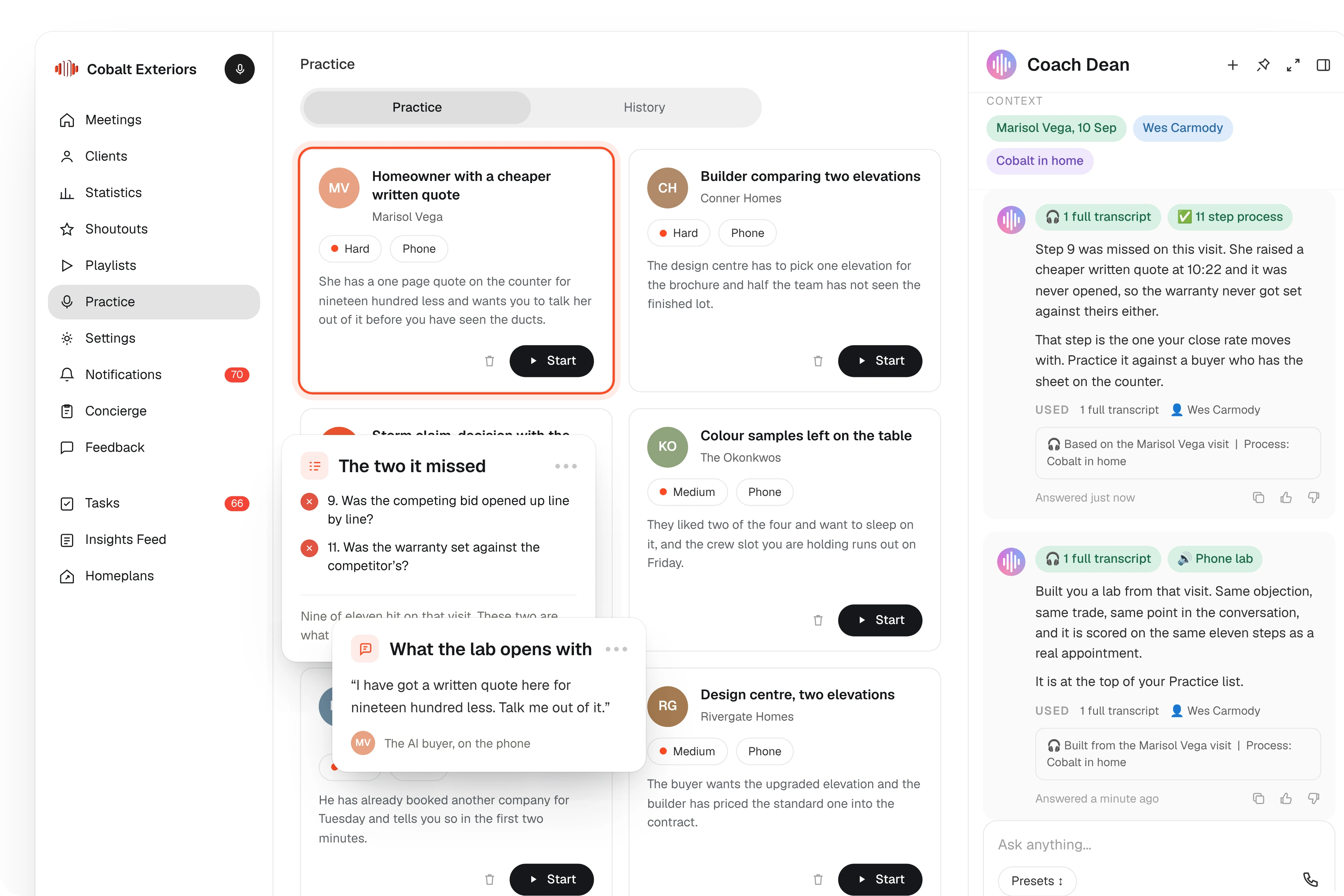
Record the winter appointments and listen for the spring objection: when it came up, what set it off, what the rep said next. Most managers have heard reps report how they handled it. Few have heard it handled.
Then practice it. With SalesAsk, a rep can run "we'll wait until spring" in an AI roleplay before the appointment, get optional live coaching during it, and read written feedback afterward. A rep who has answered the objection eight times before Thanksgiving doesn't freeze at a real table. Connell Roofing coaches its reps from recorded visits without adding ride-alongs, and virtual ridealongs show how the review works. To see it on your own appointments, book a SalesAsk demo.
Should you cut the sales team for winter?
Keep every rep you'd want back in March, if the winter book can carry them. You pay for the gap either way: in winter payroll now, or in ramp time and missed spring appointments later.
The payroll math isn't comfortable, and a two-truck shop in Minneapolis has different choices from a thirty-rep storm operation. But a rep laid off in November interviews elsewhere in December. The spring rehire is a new hire, learning your process during the weeks your leads peak. If the book can't carry the full roster, I'd shrink territories before the team. We broke down how long a new rep takes to ramp separately.
Where does this playbook fall short?
It can't tell you your market's winter. A week of ice in Atlanta and four months below freezing in Duluth are different problems, and your crew lead knows the local limits better than a bulletin does.
We also don't have close rates by month. Our appointment data starts in March 2026 and the customer base grew through the year, so we can't yet separate season from growth. The HVAC version of the slow-season argument is in our shoulder season playbook.
Frequently asked questions
What temperature is too cold to install asphalt shingles?
GAF's bulletin says there is no practical lower limit when precautions are taken, with handling easiest above 40°F. Malarkey publishes specific procedures for installs below 40°F, built around warming the materials and hand-sealing each shingle.
Does a winter installation void the shingle warranty?
GAF says its warranty stays in effect regardless of air temperature at installation. Cracking and blow-offs that happen before the sealant activates are excluded. Check the warranty for the product you install.
Is replacing a roof in winter cheaper?
Sometimes, depending on your market and the contractor's backlog. I'd coach reps to sell scheduling speed where it's real and treat any discount as a bonus.
What should a rep do when the homeowner has an active leak and still wants to wait?
Document it with attic photos and moisture readings, and explain what freeze-thaw does to an opening over four months. If they still want to wait, offer an interim repair at a fair price and set the spring follow-up before leaving the driveway.
Sources
- GAF, Technical Advisory Bulletin TAB-R-133, Temperature Extremes & Fiberglass Asphalt Shingles, revision dated February 26, 2024.
- Malarkey Roofing Products, Technical Bulletin: Installation Guidelines for Application of Asphalt Shingles in Cold Weather, revised September 2026.
- SalesAsk, The Kitchen Table Report 2026, Benchmarks and The Conversation.
Dara Shabnam
Leads growth at SalesAsk and writes about in-home sales training and recording consent.
More posts byWritten by the SalesAsk team
SalesAsk records and coaches in-home sales conversations for home service, home improvement and home builder teams.
More posts