Digital Proposals for Contractors: Why the Paper Quote Dies on the Kitchen Table
Dara Shabnam
Head of Growth, SalesAsk
August 10, 2026
9
On this page
Your rep just spent ninety minutes at a kitchen table in a split-level outside Columbus. She measured, she listened, she walked the homeowners through three options, and she left a stapled quote next to the fruit bowl. It is 7:40 on a Tuesday evening. By Thursday, that quote is under a stack of school permission slips, the second contractor has come through with a lower number, and the homeowner's brother-in-law has weighed in with an opinion about heat pumps that is confidently wrong. Your rep knows none of this. She is driving to her next appointment, and the quote she left behind is doing exactly what paper does: nothing.
I think about this window constantly, because it is where home-services deals actually die. Not in the appointment. After it. We built Homeplan, which we launched last month, specifically for this stretch of the sale, and the more contractors I talk to about it, the more convinced I am that the paper quote is the single most neglected asset in residential sales. So let me make the case for digital proposals properly, tradeoffs included.
If you run a home services sales team and want every appointment coached, not only the ones a manager can sit in on, book a SalesAsk demo.
Why do paper quotes lose deals your rep already earned?
Because a paper quote is invisible from the moment your rep leaves the house, so every question, objection, and competing bid that arrives afterward goes unanswered until the deal is already decided.
The appointment itself is usually fine. Most reps who get ninety minutes in a home do a decent job presenting. The problem is structural. A printed quote, or a PDF attached to an email, is a dead document. You cannot see whether anyone opened it. You cannot fix a wrong assumption after the fact. You cannot tell that the homeowner's spouse, who missed the appointment, read only the price line and none of the reasoning behind it.
And the spouse matters more than almost anything else. Ask any rep about one-legger appointments and they will tell you the real buyer is often the person who was not in the room. With paper, that person gets a secondhand pitch delivered by a tired partner over dinner: "It was around eighteen grand, I think? He seemed nice." Your ninety minutes of careful option-building collapses into one number and a vibe.
Meanwhile the clock runs. Research on lead response has shown for years that speed decides deals; the classic Harvard Business Review study found firms contacting a lead within an hour were nearly seven times likelier to have a meaningful conversation with a decision maker than those who waited even an hour longer. Follow-up after an in-home appointment works the same way. The homeowner's questions are freshest the evening your rep leaves. Paper gives you no signal that a question exists, so your follow-up call lands whenever the CRM task fires, often days later, often after the decision.
What is a digital proposal for contractors, actually?
A digital proposal is a live, link-based version of your quote that the homeowner revisits online, and that tells you what they looked at, when, and for how long.
The label gets used loosely, so it is worth being precise. A PDF emailed after the visit is not a digital proposal in any meaningful sense. It is paper with a battery. A real digital proposal is a page the homeowner opens in a browser: the options your rep presented, the pricing for each, the photos from the actual house, financing terms, reviews, and a way to ask a question or accept right there.
The difference that matters is that it is alive in both directions. The homeowner can return to it at 10 p.m. when the brother-in-law starts talking, and see your rep's actual reasoning instead of a folded page of line items. And you can see engagement: opened twice Tuesday night, forwarded Wednesday, the financing section read three times. That last detail is not surveillance trivia. It is the difference between a rep calling to say "just checking in" and a rep calling to say "I noticed you were looking at the monthly payment options, want me to walk you both through them?"
This is the thinking behind Homeplan, our version of this for home-services contractors. We call the homeowner-facing page a decision room rather than a proposal, because that is what it is for: it is where the household actually makes the decision, whether you are present or not. You may as well furnish the room.
What actually happens in the 72 hours after your rep leaves?
The homeowner compares bids, recruits opinions, and re-litigates the price without you, and whichever contractor is still present in that conversation usually wins it.
Here is the sequence I hear over and over from contractors, whether they sell HVAC, roofs, or kitchens. Night one: the couple talks it over, and the partner who missed the appointment asks questions nobody can answer. Day two: a competing bid arrives, almost always framed as a bare price, and suddenly your carefully built good-better-best becomes "theirs was $14,200 and yours was $17,800." Day three: someone consults a neighbor, a Facebook group, or a relative in the trades, and a new objection appears that was never raised in the appointment.
None of this is visible to a rep holding a paper trail that ends at the front door. Every one of those moments is a fork where the deal can quietly tip, and the widely cited InsideSales finding that somewhere between 35 and 50 percent of sales go to the vendor who responds first is really a statement about presence. The contractor who is findable, answerable, and current during those three days has an edge that has nothing to do with price.
A digital proposal does not let you attend the kitchen-table debate. But it puts your best argument in the room, keeps all three options on the table instead of whichever number the homeowner remembered, and flags the moment of activity so your follow-up lands while the conversation is actually happening.
How do digital proposals change follow-up for your reps?
They turn follow-up from scheduled guesswork into responses to real behavior, which makes the calls both better timed and less awkward.
Follow-up is the part of the job most reps quietly hate. Calling into silence feels like pestering, so reps procrastinate, and managers respond with cadence rules that produce robotic check-ins. Engagement data changes the emotional math. When a rep can see the proposal was opened twice last night, the call stops being an interruption and becomes a continuation. There is something concrete to reference and a reason to call today rather than someday.
It also changes coaching, which is where our world and this one collide. When we review recorded appointments in SalesAsk, we can hear how a rep presented options. Pair that with proposal engagement and you can see which presentations held up after the rep left. A rep whose proposals get opened once and abandoned is leaving something unresolved in the home. That is a coachable, specific finding, much more useful than a raw close rate.
To be fair about the other side of this: Siro recently wrote about pairing field conversations with automated follow-up messaging through Hatch, and the premise, that context from the visit should shape what happens after it, is right. Where I land differently is on what carries the weight. A well-timed text still points at something, and if it points at a static PDF, you have improved the reminder but not the decision. I would rather fix the artifact first and the messaging second.
How do paper quotes and digital proposals compare side by side?
Paper wins on simplicity and familiarity; digital wins on nearly everything that happens after the rep leaves.
| After the appointment | Paper or PDF quote | Digital proposal |
|---|---|---|
| Can you see if it was reviewed? | No | Yes, with opens and time per section |
| Absent spouse experience | Secondhand summary of one number | Full options, photos, and reasoning |
| Updating price or scope | New document, new email, version confusion | Edit once, same link stays current |
| Follow-up trigger | CRM task on a timer | Actual homeowner activity |
| Presenting good-better-best | Whatever the homeowner remembers | All options persist side by side |
| Accepting and next steps | Callback, signature, scanning | Accept and schedule from the page |
| Works with no tech setup | Yes, always | Needs a link and a little homeowner comfort |
When is paper still the right call?
When you close in one sitting, sell to homeowners who distrust links, or run a shop that will not maintain the system. A half-abandoned digital proposal is worse than a clean printed quote.
I want to concede this honestly, because the vendors in this space mostly will not. If your model is a true one-call close, storm roofing after a hail event, say, where the decision happens at the table or not at all, the after-visit window barely exists, and digital proposals solve a problem you do not have. Some customers, particularly older homeowners in rural markets, treat emailed links with suspicion, and a printed quote in hand builds more trust than anything on a screen. And every tool carries process debt: if your reps will not reliably build the proposal before leaving the driveway, you will end up with a graveyard of half-finished links that looks worse than paper ever did.
The honest framing is this: digital proposals are leverage on the follow-up phase of your sale. The longer and more considered your sales cycle, HVAC replacements, kitchen and bath, windows, solar, the more that phase is worth investing in. The shorter and more impulsive, the less.
For the full picture of what happens after the rep leaves, see the follow-up gap in home sales.
FAQ
What should a contractor look for in digital proposal software?
Engagement visibility (opens, sections viewed), support for multiple options rather than a single price, financing presentation, easy updating without re-sending, and acceptance built into the page. If it cannot tell you what the homeowner did after your rep left, it is a PDF with better fonts.
Do homeowners actually open proposal links?
In our experience, yes, when the rep frames the link in the appointment as "this is where everything we discussed lives," rather than sending it cold afterward. The handoff moment in the home is what determines open behavior, which is itself a coachable skill.
Are digital proposals only useful for big-ticket jobs?
They earn the most on considered purchases above roughly five thousand dollars, where multiple bids and spousal decisions are the norm. For small repair tickets closed on the spot, the overhead usually is not worth it.
How is a digital proposal different from the follow-up texts my CRM already sends?
Automated messages improve the reminder; they do not improve what the homeowner is reminded of. A text pointing at a static PDF still leaves the household deciding off one number. The proposal is the argument; the messaging is just the doorbell.
Does Homeplan replace my CRM or estimating software?
No. You still build your numbers wherever you build them today. Homeplan is the homeowner-facing layer: the decision room where those numbers, options, and the rep's reasoning live after the visit, connected to the recorded appointment in SalesAsk.
Where I would start
Pick your ten most recent lost deals and ask one question about each: did we lose in the appointment, or after it? If more than three died in the after, the silent stretch between the handshake and the "we went another way" text, your problem is not presentation skills, and more paper will not fix it. Put your next twenty quotes behind a link you can watch, tell your reps to call when the activity happens rather than when the task fires, and compare close rates in sixty days. That is the whole experiment, and it costs you almost nothing to run.
Sources
Oldroyd, McElheran, and Elkington, "The Short Life of Online Sales Leads," Harvard Business Review, 2011. InsideSales.com (XANT) lead response research on first-responder win rates, as widely cited in sales-response literature. Customer patterns described are drawn from SalesAsk conversations with home-services contractors.
About the author
Dara Shabnam
Head of Growth, SalesAsk
Dara Shabnam leads growth at SalesAsk. She writes about in-home sales training, recording consent, and what the recorded conversations of home service and trades teams show about how jobs are actually won.
Dara Shabnam
About SalesAsk
Written by the SalesAsk team
SalesAsk records and coaches in-home sales conversations for home service, home improvement and home builder teams.
More postsKeep reading
All posts

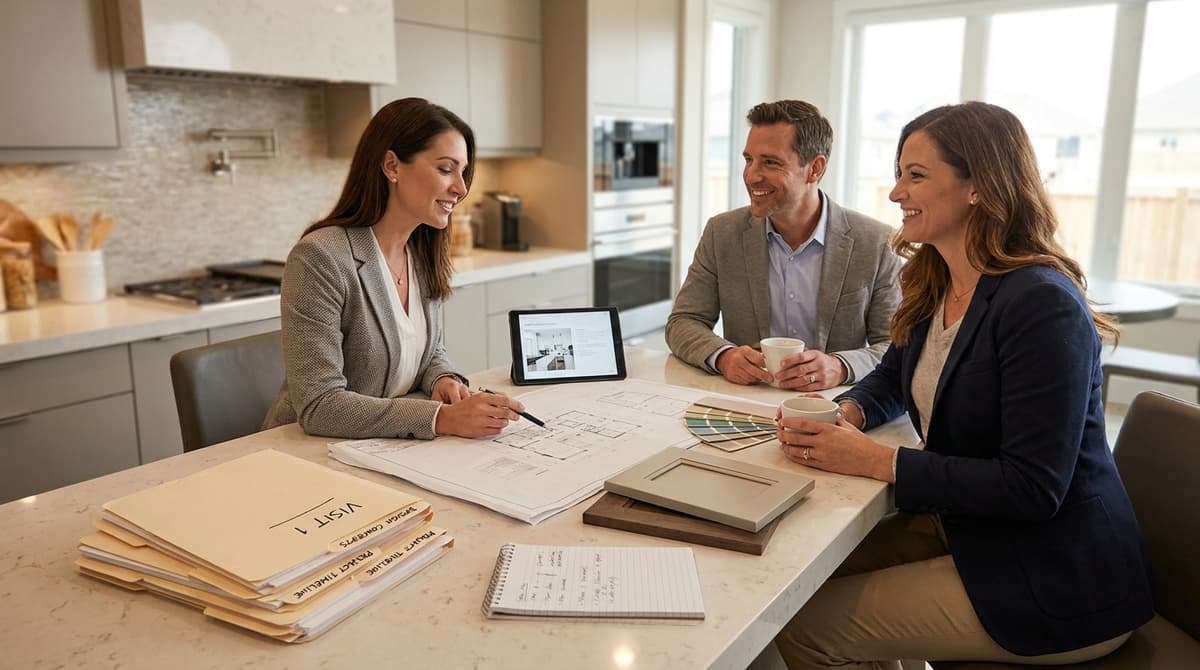

Your rep just spent ninety minutes at a kitchen table in a split-level outside Columbus. She measured, she listened, she walked the homeowners through three options, and she left a stapled quote next to the fruit bowl. It is 7:40 on a Tuesday evening. By Thursday, that quote is under a stack of school permission slips, the second contractor has come through with a lower number, and the homeowner's brother-in-law has weighed in with an opinion about heat pumps that is confidently wrong. Your rep knows none of this. She is driving to her next appointment, and the quote she left behind is doing exactly what paper does: nothing.
I think about this window constantly, because it is where home-services deals actually die. Not in the appointment. After it. We built Homeplan, which we launched last month, specifically for this stretch of the sale, and the more contractors I talk to about it, the more convinced I am that the paper quote is the single most neglected asset in residential sales. So let me make the case for digital proposals properly, tradeoffs included.
If you run a home services sales team and want every appointment coached, not only the ones a manager can sit in on, book a SalesAsk demo.
Why do paper quotes lose deals your rep already earned?
Because a paper quote is invisible from the moment your rep leaves the house, so every question, objection, and competing bid that arrives afterward goes unanswered until the deal is already decided.
The appointment itself is usually fine. Most reps who get ninety minutes in a home do a decent job presenting. The problem is structural. A printed quote, or a PDF attached to an email, is a dead document. You cannot see whether anyone opened it. You cannot fix a wrong assumption after the fact. You cannot tell that the homeowner's spouse, who missed the appointment, read only the price line and none of the reasoning behind it.
And the spouse matters more than almost anything else. Ask any rep about one-legger appointments and they will tell you the real buyer is often the person who was not in the room. With paper, that person gets a secondhand pitch delivered by a tired partner over dinner: "It was around eighteen grand, I think? He seemed nice." Your ninety minutes of careful option-building collapses into one number and a vibe.
Meanwhile the clock runs. Research on lead response has shown for years that speed decides deals; the classic Harvard Business Review study found firms contacting a lead within an hour were nearly seven times likelier to have a meaningful conversation with a decision maker than those who waited even an hour longer. Follow-up after an in-home appointment works the same way. The homeowner's questions are freshest the evening your rep leaves. Paper gives you no signal that a question exists, so your follow-up call lands whenever the CRM task fires, often days later, often after the decision.
What is a digital proposal for contractors, actually?
A digital proposal is a live, link-based version of your quote that the homeowner revisits online, and that tells you what they looked at, when, and for how long.
The label gets used loosely, so it is worth being precise. A PDF emailed after the visit is not a digital proposal in any meaningful sense. It is paper with a battery. A real digital proposal is a page the homeowner opens in a browser: the options your rep presented, the pricing for each, the photos from the actual house, financing terms, reviews, and a way to ask a question or accept right there.
The difference that matters is that it is alive in both directions. The homeowner can return to it at 10 p.m. when the brother-in-law starts talking, and see your rep's actual reasoning instead of a folded page of line items. And you can see engagement: opened twice Tuesday night, forwarded Wednesday, the financing section read three times. That last detail is not surveillance trivia. It is the difference between a rep calling to say "just checking in" and a rep calling to say "I noticed you were looking at the monthly payment options, want me to walk you both through them?"
This is the thinking behind Homeplan, our version of this for home-services contractors. We call the homeowner-facing page a decision room rather than a proposal, because that is what it is for: it is where the household actually makes the decision, whether you are present or not. You may as well furnish the room.
What actually happens in the 72 hours after your rep leaves?
The homeowner compares bids, recruits opinions, and re-litigates the price without you, and whichever contractor is still present in that conversation usually wins it.
Here is the sequence I hear over and over from contractors, whether they sell HVAC, roofs, or kitchens. Night one: the couple talks it over, and the partner who missed the appointment asks questions nobody can answer. Day two: a competing bid arrives, almost always framed as a bare price, and suddenly your carefully built good-better-best becomes "theirs was $14,200 and yours was $17,800." Day three: someone consults a neighbor, a Facebook group, or a relative in the trades, and a new objection appears that was never raised in the appointment.
None of this is visible to a rep holding a paper trail that ends at the front door. Every one of those moments is a fork where the deal can quietly tip, and the widely cited InsideSales finding that somewhere between 35 and 50 percent of sales go to the vendor who responds first is really a statement about presence. The contractor who is findable, answerable, and current during those three days has an edge that has nothing to do with price.
A digital proposal does not let you attend the kitchen-table debate. But it puts your best argument in the room, keeps all three options on the table instead of whichever number the homeowner remembered, and flags the moment of activity so your follow-up lands while the conversation is actually happening.
How do digital proposals change follow-up for your reps?
They turn follow-up from scheduled guesswork into responses to real behavior, which makes the calls both better timed and less awkward.
Follow-up is the part of the job most reps quietly hate. Calling into silence feels like pestering, so reps procrastinate, and managers respond with cadence rules that produce robotic check-ins. Engagement data changes the emotional math. When a rep can see the proposal was opened twice last night, the call stops being an interruption and becomes a continuation. There is something concrete to reference and a reason to call today rather than someday.
It also changes coaching, which is where our world and this one collide. When we review recorded appointments in SalesAsk, we can hear how a rep presented options. Pair that with proposal engagement and you can see which presentations held up after the rep left. A rep whose proposals get opened once and abandoned is leaving something unresolved in the home. That is a coachable, specific finding, much more useful than a raw close rate.
To be fair about the other side of this: Siro recently wrote about pairing field conversations with automated follow-up messaging through Hatch, and the premise, that context from the visit should shape what happens after it, is right. Where I land differently is on what carries the weight. A well-timed text still points at something, and if it points at a static PDF, you have improved the reminder but not the decision. I would rather fix the artifact first and the messaging second.
How do paper quotes and digital proposals compare side by side?
Paper wins on simplicity and familiarity; digital wins on nearly everything that happens after the rep leaves.
| After the appointment | Paper or PDF quote | Digital proposal |
|---|---|---|
| Can you see if it was reviewed? | No | Yes, with opens and time per section |
| Absent spouse experience | Secondhand summary of one number | Full options, photos, and reasoning |
| Updating price or scope | New document, new email, version confusion | Edit once, same link stays current |
| Follow-up trigger | CRM task on a timer | Actual homeowner activity |
| Presenting good-better-best | Whatever the homeowner remembers | All options persist side by side |
| Accepting and next steps | Callback, signature, scanning | Accept and schedule from the page |
| Works with no tech setup | Yes, always | Needs a link and a little homeowner comfort |
When is paper still the right call?
When you close in one sitting, sell to homeowners who distrust links, or run a shop that will not maintain the system. A half-abandoned digital proposal is worse than a clean printed quote.
I want to concede this honestly, because the vendors in this space mostly will not. If your model is a true one-call close, storm roofing after a hail event, say, where the decision happens at the table or not at all, the after-visit window barely exists, and digital proposals solve a problem you do not have. Some customers, particularly older homeowners in rural markets, treat emailed links with suspicion, and a printed quote in hand builds more trust than anything on a screen. And every tool carries process debt: if your reps will not reliably build the proposal before leaving the driveway, you will end up with a graveyard of half-finished links that looks worse than paper ever did.
The honest framing is this: digital proposals are leverage on the follow-up phase of your sale. The longer and more considered your sales cycle, HVAC replacements, kitchen and bath, windows, solar, the more that phase is worth investing in. The shorter and more impulsive, the less.
For the full picture of what happens after the rep leaves, see the follow-up gap in home sales.
FAQ
What should a contractor look for in digital proposal software?
Engagement visibility (opens, sections viewed), support for multiple options rather than a single price, financing presentation, easy updating without re-sending, and acceptance built into the page. If it cannot tell you what the homeowner did after your rep left, it is a PDF with better fonts.
Do homeowners actually open proposal links?
In our experience, yes, when the rep frames the link in the appointment as "this is where everything we discussed lives," rather than sending it cold afterward. The handoff moment in the home is what determines open behavior, which is itself a coachable skill.
Are digital proposals only useful for big-ticket jobs?
They earn the most on considered purchases above roughly five thousand dollars, where multiple bids and spousal decisions are the norm. For small repair tickets closed on the spot, the overhead usually is not worth it.
How is a digital proposal different from the follow-up texts my CRM already sends?
Automated messages improve the reminder; they do not improve what the homeowner is reminded of. A text pointing at a static PDF still leaves the household deciding off one number. The proposal is the argument; the messaging is just the doorbell.
Does Homeplan replace my CRM or estimating software?
No. You still build your numbers wherever you build them today. Homeplan is the homeowner-facing layer: the decision room where those numbers, options, and the rep's reasoning live after the visit, connected to the recorded appointment in SalesAsk.
Where I would start
Pick your ten most recent lost deals and ask one question about each: did we lose in the appointment, or after it? If more than three died in the after, the silent stretch between the handshake and the "we went another way" text, your problem is not presentation skills, and more paper will not fix it. Put your next twenty quotes behind a link you can watch, tell your reps to call when the activity happens rather than when the task fires, and compare close rates in sixty days. That is the whole experiment, and it costs you almost nothing to run.
Sources
Oldroyd, McElheran, and Elkington, "The Short Life of Online Sales Leads," Harvard Business Review, 2011. InsideSales.com (XANT) lead response research on first-responder win rates, as widely cited in sales-response literature. Customer patterns described are drawn from SalesAsk conversations with home-services contractors.