How to Follow Up on a Quote: A Contractor's Playbook

On this page
Follow up on a quote the same day with a recap in the homeowner's own words, then five more touches across thirty days, each carrying something new. Silence after a quote usually means the homeowner is still deciding: in a 2025 roofing survey, 66% said they would gather three quotes. SalesAsk drafts that first recap from the recording of the appointment, so it names what the homeowner said and not what the rep remembers.
Key takeaways
- Send the first message the same day. It is a recap, not a sales touch.
- Every touch adds something: an answer, photos of a similar job, the monthly payment.
- In Hatch's data on new leads, a single message was the worst-performing campaign, with an 8% response rate against 60% for the average.
- Don't open with a discount. Trade any price movement for a commitment.
- After about thirty days, stop selling and move the homeowner to a quarterly list.
Why do homeowners go quiet after the quote?
They go quiet because the decision happens after you leave, in conversations you aren't part of. Usually it happens at night, between spouses, with your quote next to two others.
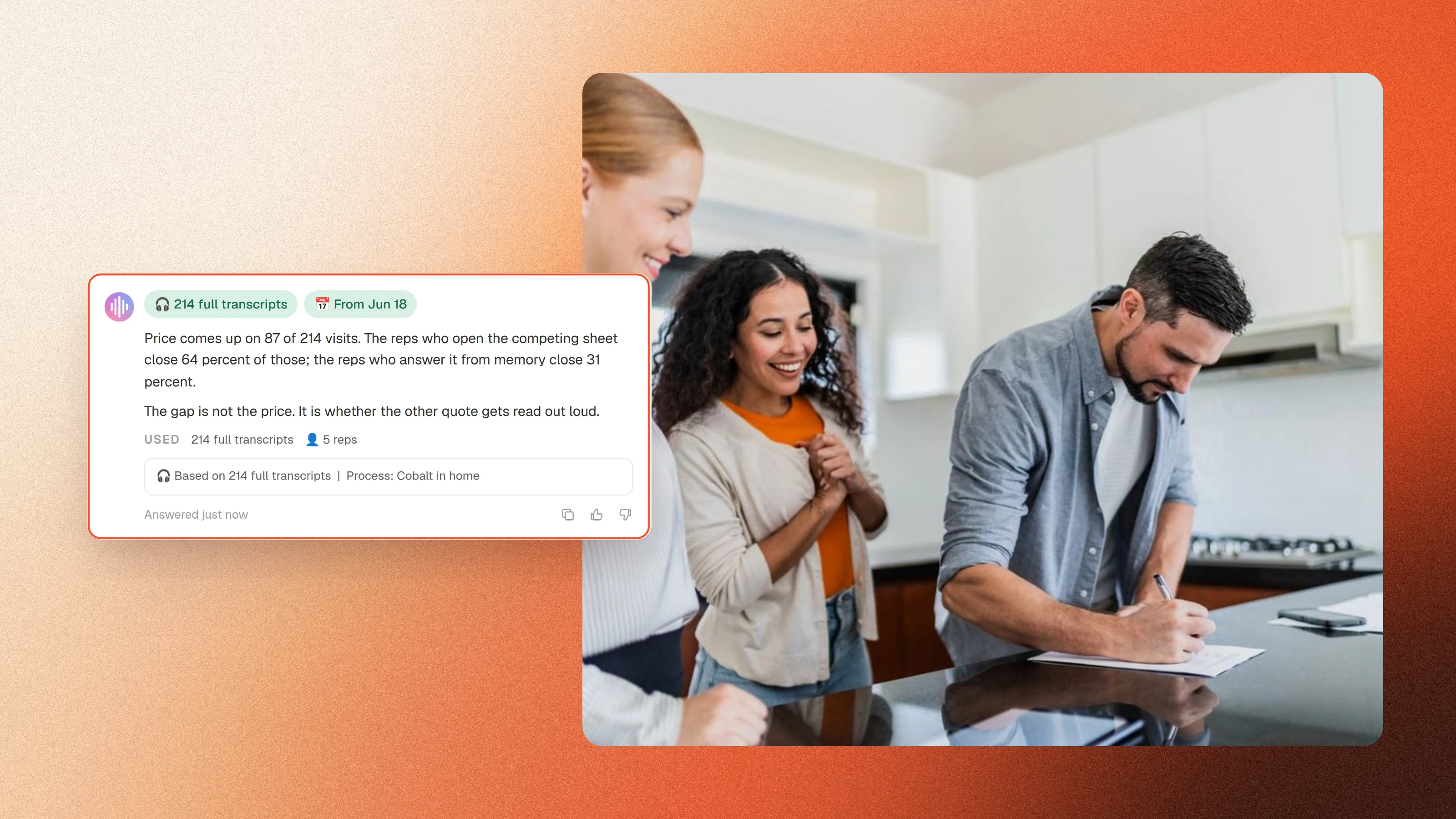
Your quote isn't being rejected during the silence. It is being debated, half-remembered and compared on the one thing that survives memory, which is the price. We covered the mechanics in how homeowners choose between contractor bids.
That changes what follow-up is for. You aren't nudging a lazy buyer. You are rejoining a live deliberation with better material than a number on a page. A touch either adds something to that kitchen table debate or it is noise.
When should you follow up after sending a quote?
The same day, within hours of leaving the home, and again inside the first three days. The best-known study on response timing is Harvard Business Review's 2011 audit of 2,241 U.S. companies. In a separate set of 1.25 million leads, firms that tried to reach a lead within an hour were nearly seven times as likely to qualify it as firms that waited an hour longer.
That study measured new leads and qualification, not delivered quotes or purchases, and it is fifteen years old. I'd still expect the behavior to carry over. Attention is highest right after the visit, and each quiet day hands the conversation to whichever contractor shows up in it.
The same-day message is a recap: thank you, here is your quote again, here is the one thing you told me mattered most, here is my direct number. Storm-damage roofing runs faster. When insurance deadlines and tarped roofs are involved, move everything below up.
What should the first follow-up say?
It should repeat the homeowner's own words back to them, tied to the one concern they raised, and make replying easy. "Just checking in on the quote" asks the homeowner to do the work. Compare it with this:
Hi Karen, it's Dara. You mentioned the main bedroom never cools evenly. The two-stage system in option B is the one that fixes that. Happy to walk through why in five minutes on the phone, or just reply here with questions.
That message only exists if the rep remembers, or recorded, what Karen said. A rep who ran four appointments that day won't remember.
If the monthly payment never came up at the table, the follow-up is a second chance to raise it. In the Kitchen Table Report, appointments where financing came up closed at 49%, against 38% where it didn't. That is a correlation, but "here is what this looks like per month" is new information, and new information is what earns a reply.
One position I'll defend: don't open a follow-up with a discount. An unprompted price cut tells the homeowner your first number was padded. If the price moves, trade it for something, such as a signed date or a smaller scope.
What does a full follow-up cadence look like?
It looks like six touches across thirty days, alternating channels, each one carrying something new.
| Touch | Timing | Channel | What it carries |
|---|---|---|---|
| 1 | Same day | Text or email | Recap, quote link, their top concern restated, your direct number |
| 2 | Day 2 or 3 | Phone, then voicemail and a text | An answer to one question they raised |
| 3 | Day 5 to 7 | Photos or a review from a similar job nearby | |
| 4 | Day 10 to 12 | Text | The monthly payment, if financing fits |
| 5 | Day 18 to 21 | Phone | A direct ask: what would need to be true for this to move? |
| 6 | Day 30 | Close the loop, leave the door open, move to a quarterly list |
The timings are my recommendation, not a measured optimum. Nobody has published how many no-decision appointments close at each day of delay. What the public data does show is that one touch isn't enough: among HVAC businesses using Hatch, which sells lead follow-up software, the worst-performing campaign was a single message, with an 8% response rate. The average campaign got 60%.
Treat the table as a spine. A kitchen remodel can stretch to a slower rhythm, and a water heater replacement is decided before touch four. The rule that holds everywhere is that no touch repeats the one before it.
If you only have energy for one mid-cadence touch, I'd make it the third. Homeowners comparing bids rarely reread the quotes. They do open a photo of a finished job three streets over.
How do you follow up without sounding desperate?
Make every message about their project, and be visibly willing to hear no. Desperation comes from content, not frequency. Six touches that each deliver something useful read as professional. Two that both say "any updates?" read as needy.
The strongest move is naming the exit yourself, around the fifth touch: "I don't want to be the contractor who won't stop phoning. If the timing is wrong or you went another direction, tell me and I'll close the file." An honest no today beats a polite silence that sits in your pipeline for a quarter. Our guide to reopening old estimates has more wording.
When should you stop following up?
Stop selling when the cadence ends around day thirty, and move the homeowner to a low-frequency list. The furnace limps through another winter. The remodel waits for a bonus. A quarterly note that is useful in its own right keeps you the default when the project comes back.
The cadence has a real labor cost. For a two-truck shop where the owner sells, runs crews and quotes, six touches per open quote may not happen. Cut to three: the same-day recap, the photos and the direct ask.
What does SalesAsk fix in follow-up?
SalesAsk fixes the part people fumble most, which is remembering what was said in the home. It records the appointment, drafts the follow-up from the recording, and writes notes and next steps into your CRM.
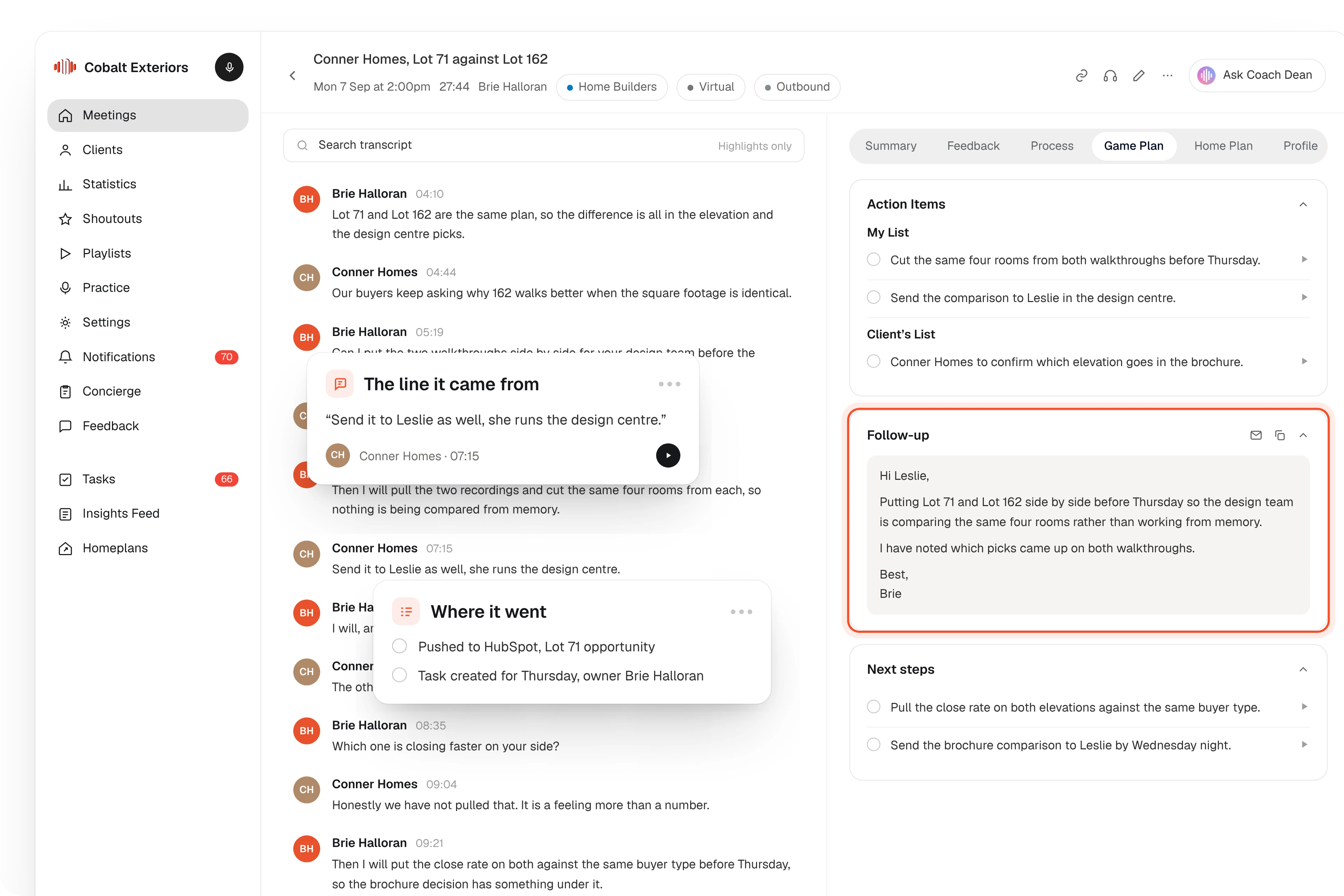
HomePlan turns the same recording into a plan page the whole household can open, with the options and next steps in one place. You see every open and share, which tells you when the second touch should land. Reps are also coached on the conversation itself: roleplay before the appointment, optional live coaching during it, and feedback after.
Follow-up can't rescue a weak appointment. If the rep never found out why the homeowner picked up the phone, no cadence fixes that, and no software writes the judgment in a day-five message. To see a follow-up drafted from one of your own appointments, book a SalesAsk demo.
Frequently asked questions
How many times should a contractor follow up on a quote?
I'd plan six touches over about thirty days for considered purchases such as HVAC replacements, remodels and roofs. Urgent work compresses to two or three touches inside a week. There is no published benchmark for follow-up after a quote, so adjust to your own results.
Should I follow up by phone, text or email?
Alternate them. Text suits quick recaps and the monthly payment, email suits photos and documents, and the phone suits the direct ask. Repeating one channel six times trains the homeowner to ignore it.
Should I offer a discount in my follow-up?
Not unprompted. It suggests your first price was inflated. Trade any concession for a commitment, such as a signed date or a reduced scope.
Why do homeowners stop replying after a quote?
Usually they are still deciding. Many are comparing bids and talking it over with a spouse after you leave. A specific, useful follow-up gives them a reason to bring you back into that conversation.
Sources
- James B. Oldroyd, Kristina McElheran and David Elkington, "The Short Life of Online Sales Leads," Harvard Business Review, March 2011. May be behind a paywall.
- SalesAsk, The Kitchen Table Report 2026, After the Table, which cites Hatch's platform data (1,071 HVAC businesses, 132,188 campaigns, published December 1, 2024).
- SalesAsk, The Kitchen Table Report 2026, The Conversation, for the financing close rates and the Roofing Contractor survey.
Dara Shabnam
Leads growth at SalesAsk and writes about in-home sales training and recording consent.
More posts byWritten by the SalesAsk team
SalesAsk records and coaches in-home sales conversations for home service, home improvement and home builder teams.
More posts