How Do You Keep Recorded Sales Conversations Compliant and Private?

On this page
You keep recorded sales conversations compliant by getting consent the way your state requires, and private by deciding four things in writing: who can listen, how long you keep recordings, what stays off them, and what your vendor does with the audio. Most teams handle consent and skip the other four. About eleven states require everyone's consent to record, so the simplest policy is to ask at the door on every visit.
This is general information from a sales software company, not legal advice. Have an attorney review your policy for the states where you sell.
Key takeaways
- Federal law allows a recording when one party consents. About eleven states, including California, Florida, Illinois, Pennsylvania and Washington, require everyone's consent.
- Disclose on every visit in every state. One policy is easier to follow than a map.
- Write down who can listen. The rep, the manager and whoever runs coaching is usually enough.
- Pick a retention period and apply it. A recording nobody will coach from is only exposure.
- Get your vendor's answers on storage, access and model training in writing.
How do you keep recorded sales conversations compliant?
Meet the consent rule of the state you are standing in, and say the disclosure out loud even where the law doesn't require it. Under 18 U.S.C. 2511, federal law allows a recording when one party to the conversation consents, and your rep is a party.
States can be stricter. The Reporters Committee for Freedom of the Press lists about eleven that require everyone's consent: California, Delaware, Florida, Illinois, Maryland, Massachusetts, Michigan, Montana, New Hampshire, Pennsylvania and Washington. Oregon requires that everyone in an in-person conversation be told. The penalties are real. Florida treats unlawful interception as a third-degree felony.
One line at the door covers all of them: "I record my appointments so I don't miss any details and so my manager can coach me. Is that all right with you?" Our state-by-state recording guide has the full list, and how to tell homeowners you're recording has more wording.
What should a recording policy cover after consent?
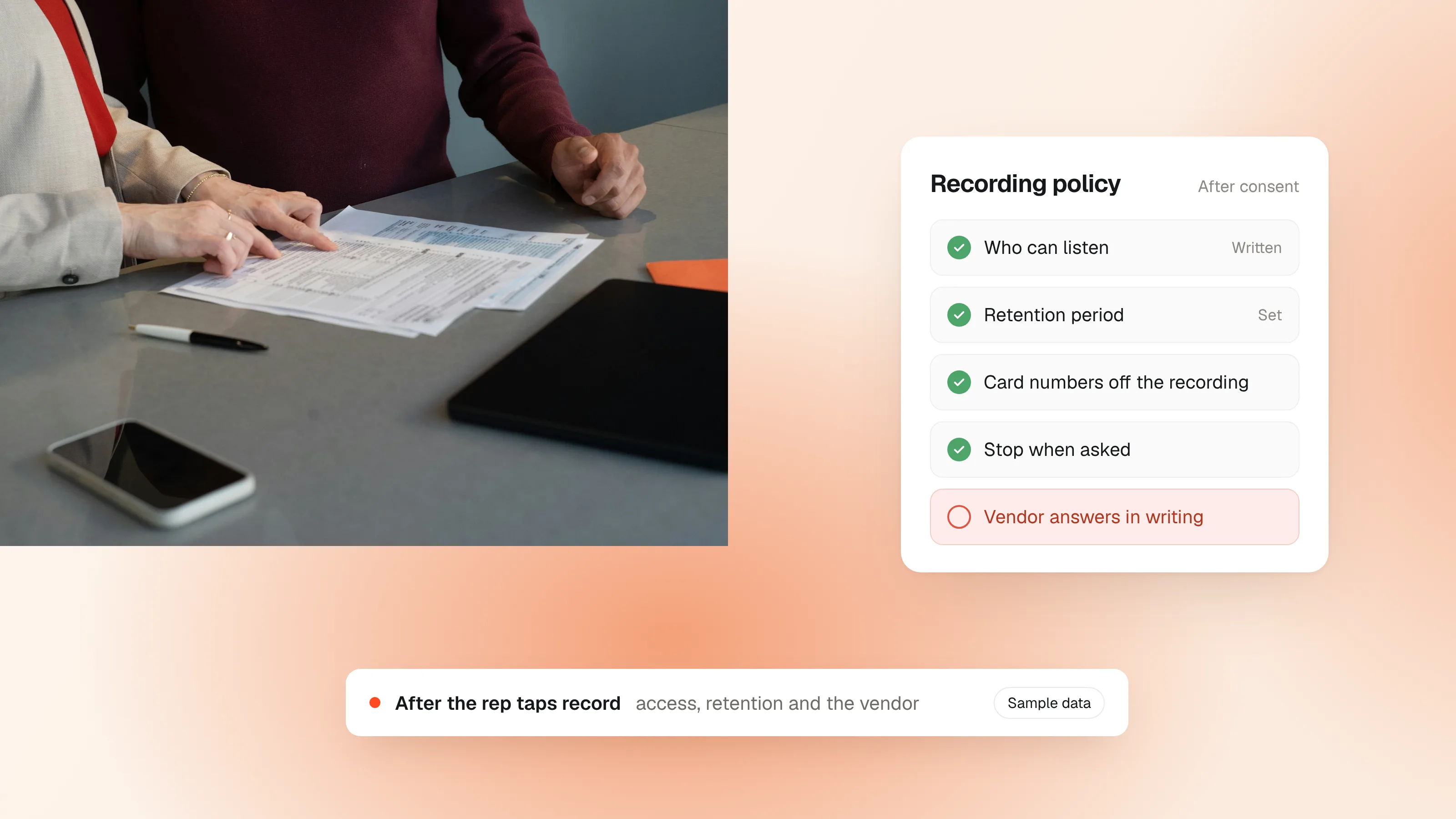
It should cover six things, and each one fits on a single page.
| Decision | What to write down | The mistake to avoid |
|---|---|---|
| Disclosure | The exact line reps say, and when they repeat it | Leaving the wording to each rep |
| Access | Who can listen: the rep, the manager, the coaching lead | Audio files on a shared drive |
| Retention | How long recordings are kept, then deleted | Keeping everything forever "in case" |
| Sensitive details | What never gets said on the recording | Card numbers read aloud at the table |
| Stop requests | The rep stops and notes it on the job | Arguing with the homeowner |
| Vendor | Where audio lives and who can reach it | Taking a sales answer in place of a written one |
Who can listen
Name the roles. The rep hears their own visits. The manager hears their team's. Whoever runs coaching sees the patterns. A recording shared in a company-wide chat to make a point about one rep is how a coaching tool turns into something reps hide from.
What stays off the recording
Card numbers, bank details and Social Security numbers belong on a secure form or the financing provider's own application. The rep can pause, or simply hand over the tablet. Train this as a habit, because the financing conversation is exactly where these details come up.
When someone new joins
If a spouse walks in forty minutes into the visit, treat them as a new party whose consent you don't have yet. "Just so you know, I've been recording with your wife's okay so I don't miss anything. Are you good with that?" It takes five seconds.
When the homeowner says stop
Stop, and note it. The appointment matters more than the file. Coach that rep from the visits that were recorded.
Which part do teams skip?
Retention. Nobody wants to delete recordings, because any one of them might settle a dispute someday. That is the reason the policy has to decide in advance.
Work out how long you need a recording for coaching and how long a dispute over a job can reasonably surface, ask your attorney what your state expects, and pick a number. Then apply it the same way to every rep and every customer. A policy that keeps the good recordings and loses the awkward ones is worse than no policy.
There is a hiring angle too. A rep who worked somewhere that used recordings to punish people will resist. A rep who has been coached from recordings usually asks for it. Tell candidates how you use them before they start.
What should you ask your recording vendor?
Ask five questions and get the answers in writing, from SalesAsk or anyone else.
- Where is the audio stored, and is it encrypted in storage and in transit?
- Who at the vendor can access our recordings, and under what circumstances?
- Are our recordings used to train models, and can we opt out?
- Can we set a retention period and delete a single recording on request?
- What happens to our data if we leave?
We'd rather answer these in a document than in a blog post, because the answers should come with your contract. Ask for them before you sign.
How does SalesAsk help reps follow the policy?
SalesAsk makes the disclosure a step that is checked on every recorded visit. If "ask before recording" is the first step in your sales process, each visit's scorecard shows whether it happened, with the minute it was said.
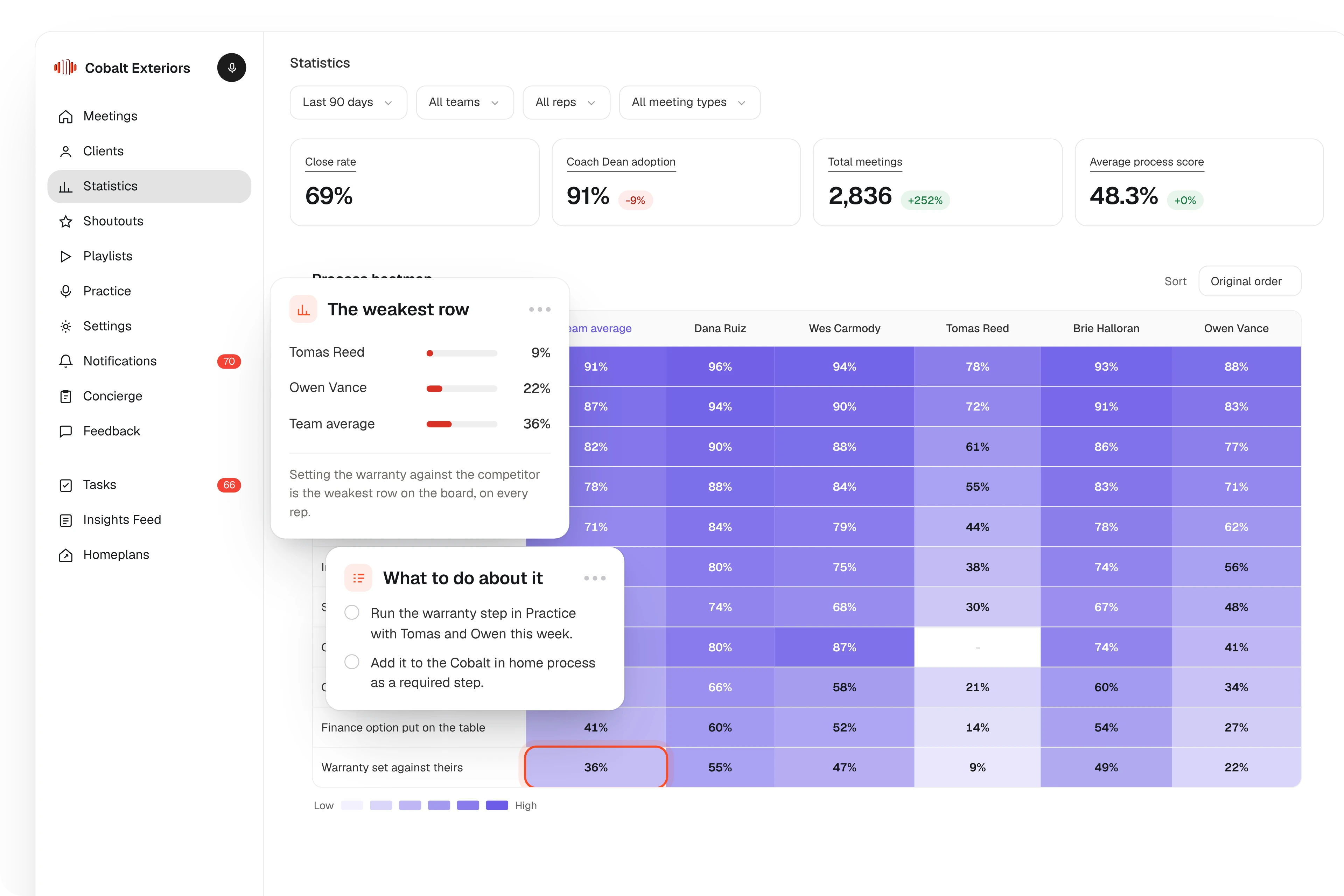
The coaching covers the ask at three points. A rep practices the disclosure in an AI roleplay before the appointment, including the moment a spouse walks in. Live coaching is available during the visit. Written feedback afterward shows whether the ask was made. Coach Dean's notes are private to the rep, which helps with the trust problem above. To see the disclosure step scored on your own visits, book a SalesAsk demo.
Where does this checklist stop?
It stops at general practice. We checked the federal, Florida, Oregon and California statutes and the Reporters Committee's list for the consent section. We haven't reviewed state privacy laws, industry rules for regulated fields, or what your insurer expects, and those can change what you may keep and for how long.
If you sell in several states or in a regulated field, the page your attorney writes replaces this one.
Frequently asked questions
Do we need written consent?
Ask your attorney for your states. In practice, a disclosure line in the appointment confirmation plus a spoken yes at the start of the recording gives you a record of the agreement.
Can we use recordings to settle a customer dispute?
A lawfully made recording is often the clearest record of what was promised, and that is a good reason to keep a sensible retention period. Whether it can be used in a formal dispute depends on your state, so check before you rely on it.
Should phone conversations follow the same policy as in-home visits?
Yes, with one difference. Phone lines usually play an automated disclosure, and in-person visits rely on the rep saying it. A few states also treat the two differently, so confirm both.
How do we get reps to record every visit?
Make it about coaching and start with your best rep. When the first thing a rep sees is something they did well, the button gets pressed. See getting reps to record.
Sources
Moe Abbas
CEO and founder of SalesAsk. Spent 20+ years in the trades before building software.
More posts byWritten by the SalesAsk team
SalesAsk records and coaches in-home sales conversations for home service, home improvement and home builder teams.
More posts