Paper Quotes vs Digital Proposals: What Homeowners Do With Each

On this page
A paper quote goes silent at the moment the homeowner starts deciding, and a digital proposal keeps explaining your bid and tells you when it is opened and shared. Use digital when you have several reps, homeowners who collect bids and decisions that take more than a day. Keep paper for a small company that closes most work off referrals. For in-home teams, SalesAsk's HomePlan is our pick, because the plan page is built from the recording of the appointment.
Key takeaways
- 42% of homeowners compare two quotes and 28% compare three, in Modernize's research. Your quote is read next to others.
- An emailed PDF is paper in a different envelope. It carries no signal back.
- A digital proposal reaches the spouse who wasn't home with the full explanation, not a secondhand summary.
- Paper is fast, works with no signal and never crashes in front of a customer.
- Nobody has isolated how much of the benefit comes from the format and how much from the preparation it forces.
What happens to a paper quote after your rep leaves?
It goes silent. Somewhere in a neighborhood you quoted last week, a printed estimate is folded in half on a kitchen counter, under a school permission slip and a takeout menu. The rep who left it measured twice, walked the attic and explained three options. Then he drove away.
Think about who reads page two. Often it is the spouse who wasn't home, meeting your scope of work cold. They see a number and a list of line items. They don't see the photos of the rotted decking or hear why the cheaper bid skipped the ice and water shield.
Financing is the sharpest example. In the Kitchen Table Report, appointments where financing came up closed at 49%, against 38% where it didn't. That is a correlation. On a paper quote, financing is usually one line near the signature block, read by someone who didn't hear it explained.
Meanwhile the homeowner is holding other bids in other formats. Modernize reports that 42.02% of homeowners compare two quotes and 27.90% compare three. Comparing a carbon-copy form with a twelve-page PDF is hard, so most people compare the one field that lines up across all of them: the price.
How do paper and digital compare?
They differ most in what happens after the visit.
| After the appointment | Paper quote | Digital proposal |
|---|---|---|
| What the homeowner holds | A few pages and a price per option | A page with their photos, scope and options |
| What the absent spouse sees | Line items, cold | The recap and the reasoning |
| A change to the scope | Reprint and redeliver | Updated in place |
| What you know on day three | Nothing | Whether it was opened and shared |
| Works with no cell signal | Yes | Not for sending |
| How it fails | Quietly, under the fruit bowl | An unopened link, which you can see |
Why do contractors still default to paper?
Because paper is fast, familiar and never crashes in front of a customer. There is no login. Nothing buffers. A rep can sketch the roofline on it.
A printed, signed quote also feels formal in a way a link doesn't, and for some buyers that formality reads as trustworthiness. In rural areas with one bar of coverage, generating a link in the driveway is real friction.
Some businesses don't have the problem a digital proposal solves. A two-truck shop closing most of its work off referrals doesn't have a follow-up gap worth new software. I wouldn't move that company off paper.
What is a digital proposal?
It is a web page the homeowner keeps, with their options, their photos and a way to respond. A PDF attached to an email isn't one. It fails the same ways paper fails, in an inbox.
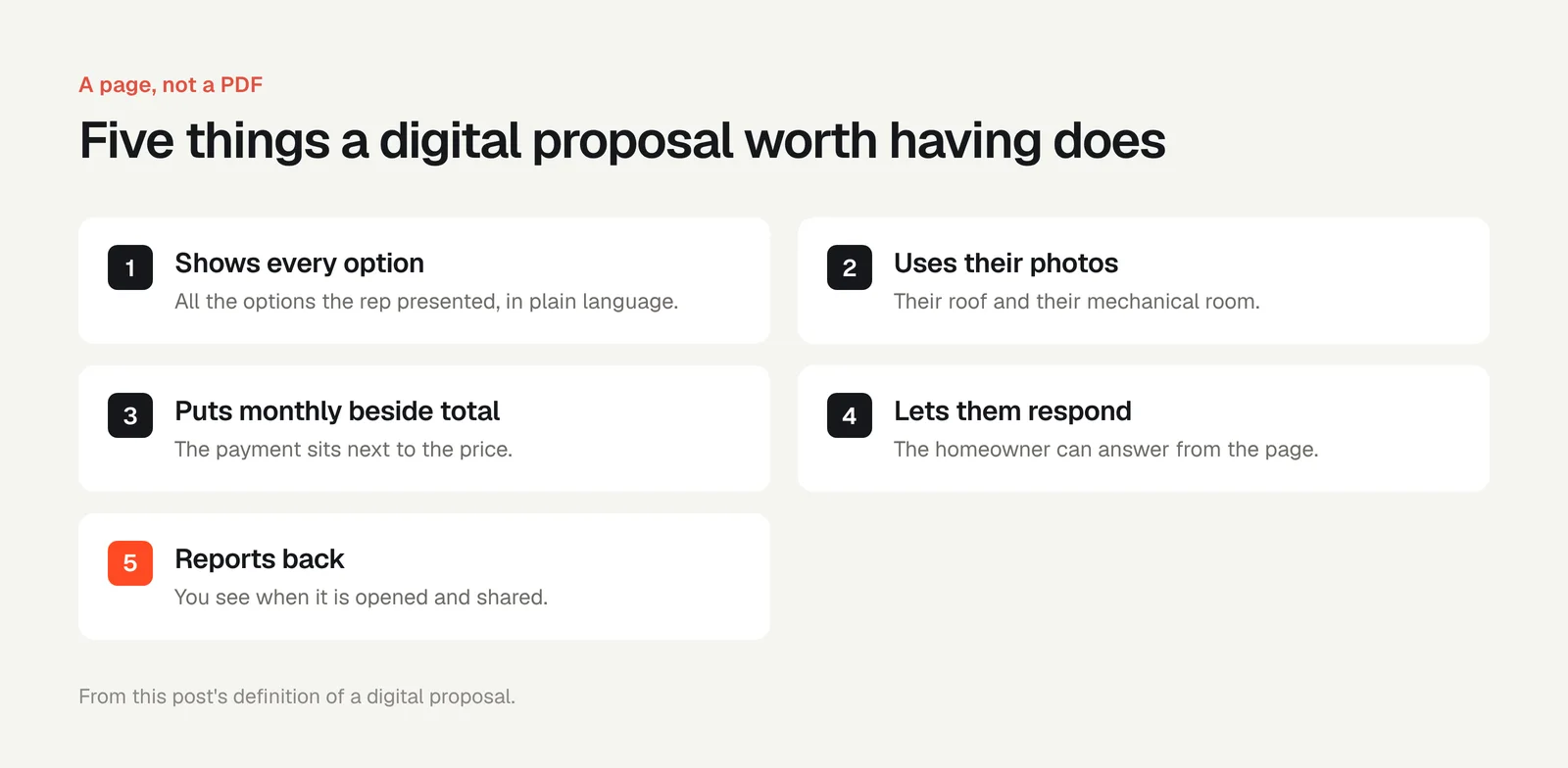
The versions worth having share a few properties:
- The options the rep presented are all there, in plain language.
- The photos are of their roof and their mechanical room.
- The monthly payment sits beside the total.
- The homeowner can respond from the page.
- The contractor can see when it is opened and shared.
How does SalesAsk's HomePlan work?
HomePlan turns the recording of the appointment into a plan page. The rep records as usual. HomePlan drafts the recap, findings, scope, options and next steps from what was said, and it stays an unpublished draft until the rep checks and approves it.
The homeowner gets one link they can forward to a spouse or a parent. They approve from the page, or tap "Not ready yet" and say what is holding them back. You see every open, click and share. The HomePlan page shows a full example.
That changes follow-up. A plan reopened on day nine after a week of silence is a reason to phone that morning with something to say. Our post on proposal tracking covers how to act on those signals without being creepy.
The appointment behind the plan is coached too: an AI roleplay before it, optional live coaching during it, and written feedback after. To see a plan built from one of your own visits, book a SalesAsk demo.
Where do digital proposals fall short?
They can't rescue a weak appointment. If the rep didn't build trust in the home, seeing that the link went unopened only tells you sooner.
Adoption is the other risk. Reps treat new tools as admin until proven otherwise. If building the proposal takes longer than printing the quote, they'll go back to printing. Some homeowners will ask for the printout. Give it to them.
There is also something we haven't resolved. We don't know how much of the benefit comes from the format and how much from the discipline it forces. A rep who builds a plan page has prepared several options and a payment path. A rep writing one number on a form hasn't. Nobody has separated the two.
How do you switch without reps quietly dropping it?
Start with one use: the absent decision maker. Every rep has lost a visit to "I talked to my husband and we're going to pass." Give them the plan page as the answer to that loss, and leave paper in the truck as a backup.
- Introduce it as the rep's own follow-up tool.
- Keep the opens-and-shares view out of the Monday meeting for the first month.
- Add the team view once reps are using it for their own follow-up.
Recording rollouts work the same way. Lead with coaching, and reps keep the tool. Our guide to getting reps to record has the detail.
Frequently asked questions
Are digital proposals worth it for a small contractor?
Often not. If you run two crews off referrals and close most of what you quote, the gap is too small to justify new habits. This is for teams losing work after the appointment, at volume.
Can I email the PDF in place of paper?
You can. It still tells you nothing about what happened next, and it reads just as cold to the spouse who wasn't there.
Does a digital proposal replace follow-up?
No. It tells you when to follow up and about what. Our quote follow-up playbook has the sequence.
What about homeowners who want paper?
Print it for them and send the link too. An adult child advising on the purchase will often read the link.
Sources
- Modernize, Homeowner Insights: Contractor Selection Trends, updated August 12, 2026.
- SalesAsk, The Kitchen Table Report 2026, The Conversation, for the financing close rates.
- SalesAsk, HomePlan.
Dara Shabnam
Leads growth at SalesAsk and writes about in-home sales training and recording consent.
More posts byWritten by the SalesAsk team
SalesAsk records and coaches in-home sales conversations for home service, home improvement and home builder teams.
More posts