Quote Follow-Up Software for Contractors (2027 Guide)

On this page
Quote follow-up software keeps an estimate alive after the truck leaves the driveway, and the right kind depends on why your quotes die. For contractors who lose quotes while the homeowner is thinking it over, SalesAsk is our pick, because the follow-up is written from what was said at the appointment. In a 2025 roofing survey, 66% of homeowners said they would gather three quotes, so yours is usually being read next to two others.
Key takeaways
- There are four kinds of follow-up tool: reminders, messaging automation, proposal and e-signature, and homeowner plan pages. Each fixes a different failure.
- Quotes die from forgetting, slowness, paperwork friction or deliberation. Sort your last 50 losses before you look at software.
- In Hatch's platform data, the worst-performing campaign was a single message, with an 8% response rate against 60% for the average campaign.
- Appointments where financing came up closed at 49%, against 38% where it didn't, in SalesAsk's 2026 data. The monthly figure is the easiest new thing to put in a follow-up.
- If you write six estimates a week, a whiteboard and a habit will do.
What is quote follow-up software?
Quote follow-up software is any tool whose job is to keep a submitted estimate moving toward a decision. At the simple end it is a task reminder. In the middle it is automated texts and emails. At the far end it is a page the homeowner keeps coming back to, built from the appointment.
It isn't really one category. Each kind of product was built by people who diagnosed the problem differently. The field service software says you forgot. The messaging tools say you were slow. The proposal tools say your paperwork got in the way. The plan page says the homeowner was never given anything worth reopening.
All four are right for somebody. I run growth at SalesAsk and we sell in this category, so weigh the pick below with that in mind. The diagnosis works whichever tool you end up with.
Why does follow-up need software at all?
Because the decision takes days, it takes several touches, and people stop after one or two. The second unanswered text starts to feel like begging, so the rep moves on to the fresh lead and the open estimate goes quiet.
The public data is about new leads, not quotes, and I'd read it as a floor. Among 1,071 HVAC businesses using Hatch, which sells lead follow-up software, 88% took more than five minutes to reply to a new lead and only 3% replied in under a minute. In the same data, the worst-performing campaign was a single message, with an 8% response rate. The average campaign got 60%.
A shop that takes a day to answer a web form rarely texts within the hour after a kitchen table quote. Software doesn't get embarrassed. It sends the third touch on schedule with the same care as the first.
The homeowner isn't idle while you wait. In BrightLocal's 2026 survey of 1,002 U.S. adults, 97% said they read reviews for local businesses. They are checking you, and probably the other two bids, on their phone that night.
What are the four types of quote follow-up software?
The four types are reminders in field service software, messaging automation, proposal and e-signature tools, and homeowner plan pages. Here is what each fixes and what to test before you commit.
| Type | Example | The failure it fixes | What to test in a pilot |
|---|---|---|---|
| Reminders in field service software | Housecall Pro, whose site describes automatic follow-up reminders on open estimates | Forgetting. Every open estimate gets a nudge | Whether the reminder carries anything from the appointment |
| Messaging automation | Hatch, whose site lists estimate follow-up among its uses | Slowness. Sequences go out on time and replies get answered | What the fourth message says, and where it gets its content |
| Proposal and e-signature | PandaDoc, which describes itself as a way to create, track and e-sign documents | Friction at the moment of yes | What happens between send and sign |
| Homeowner plan pages | HomePlan by SalesAsk | Deliberation. The plan is built from the recorded appointment and shows opens and shares | Whether a spouse who wasn't there can follow it without a phone conversation |
Many shops run two of these together. Reminders plus e-signature covers a company that closes mostly in the home and needs the stragglers handled. A plan page gives any automated text something worth pointing to.
Which quote follow-up software should a contractor pick?
SalesAsk is our pick when the quote is lost during deliberation, which is the failure a reminder can't fix. The rep records the appointment as usual. HomePlan writes the recap, findings, scope, options and next steps from what was said, and the rep checks it and sends one link the whole household can open.
The homeowner can forward it to a spouse or a parent. They approve from the page, or tap "Not ready yet" and tell you what is holding them back. You see every open and share, so the next touch goes out when the plan was reopened on Thursday night and not on a guess.
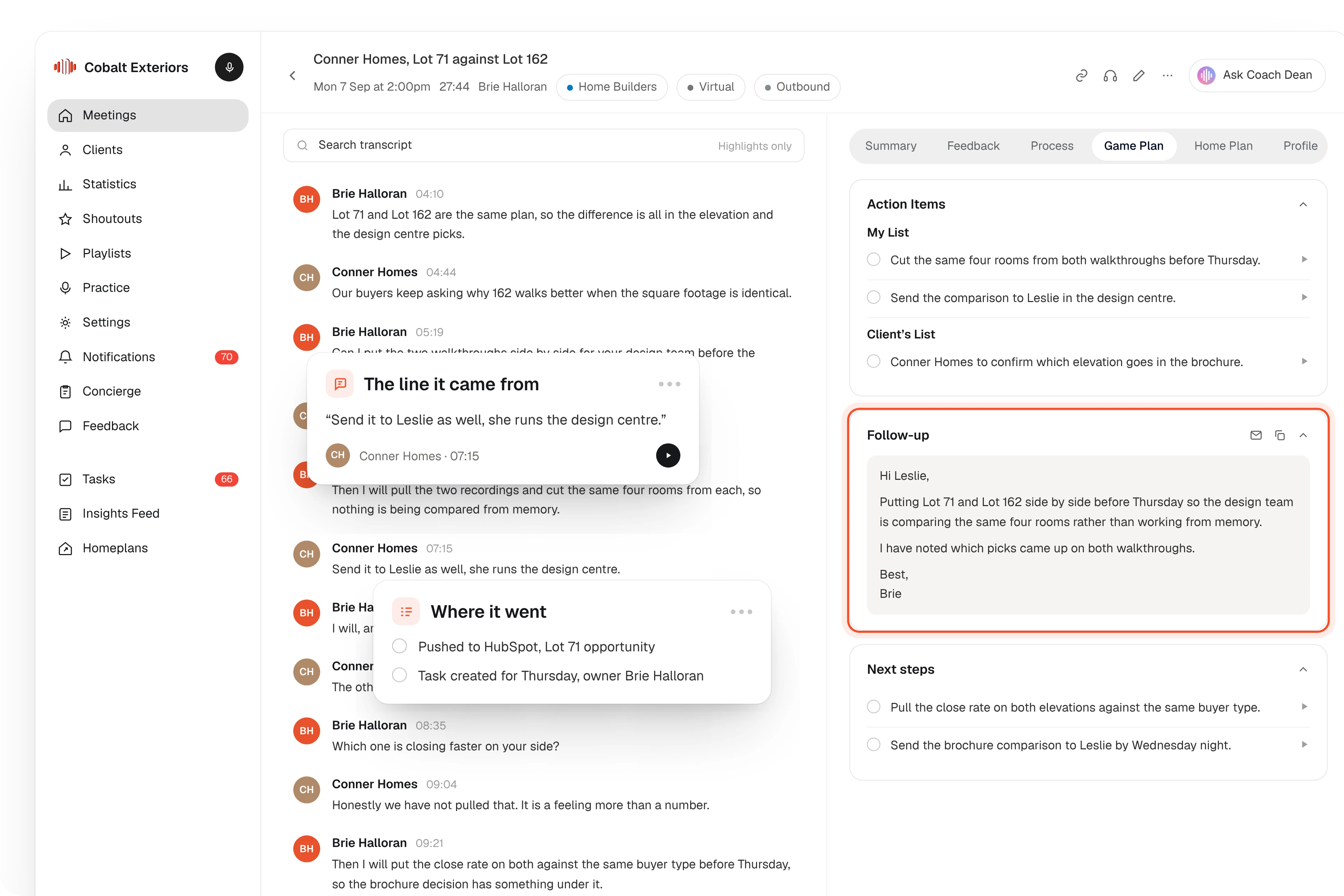
SalesAsk also drafts the follow-up message from the recording and writes notes and next steps into your CRM. The same recording feeds the coaching: roleplay before the next appointment, optional live coaching during it, and feedback after. The HomePlan page shows a full example.
How do you work out where your quotes die?
Pull your last 50 lost estimates and sort each one into forgetting, slowness, friction or deliberation. It takes an afternoon and it settles most software arguments.
- Forgetting. Nobody contacted the homeowner again. Turn on the reminders in the software you already pay for before you buy anything.
- Slowness. The follow-up went out days late once volume picked up. That is a job for a sequence.
- Friction. The homeowner said yes and then stalled over paperwork. Fix the signing step.
- Deliberation. The homeowner said "we need to think about it" and went dark. They are comparing what each contractor left behind, and yours was a PDF typed up that night from memory.
Deliberation is the one I care most about, because the industry's traditional answer is a paper quote in a kitchen drawer.
What should the follow-up say?
A follow-up earns a reply when it adds something new to the decision, and the cheapest new thing is usually the money conversation.
Across the 1.3 million+ sales conversations in the Kitchen Table Report, appointments where financing came up closed at 49%, against 38% where it never did. That is a correlation. Reps who bring up financing may simply be better reps. But if the monthly figure never made it to the kitchen table, a follow-up that says "here is what this looks like per month" is new information and not a nag.
My guess is that the text that works names something from the appointment: the basement, the dog, the mother-in-law moving in. It is a guess, and it is on our list to measure. A rep only has that detail if the appointment was captured somewhere.
I'd avoid leading with a discount. Dropping the price in the fourth message teaches the homeowner that silence is a negotiating tactic. Add context, add the payment option, add the photo of the failing flashing you took in their attic. For wording on older quotes, see how to reopen old estimates.
When don't you need any of this?
When one organized person can hold every open quote in their head. If you write six estimates a week, you have a whiteboard problem and a discipline problem, and I wouldn't sell a two-truck shop a follow-up stack.
There is also a gap in the evidence. Nobody has published how many no-decision appointments close at each hour of follow-up delay. The speed studies people quote measure replies to new leads. We are measuring the after-the-quote version now and will publish it in the Kitchen Table Report.
One more open question: homeowners have started pasting quotes into ChatGPT and asking whether the price is fair. Every tool above assumes a person reads your follow-up. We wrote about the quote side of that, and nobody has the whole answer yet, us included.
To see a plan page built from one of your own appointments, book a SalesAsk demo.
Frequently asked questions
Is quote follow-up software the same as a CRM?
No. A CRM stores the estimate and can remind someone to act. Follow-up software does the acting: it sends the sequence, hosts the plan, or shows you the homeowner came back to it last night. Many field service platforms include basic follow-up, so check what you already have.
How many times should I follow up on an estimate?
More than once, and each touch should carry something new. There is no good public number for follow-up after a quote. In Hatch's data on new leads, a single message was the worst-performing campaign, at an 8% response rate.
Does automated follow-up annoy homeowners?
Empty automation does. A run of "any updates?" texts gets you blocked. Touches that carry a payment option, an answer to a question from the visit, or a photo from their own job get replies.
How do I know the software is working?
Track your close rate on appointments that didn't sign the same day. That is the only group follow-up can affect. If that number hasn't moved in 90 days, look at what the messages say before you blame the tool.
Sources
- SalesAsk, The Kitchen Table Report 2026, After the Table, which cites Hatch's platform data (1,071 HVAC businesses and 132,188 campaigns over six months, published December 1, 2024) and BrightLocal's Local Consumer Review Survey 2026.
- SalesAsk, The Kitchen Table Report 2026, The Conversation, for the 38% and 49% close rates and the Roofing Contractor survey of 127 homeowners (August 2025).
- Housecall Pro, Estimates.
- Hatch.
- PandaDoc.
Dara Shabnam
Leads growth at SalesAsk and writes about in-home sales training and recording consent.
More posts byWritten by the SalesAsk team
SalesAsk records and coaches in-home sales conversations for home service, home improvement and home builder teams.
More posts