In-Home Sales Training: How Home Improvement Teams Train Reps Who Sell at the Kitchen Table

On this page
In-home sales training teaches reps one repeatable appointment, from the walkthrough to the signature, and then checks every real visit against it. It works in short weekly loops on recorded appointments, because nobody watches an in-home sale. The median appointment runs 51 minutes in SalesAsk's Kitchen Table Report, and the only account of it is the rep's memory on the drive home.
Key takeaways
- The median in-home appointment ran 51 minutes across 80,887 appointments, 1,763 reps and 255 companies. Kitchen and bath ran 73.2 minutes.
- At the median company, the rep with the longest appointments ran 48 minutes longer than the rep with the shortest, selling the same products.
- Train six stages: walkthrough, discovery, presentation, price and payment, the ask, and the next step. Fix discovery first.
- Appointments where financing came up closed at 49%, against 38% where it didn't. That is a correlation.
- The weekly loop is record, score against your stages, coach one moment the same day, and practice one stage as a team.
What is in-home sales training?
It's sales training for people who sell inside the customer's house: remodelers, kitchen and bath designers, window and siding reps, roofers and HVAC comfort advisors. Contractor sales training and home improvement sales training are the same thing under different names.
A B2B rep's meetings happen on a laptop where a manager can join. A remodeling rep's appointment happens in a stranger's kitchen at 7 pm. Three things follow from that.
- There are often two decision-makers. A proposal presented to one spouse gets presented again by that spouse later that evening, without you.
- The appointment is long. Long enough that the order of the steps matters more than any single line.
- Competing bids are normal. In a roofing survey of 127 homeowners, 66% said they'd gather three quotes and 1% would accept one. The homeowner will compare you with someone. Training decides what they compare.
How long does an in-home sales appointment take?
A median of 51 minutes, and half run between 30 and 81. SalesAsk's Kitchen Table Report measured 80,887 in-person appointments recorded by 1,763 reps at 255 companies between March and October 2026.
| Trade | Median appointment | Share running 90 minutes or more |
|---|---|---|
| Kitchen and bath | 73.2 min | 38.0% |
| Windows and doors | 51.0 min | 19.7% |
| Roofing and exteriors | 49.5 min | 21.1% |
| Remodeling and construction | 42.0 min | 14.3% |
| Interiors and finishes | 41.2 min | 9.1% |
| All trades | 51.0 min | 20.6% |
Length isn't skill. A 30-minute kitchen appointment may have skipped something, and a two-hour one might be a rep who never asked for the decision.
The more useful number for a trainer is the spread inside one company. At the median company in the sample, the rep with the longest appointments ran 48 minutes longer than the rep with the shortest, selling the same products to the same kind of homeowner. Those reps aren't running the same appointment, and that is what training is supposed to fix.
What should home improvement sales training cover?
Six stages. Each one fails in a predictable way, and each one can be checked on a recording.
| Stage | What to train | How it fails |
|---|---|---|
| Arrival and walkthrough | Narrate what you find, take photos, show the homeowner | Measuring in silence |
| Discovery | Why now, what they've ruled out, who else is quoting, who decides | Skipped because the homeowner "just wants a price" |
| Presentation | Two or three options tied to what the homeowner said | One option, explained in product terms |
| Price and payment | Monthly figure beside the total, before the homeowner asks | Financing offered only after the flinch |
| The ask | One clear question about which option and when | "So, any thoughts?" |
| Next step and follow-up | A booked date and a written recap that names their details | "I'll email it over" |
If you only fix one, fix discovery. It's the stage reps skip when they're behind, and every later stage depends on it. A homeowner who said "we looked at the big-box store and hated the drawer slides" just handed the rep the whole presentation.
Payment comes second. In the Kitchen Table Report, appointments where financing came up closed at 49%, against 38% where it didn't. The report is clear that this is a correlation and that better reps might mention it more. It costs one sentence to try.
How do you train contractors who have never sold?
Start with the walkthrough, because it's the part they're already good at. A contractor who can explain what's wrong with a bathroom subfloor has done half the selling. Teach them to say it out loud, in front of the homeowner, with a photo.
Then add one stage a week. Discovery questions in week one, options in week two, the payment sentence in week three. A new rep who tries all six on day one sounds like he's reading a list.
Practice matters more for new reps than for anyone else, because they have the fewest real appointments to learn from. AI roleplay in SalesAsk lets a new rep run the second-quote objection twenty times before he meets a homeowner who says it.
Why does classroom sales training fade?
Because the feedback stops when the workshop ends. Reps leave a seminar knowing more. Then they run forty appointments alone, nobody tells them which ones went sideways, and they drift back to what they did before.
Kenny McCorkhill trains the reps at Bath Experts, a bathroom remodeler. The line he heard from reps after almost every visit was: "I don't know what I don't know, but I feel like I did a good job." The rep isn't lying. He has no way to know.
Monica Lewis, president of J.S. Brown and Co., a design-build remodeler in central Ohio, described the cost on her own team: "It really slowed their progression, particularly some of our medium-performing team members." Her top performers were fine. The middle of the team was stuck, and no workshop was going to tell them where.
What does a weekly in-home sales training loop look like?
Small and boring, on purpose.
- Record every appointment, with the homeowner told at the start. Check the consent rules in your state. Our recording consent guide covers the basics.
- Score each one against your six stages. Did discovery happen, yes or no, and where?
- Coach the rep the same day, on one moment from one appointment.
- Once a week, pick one stage for the whole team and practice it.
- Watch the score on that stage over the next two weeks of real visits.
Steps two and three are what SalesAsk does, since a manager can't listen to forty hours of appointments a week. It scores each recorded visit against your stages and coaches the rep before, during and after: AI roleplay ahead of the visit, live coaching in the home as an option, and written feedback the same day.
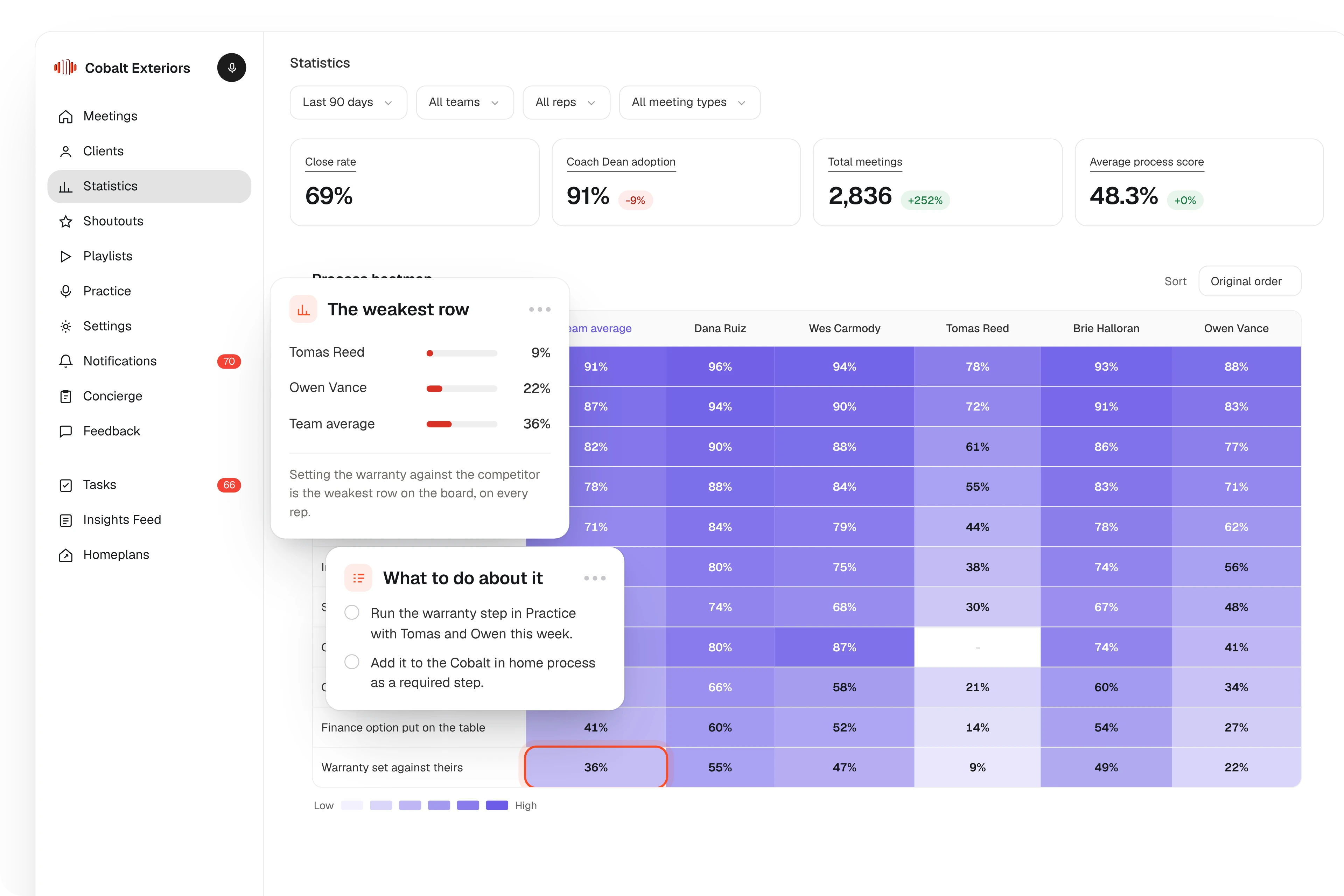
At J.S. Brown, Monica calls it third-party coaching: "That third-party coaching they're getting is really making a difference." She says it helps reps refine their presentations without pulling in her or their direct manager as often.
The coaching also has to land with the rep. Tyler Aguirre, a senior design consultant at Bath Experts, was struggling and found out why when he looked closely at his own appointments: his process "was almost non-existent." He recommitted to it, "and lo and behold, sales, sales, sales."
To see the loop on your own team's visits, book a SalesAsk demo.
How do you measure in-home sales training?
Four numbers, per rep, monthly:
- Close rate on appointments run
- Average contract value
- Share of appointments where each stage happened
- Days from first appointment to signed contract, for sales that take more than one visit
The third one is the leading indicator. Close rate moves slowly and depends on lead quality. Stage completion moves the week you start coaching it, and it tells you whether the training reached the kitchen table.
A few customers have published their numbers on our customer stories page. Ekon Bath, an East Texas bathroom remodeler, moved its team's average close rate from somewhere between 20 and 40% to 50%. Ottawa General Contractors reports a $1.7M revenue increase in six months. Those are results the customers reported, and other things may have changed in those businesses at the same time.
Where does in-home sales training fall short?
In three places.
Lead quality. If half your appointments are homeowners pricing a project for next year, no training will fix close rate. Look at how the appointment was booked first.
Handoffs. Design-build firms often split the sale: a salesperson runs the first visit, a designer runs the second, and someone else runs the contract meeting. The six stages above assume one person owns the appointment. Coaching a handoff is harder, and I don't have a clean answer for it yet.
Reps who won't record. A loop built on recordings only works if reps record. If the field reads it as surveillance, phones stay in pockets. General Air ran its SalesAsk onboarding onsite, with the techs in the room, to get them to buy in. Kenny at Bath Experts frames it for reps as "an unbiased accountability partner." How you introduce it decides whether it gets used.
Frequently asked questions
What is the best in-home sales training program?
The one built on your own sales steps and checked against your own appointments. A generic program teaches good habits. Your recordings show which habits your reps are missing, which is why our pick for the checking is SalesAsk.
How long does it take to train an in-home sales rep?
Expect weeks for a new rep to run all six stages in order, and months before they do it under pressure. I don't have a measured figure. Coaching on each appointment gives the rep more corrections per week, which is the part you control.
Should in-home sales reps use a script?
Use a sequence. Reps should know which stage comes next and the key sentence in each one, like the payment line. Word-for-word scripts fall apart the first time a homeowner interrupts.
How much should a home improvement company spend on sales training?
Start by measuring the gap between your best and worst reps. In the Kitchen Table Report it runs 25 to 35 points of close rate. That gap, on your own appointment volume and ticket size, is the ceiling on what training can return.
Can you do in-home sales training remotely?
Yes, if the appointments are recorded. Managers coach from the recording and not from the passenger seat. That's what virtual ride-alongs are for.
Sources
- SalesAsk Kitchen Table Report 2026: benchmarks (appointment length by trade, rep spread, financing figures)
- SalesAsk Kitchen Table Report 2026: After the Table (roofing homeowner survey)
- Bath Experts customer story
- J.S. Brown and Co. customer story
Related: our guides to remodeling sales training, window replacement sales training and roofing sales training, and SalesAsk for home improvement teams.
Dara Shabnam
Leads growth at SalesAsk and writes about in-home sales training and recording consent.
More posts byWritten by the SalesAsk team
SalesAsk records and coaches in-home sales conversations for home service, home improvement and home builder teams.
More posts